

Is your 401k allocation matching your timeline, or are you following a one-size-fits-all rule that could cost you years of growth?
Timeline (how long until you retire) is the biggest factor, and simple shortcuts like the 110 or 100 rule give a starting mix of stocks and bonds.
This post shows clear allocation ranges by age, when to adjust for risk or extra income, and how to pick between doing it yourself or using a target-date fund.
Read on for a practical, step-by-step plan you can apply to your next 401k contribution, no finance degree required.
Building a Strong Foundation for Your 401k Allocation Strategy

A 30-year-old using the 110 shortcut puts 80% in stocks and 20% in bonds. A 45-year-old drops to 65% stocks and 35% bonds. By 65, that same person holds just 45% stocks and 55% bonds. If you use the more conservative 100 rule instead, those numbers shift down by 10 percentage points at every age. Age 30 becomes 70% stocks, Age 45 becomes 55%, and Age 65 becomes 35%. These two simple formulas give you a starting point for 401k allocation based on how much time you have until retirement.
401k allocation is how you divide your retirement money across different types of investments. Stocks, bonds, and sometimes alternatives like real estate funds. The mix you choose determines both your growth potential and how much your account balance bounces around when markets drop. Spread your money across asset classes and you reduce the chance that one bad year wipes out your progress. Younger savers can ride out crashes because they’ve got decades to recover. Older savers need stability because they’ll start withdrawing soon.
Age is the biggest factor in setting your allocation, but it’s not the only one. Risk tolerance matters. If a 20% market drop keeps you awake or makes you panic-sell, dial back stocks even if the formula says go heavy. Your timeline to retirement is closely tied to age, but if you plan to work until 70 or retire at 55, adjust accordingly. Other income sources also shift the picture. A pension or rental income means you can take more stock risk inside your 401k because you’ve got a safety net outside it.
Understanding Core Investment Choices Within a 401k Allocation
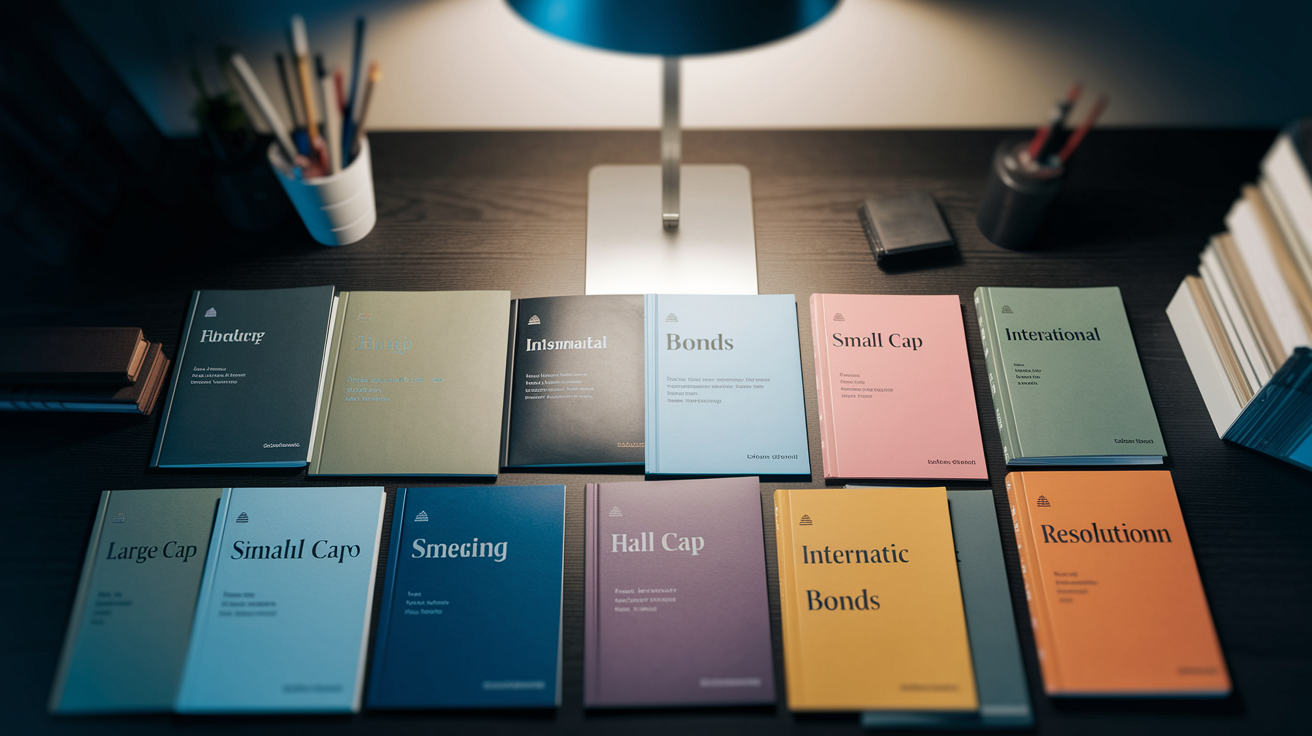
Most 401k plans offer a menu of mutual funds and index funds grouped by investment type. Plan providers build these menus to let you construct a diversified portfolio without needing a brokerage account. You pick funds from the list and decide what percentage of each paycheck goes into each one. The goal is to give you access to different regions, company sizes, and asset types so you can spread risk and capture growth across the economy.
Knowing what each fund category does helps you avoid accidental over-concentration. If you pick three funds that all hold U.S. large companies, you’re not really diversified. You just own the same stocks three times over. Understanding the categories lets you intentionally mix growth and stability.
U.S. large cap funds own big, established companies like those in the S&P 500. These are the core of most stock allocations. U.S. small cap funds hold smaller companies with higher growth potential and higher volatility. International funds invest in companies outside the U.S., spreading risk across different economies and currencies. Emerging markets funds focus on faster-growing developing countries, higher potential returns but bigger swings. Bond funds lend money to governments or corporations in exchange for regular interest payments. Lower volatility than stocks. REIT and alternative funds cover real estate investment trusts and other non-traditional assets. Some plans include these for extra diversification.
Creating a 401k Allocation Mix Based on Age and Time Horizon

The longer your timeline, the more aggressive you can afford to be. Short-term crashes become noise over 30 or 40 years. As each decade passes, you slowly shift toward bonds to protect the money you’ve already grown. The pace of that shift depends on how many working years remain and how stable your other income sources are.
In your 20s and 30s, a typical allocation holds 10% to 20% bonds and the rest in stocks. That high stock exposure captures decades of compounding growth. By your 40s and 50s, bonds rise to 30% or 40% of the portfolio as retirement moves from distant to near-term. Once you hit 60 and beyond, many investors hold 50% or more in bonds to preserve capital and generate steady income for withdrawals. A 25-year-old might sit at 15% bonds, a 35-year-old at 20%, a 45-year-old at 35%, a 55-year-old at 45%, and a 65-year-old at 55% or higher.
Personal factors bend these decade ranges in both directions. If you plan to retire at 55, you need to dial down stock risk faster than someone working until 70. A volatile job or commission-based income argues for holding more bonds earlier, because you already have income uncertainty. On the flip side, a secure pension or Social Security estimate lets you stay stock-heavy longer inside your 401k because your essential expenses are covered outside the account.
| Age Range | Typical Stocks % | Typical Bonds % |
|---|---|---|
| 20s – 30s | 80% – 90% | 10% – 20% |
| 40s | 60% – 70% | 30% – 40% |
| 50s | 50% – 60% | 40% – 50% |
| 60s and beyond | 35% – 50% | 50% – 65% |
Sample 401k Allocation Models for Different Investor Types

Aggressive Allocation Model
An aggressive portfolio holds 80% stocks and 20% bonds. This mix suits younger investors or anyone with a long runway and the stomach to watch their balance swing during downturns. Within the 80% equity slice, spread the money to capture different growth engines. 50% in U.S. large cap for stable core exposure, 15% in U.S. small cap to add higher-growth potential, 25% in international stocks to diversify across economies, and 10% in emerging markets for faster-growing regions. The 20% bond allocation acts as a small cushion during crashes but doesn’t drag down long-term returns much.
Moderate Allocation Model
A moderate portfolio splits 60% stocks and 40% bonds. This is a common middle ground for investors in their 40s or 50s who still want growth but need to protect some of what they’ve already saved. The 60% equity portion tilts a bit more toward stability. 55% in U.S. large cap, 10% in U.S. small cap, 25% international, and 10% emerging markets. The 40% bond allocation smooths out the ride when stocks drop and starts generating the income stream you’ll rely on in retirement.
Conservative Allocation Model
A conservative portfolio holds just 30% stocks and 70% bonds. This suits investors within a few years of retirement or anyone who can’t afford to lose principal. The small equity slice focuses heavily on large, stable companies. 65% U.S. large cap, 5% U.S. small cap, 20% international, and 10% emerging markets. To capture some growth without big swings. The 70% bond position preserves capital and delivers steady interest payments you can start tapping when paychecks stop.
Using Target-Date Funds in Your 401k Allocation

Target-date funds are mutual funds that own a mix of other funds and automatically adjust that mix as your retirement year approaches. You pick the fund with a date closest to when you plan to retire. Say, a 2055 fund if you’re retiring around 2055. And the fund manager shifts the allocation from stocks to bonds over time along a pre-set glide path. In your 20s the fund might be 90% stocks, but by your 60s it’ll have moved to 40% stocks and 60% bonds without you lifting a finger.
Target-date funds handle rebalancing for you and remove the guesswork of building your own mix. The downside is you give up control. You can’t tweak the glide path if your risk tolerance or timeline changes, and some target-date funds charge higher fees than plain index funds. If you want a hands-off approach and the fund’s glide path matches your plan, a target-date fund simplifies everything into one holding.
Managing Fees and Expense Ratios Within Your 401k Allocation

Index funds usually carry the lowest expense ratios because they track a market benchmark and don’t require active stock picking or frequent trading. On a $100,000 balance growing at 7% annually, a fund charging 0.80% in expenses will cost you about $70,000 more in lost returns over 30 years compared to a fund charging 0.40%. That difference compounds every year. High fees quietly shrink your retirement account even when the market goes up.
Fees are disclosed on your 401k plan website and in each fund’s prospectus. Compare expense ratios before you invest and favor low-cost options when performance and strategy are similar. A 0.05% difference sounds tiny today but adds up to thousands of dollars by retirement.
Check the expense ratio on your plan provider’s fund comparison page. Compare index funds to actively managed funds in the same category. Look for net expense ratios, which include fee waivers and reimbursements. If using a target-date fund, confirm its expense ratio is competitive with standalone index funds.
Rebalancing and Adjusting Your 401k Allocation Over Time

Rebalancing resets your portfolio back to your target mix after market movements push it off course. Stocks and bonds grow at different rates, so a portfolio that starts 60% stocks and 40% bonds might drift to 65% stocks and 35% bonds after a strong year in the market. That extra 5% in stocks means you’re taking more risk than you planned. Rebalancing sells some of the winners and buys more of what lagged to bring you back to 60/40.
A common rebalancing trigger is a drift of plus or minus 5 percentage points from your target. If your stock allocation climbs from 60% to 65%, sell enough to get back to 60%. If it drops to 55%, buy more stocks with bond proceeds or new contributions. Many investors rebalance once a year on a set date. Like January 1 or their birthday. To keep it simple and avoid obsessing over every market move.
Review your allocation whenever a major life event changes your timeline or income picture. A new job with a big raise might let you take more risk. A decision to retire three years earlier means you need to shift toward bonds faster. A spouse’s pension kicking in gives you a cushion that allows higher stock exposure. Rebalancing isn’t just about market drift. It’s also about matching your mix to where you are in life right now.
Tools and Calculators to Optimize Your 401k Allocation

Online calculators and visual tools turn abstract percentages into concrete plans you can act on today. Plug in your current age, planned retirement age, current balance, annual contributions, and risk comfort level, and an allocation calculator will suggest a starting stock/bond split. Glide-path charts show you how equity exposure should decline decade by decade so you can see the long-term trajectory instead of guessing.
Allocation calculators let you enter age, retirement year, and risk tolerance to get a recommended stock/bond mix. Retirement calculators estimate how much you need to save and whether your current plan gets you there. Glide path visual tools chart equity percentage by age for different risk levels. Risk assessment tools use a quiz format that measures how much volatility you can handle emotionally. Rebalancing trackers, whether spreadsheet or app, flag when your allocation drifts beyond your trigger threshold.
Final Words
You learned the 110/100 age shortcuts and sample equity mixes, plus how to split stocks, bonds, and fund types for a steady retirement plan.
We also covered picking index or active funds, the role of target-date funds, why fees matter, and simple rebalancing rules. Use the tools and the sample aggressive, moderate, or conservative mixes to pick what fits your timeline and comfort.
A clear 401k allocation that matches your age, goals, and risk tolerance is doable. Start small, check fees, rebalance, and you’ll make steady progress.
FAQ
Q: What should my 401k allocation be?
A: Your 401k allocation should start with a simple age-based rule: subtract your age from 110 to find your stock percentage, with the rest in bonds. For example, if you’re 35, aim for roughly 75% stocks and 25% bonds. Adjust this mix based on your risk tolerance, retirement timeline, and whether market drops would keep you up at night.
Q: What is the 70/20/10 rule for investing?
A: The 70/20/10 rule for investing is a budgeting guideline where you use 70% of income for living expenses, 20% for savings and investments, and 10% for debt or giving. While useful for cash flow, it differs from 401k allocation, which focuses on how you spread retirement money across stocks, bonds, and other funds inside your account.
Q: How many Americans have $1,000,000 in retirement savings?
A: Roughly 10% of Americans have $1,000,000 or more in retirement savings, according to recent surveys. Most people fall short of this mark, which is why consistent contributions, smart allocation, and decades of compounding matter more than chasing a single magic number or trying to time the market perfectly.
Q: What does allocation mean in a 401k plan?
A: Allocation in a 401k plan means how you divide your retirement money across different types of investments like stocks, bonds, and funds. A good allocation spreads risk while matching your age and goals. Younger workers typically hold more stocks for growth, while older workers shift toward bonds for stability as retirement nears.