

What if your ETF looks perfect on the quote sheet but depends on a bank that could fail?
A synthetic ETF (one that uses a swap contract instead of owning the actual stocks or bonds) hands the exposure to a counterparty bank in return for the index return.
That creates counterparty risk (the bank might not pay) and credit risk (its finances might weaken).
This post walks you through simple checks, who the swap partner is, how good the collateral is, and how often margins reset, so you can decide if the tradeoff makes sense for your money.
Understanding Synthetic ETFs and Their Core Risks

A synthetic ETF uses derivative contracts, usually total return swaps, to deliver the performance of an index without holding the underlying securities. Instead of buying stocks or bonds, the fund hands cash or low-risk collateral to an investment bank and receives the index return in exchange. That swap agreement is the engine of the fund. And it introduces a risk that physical ETFs don’t carry: the risk that the bank on the other side of the contract fails to deliver.
When you own a synthetic ETF, you’re trusting that the swap counterparty (usually a large bank) will honor its promise to pay the index return. If that counterparty defaults, you may not get the full value of your investment, even if the index itself is performing well. This is counterparty risk. Credit risk is closely related. It measures the chance that the counterparty’s financial health deteriorates to the point where it can’t meet its obligations. Both risks are central to synthetic structures because the fund’s return depends on a contract, not on assets you can touch or sell directly.
Synthetic ETFs became popular in Europe in the mid 2000s as a way to track hard to replicate indices with lower tracking error and transaction costs. They work well when markets are stable and counterparties are strong. But they carry built in exposure to the financial system’s plumbing. Understanding how that exposure works, and how to measure it, is the difference between a sensible tool and a hidden trap.
The primary risks specific to synthetic structures include:
Counterparty default. The swap provider fails and can’t deliver the promised return.
Collateral shortfall. The assets backing the swap lose value or become illiquid, leaving a gap if the counterparty defaults.
Credit deterioration. The counterparty’s creditworthiness declines over time, increasing the chance of default before you can exit.
Contagion and systemic stress. A crisis affecting one bank spreads to others, freezing collateral chains and replacement markets.
Operational and legal complexity. Enforcing claims on collateral or replacing a failed counterparty takes time and may involve legal disputes, especially across borders.
How Swap‑Based ETF Structures Create Exposure to Counterparty and Credit Risk

In a typical synthetic ETF, the fund manager transfers the economic exposure of the index to a swap counterparty, often a bank. The ETF owns cash or short term debt instruments, plus a total return swap contract. Each day, the counterparty calculates the index return and pays (or receives) the difference between that return and the return on the collateral the fund holds. The fund’s net asset value moves with the index because the swap makes up for the difference between what the fund actually owns and what the index did.
That structure means the fund’s performance depends on the counterparty honoring the contract. If the swap counterparty defaults, the fund is left holding whatever collateral it has, plus a legal claim on the failed institution. The collateral is supposed to cover most or all of the exposure. But whether it does depends on the quality, liquidity, and valuation of those assets at the moment of default. If the collateral is hard to sell or has dropped in value, the fund may recover less than 100 percent of what it’s owed.
Risk transmission happens because the ETF doesn’t own the index securities. It owns a promise. That promise is only as good as the counterparty’s balance sheet and the collateral backing it. The structure shifts market risk (tracking the index) into credit risk (trusting the bank) and collateral risk (ensuring the backup assets are solid). Every swap based fund carries this handoff. Every investor needs to evaluate whether the tradeoff makes sense for their situation.
Types of Counterparty and Credit Risks Present in Synthetic ETFs
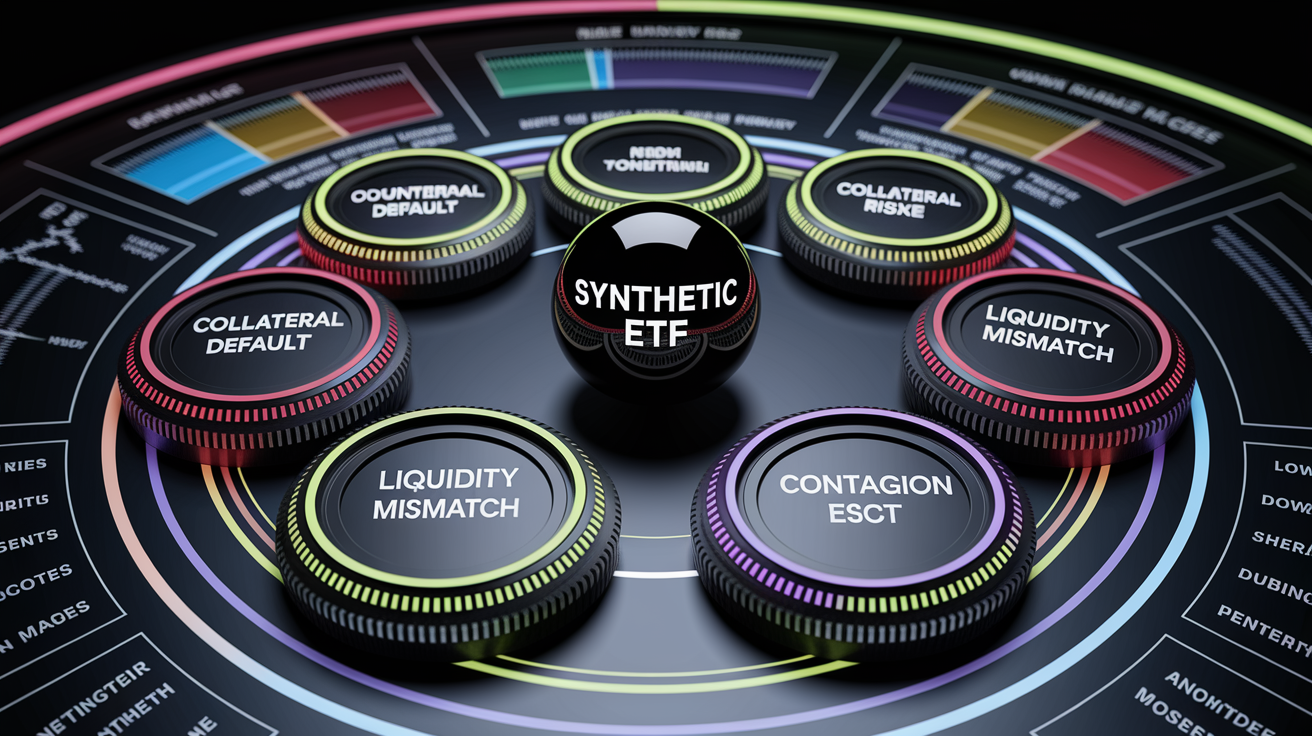
Counterparty default risk. The swap provider becomes insolvent and can’t pay what it owes. This is the headline risk. Even with collateral, recovery can be delayed, and legal processes may reduce the final amount you get back. The probability of default depends on the counterparty’s credit rating, balance sheet strength, and exposure to market stress.
Collateral shortfall risk. The assets posted as collateral lose value or become illiquid. If the counterparty defaults when collateral has already dropped by 15 or 20 percent, the fund may not recover the full exposure. Collateral concentration (for example, all government bonds from one country) or low quality assets (corporate bonds rated near investment grade) increase this risk.
Downgrade and credit deterioration risk. The counterparty’s credit rating is cut by rating agencies, or its credit default swap spread widens, signaling higher default probability. Even if default never happens, a downgrade can force the fund to post more collateral, replace the counterparty, or accept higher costs. All of which can erode returns or create operational disruption.
Liquidity mismatch risk. The collateral may be hard to sell quickly at fair value, especially during market turmoil. If the fund needs to liquidate collateral to cover a counterparty failure, illiquid assets (long dated bonds, off the run securities, or less traded equities) may only fetch 70 or 80 cents on the dollar, widening the loss.
Contagion and systemic risk. A crisis affecting one major bank can spread to others through funding markets, derivative chains, and confidence shocks. If multiple counterparties are stressed at once, replacing failed swaps becomes difficult, and collateral markets may freeze. This was visible in 2008 and remains a tail risk in synthetic ETF markets, especially in regions where a few banks dominate swap underwriting.
Practical Methods to Evaluate Counterparty Risk

Start by identifying the swap counterparty or counterparties. The ETF prospectus and fact sheet should name them. Check how many counterparties the fund uses. A single counterparty setup concentrates all your risk in one institution. Multiple counterparties spread the exposure, but you still need to evaluate each one individually.
Next, review the counterparty’s creditworthiness. Look up its current credit rating from agencies like S&P, Moody’s, or Fitch. A rating of A minus or higher is a common threshold for comfort. Below BBB, the counterparty is approaching junk territory, and default risk rises sharply. Supplement the rating with the counterparty’s credit default swap (CDS) spread, if available. A CDS spread is the annual cost (in basis points) to insure against default. A spread below 100 basis points suggests low perceived risk. A spread above 200 or 300 basis points signals rising concern. Compare the current spread to its historical range and to peers to see if stress is building.
Examine how often the fund resets or marginalizes the swap. Daily margin calls and mark to market settlement reduce the window of exposure. If the fund only reconciles weekly or monthly, the gap between collateral value and current exposure can widen, especially in volatile markets. Check the prospectus for settlement frequency and whether collateral is adjusted automatically or on demand.
| Metric | What It Reveals |
|---|---|
| Credit rating (S&P, Moody’s) | Summary assessment of default probability; watch for downgrades of 2+ notches |
| CDS spread (basis points) | Market-implied cost of default protection; rising spreads signal deteriorating credit |
| Number of counterparties | Concentration vs. diversification; single counterparty = higher risk |
| Margin call frequency | How often exposure is reset; daily is safer than weekly or monthly |
Assessing Credit Risk Through Collateral Analysis

Collateral is your safety net if the counterparty fails. The quality, liquidity, and diversification of that collateral determine how much you’ll actually recover. Start by reading the prospectus section on permitted collateral. Some funds accept only cash and government bonds. Others allow corporate bonds, equities, or even less liquid instruments. The broader the list, the higher the risk that collateral will be hard to sell or will have dropped in value when you need it.
Check whether the collateral is over collateralized. A common standard is 102 to 110 percent coverage, meaning the collateral is worth slightly more than the current swap exposure. That cushion is meant to absorb small price moves. In stress scenarios, a 5 or 10 percent cushion may not be enough if collateral drops 15 or 20 percent. Look for funds that maintain 105 percent or higher coverage and apply conservative haircuts (markdowns) to reflect liquidity and volatility.
When you review collateral composition, pay attention to these criteria:
Asset type and credit quality. Government bonds rated AAA or AA are more liquid and stable than corporate bonds or equities. Avoid funds using low rated or unrated securities as collateral.
Concentration limits. Check if collateral is spread across multiple issuers or dominated by one or two names. A single issuer collapse can wipe out collateral value.
Maturity and duration. Longer dated bonds are more volatile. Shorter maturities (under 5 years) are easier to liquidate at stable prices.
Rehypothecation rights. Confirm whether the counterparty can re use collateral for its own purposes. Unrestricted rehypothecation increases the chance that collateral disappears in a default.
Valuation frequency and independence. Daily third party valuation is standard. Weekly or monthly updates leave more room for staleness and disputes.
Regulatory Safeguards and Requirements for Synthetic ETFs

Regulators in many jurisdictions impose limits to cap counterparty exposure. Under UCITS rules (the European framework that many synthetic ETFs follow), a fund’s unsecured exposure to any single counterparty can’t exceed 10 percent of net asset value. That means if a counterparty defaults, the maximum immediate shortfall is capped at roughly 10 percent, assuming collateral covers the rest. Some funds go further and target 5 percent or zero unsecured exposure through over collateralization.
Daily collateral valuation is a standard requirement. The fund must mark the swap and the collateral to market every business day and adjust posted collateral to keep exposure within limits. This daily reconciliation reduces the chance that a sudden move or a counterparty failure leaves a large gap. Diversification rules also apply to the collateral itself. Many regimes require that collateral be spread across multiple issuers and asset types to prevent concentration in a single name or sector.
These rules aren’t guarantees. They set floors, not ceilings. Enforcement varies by jurisdiction. A fund can still face losses if collateral quality is poor, if markets are illiquid during a crisis, or if legal disputes delay recovery. Regulatory safeguards reduce risk but don’t eliminate it. Read the prospectus to confirm which regime applies and whether the fund meets or exceeds the minimum standards.
Comparing Synthetic ETFs to Physical ETFs From a Risk Perspective

Physical ETFs buy and hold the actual securities in the index. Your claim is on the stocks or bonds in the portfolio, not on a counterparty promise. That eliminates swap counterparty risk entirely. But it introduces a different risk: securities lending. Many physical ETFs lend out portfolio holdings to earn extra income, and that lending creates counterparty exposure if the borrower defaults. The difference is degree and transparency. Lending programs are disclosed and typically over collateralized, but the risk still exists.
Synthetic ETFs often deliver tighter tracking to the index because they avoid the transaction costs and timing mismatches of buying and selling securities. They can also access markets that are expensive or restricted for foreign investors. The tradeoff is that you swap market execution risk for credit and collateral risk. In calm times, that trade can save a few basis points. In a crisis, it can cost you recovery time and principal.
Some markets rely heavily on synthetic replication. Emerging market equity indices, commodity benchmarks, and certain fixed income sectors are easier and cheaper to replicate synthetically. If you want exposure to those areas, you may not have a pure physical alternative. In that case, the choice is between accepting counterparty risk or skipping the exposure altogether.
| Replication Type | Key Risk | Relative Severity |
|---|---|---|
| Synthetic (swap-based) | Counterparty default and collateral shortfall | Moderate to high, depends on counterparty credit and collateral quality |
| Physical (full replication) | Securities lending counterparty risk | Low to moderate, usually over-collateralized and disclosed |
| Physical (sampling) | Tracking error and liquidity mismatch | Low, limited to portfolio construction choices |
| Physical (optimized) | Model risk and rebalancing costs | Low, primarily operational and market-timing factors |
Real‑World Examples of Counterparty and Credit Stress in Synthetic ETFs

During the 2008 financial crisis, Lehman Brothers filed for bankruptcy on September 15, 2008. Lehman was a major swap counterparty for derivatives and structured products around the world. Funds and investors holding swaps with Lehman faced immediate uncertainty about collateral, legal claims, and replacement costs. Some synthetic ETF managers were able to switch counterparties or had diversified exposures that limited losses. Others faced delays, legal disputes, and recovery rates well below 100 percent on unsecured claims. The event showed how quickly a single counterparty failure can freeze markets and complicate recovery.
Between 2010 and 2012, European regulators and investors scrutinized synthetic ETFs more closely as the eurozone debt crisis raised concerns about bank balance sheets. Many large European banks that served as swap counterparties saw their credit ratings downgraded and their CDS spreads widen. Some funds responded by increasing collateral requirements, adding counterparties, or moving to physical replication. The stress didn’t result in widespread defaults, but it highlighted the feedback loop between bank credit risk and ETF structure risk.
Market data from that period showed wide variation in collateral quality. Some synthetic ETFs held only high grade government bonds as collateral. Others used baskets of equities, corporate bonds, or less liquid instruments. When markets became volatile, the less liquid collateral pools were harder to value and harder to sell, widening the gap between stated collateral coverage and realizable value. Investors who checked prospectuses and collateral disclosures were better positioned to exit or avoid the riskiest structures.
Investor Strategies to Reduce Exposure to Counterparty and Credit Risk

You can lower counterparty and credit risk without avoiding synthetic ETFs entirely, but it requires active evaluation and ongoing monitoring.
Choose funds with multiple counterparties. Diversifying swap providers spreads default risk. If one bank fails, the fund can continue operating with the others and replace the failed swap more easily. A single counterparty setup concentrates all your credit exposure in one institution.
Review and verify collateral composition. Read the prospectus to confirm what assets are allowed as collateral. Prefer funds that use cash, government bonds rated AAA or AA, and short maturity instruments. Avoid funds that accept equities, lower rated corporate bonds, or rehypothecated collateral without clear segregation.
Monitor counterparty credit ratings and CDS spreads regularly. Set a threshold. For example, a minimum rating of A minus and a CDS spread below 150 basis points. If a counterparty is downgraded or its spread widens significantly, reassess the fund or prepare to exit. Don’t wait for a crisis to check credit health.
Prefer funds with daily margin calls and mark to market settlement. Frequent reconciliation keeps exposure small and current. Weekly or monthly settlement allows gaps to grow, especially in volatile markets. Daily margining is the industry standard for lower risk funds.
Check collateral coverage ratios and haircut policies. Look for at least 105 percent collateral coverage with conservative haircuts (for example, 5 percent markdown on government bonds, 15 percent on equities). Higher coverage and tighter haircuts give you more cushion if collateral value drops during a default.
After you’ve selected a fund, revisit these factors every few months or whenever market stress increases. Counterparty credit can deteriorate quickly. Collateral quality can shift if the fund changes its policy or if market conditions change. The goal isn’t to eliminate all risk. It’s to understand what you’re accepting and to stay below your personal tolerance for credit and operational complexity.
Final Words
You learned how synthetic ETFs use swaps, where counterparty and credit risk come from, and what to check in collateral and swap terms.
Next, use a short checklist: review counterparty ratings, collateral quality, swap reset frequency, and regulatory limits. If one item feels weak, step back or pick a different fund.
Try one quick review this week to practice how to evaluate etf counterparty and credit risk in synthetic funds. Small steps add up. You’re building safer habits.
FAQ
Q: What is counterparty risk in the context of synthetic ETFs?
A: Counterparty risk in synthetic ETFs is the chance the swap counterparty (usually a bank) can’t meet its payments, which can lower ETF value unless collateral and protections cover the shortfall.
Q: What is the 7% rule in ETF?
A: The 7% rule in ETFs is not a formal rule; many investors use it as a personal cap—keeping any single ETF near 7% of a portfolio to avoid concentration, but practices vary.
Q: What is the 3 5 10 rule for ETFs?
A: The 3 5 10 rule for ETFs is not a universal standard; people may mean time horizons (3, 5, 10 years) for planning or confuse it with UCITS-style concentration limits like 5/10/40—ask for context.
Q: What is the risk of a synthetic ETF?
A: The risk of a synthetic ETF is primarily counterparty default and collateral shortfall, plus liquidity, downgrade, and contagion risks; check swap terms, collateral quality, and issuer credit before investing.