

Think reinvesting dividends means you don’t pay tax until you sell? Think again.
Reinvested dividends are taxable the year they’re paid, even when the cash goes straight into more shares.
This post explains how the IRS treats DRIPs, how Form 1099-DIV reports the income, the difference between qualified and ordinary dividends, and why tracking cost basis matters.
You’ll get clear rules and simple steps to avoid surprises at tax time.
By the end you’ll know what you owe and when to act.
Understanding How Taxes Apply to Reinvested Dividends

Reinvested dividends are taxable income in the year you receive them, even if you never see a dollar of cash. When you set up a DRIP, the IRS views each reinvestment the same way as if the company sent you a check, you deposited it, and then immediately bought new shares with that money. You owe taxes on the dividend payout, not on when you eventually sell the shares.
Brokers send you Form 1099‑DIV every January. Box 1a shows ordinary dividends and Box 1b shows qualified dividends. These numbers tell you what income to report for the prior tax year. If your 1099‑DIV shows $500 in Box 1b, you report that $500 whether the broker mailed you a check or used that money to buy more stock on your behalf. The form doesn’t care if the dividend went into your bank account or back into the market.
Qualified dividends follow the long‑term capital gains tax schedule at 0%, 15%, or 20%, depending on your taxable income. Ordinary dividends get taxed at your standard income‑tax rate, which can climb anywhere from 10% to 37%. The lower qualified rate only applies if you hold the stock long enough and meet IRS holding‑period rules. Without the right holding period, every reinvested dollar faces the higher bracket.
Five realities of DRIP taxation:
Dividends trigger tax liability in the year paid, not the year shares are sold. Reinvestment changes nothing about the IRS treatment of the dividend payment. Qualified dividends receive preferential rates only if holding‑period tests are met. Each reinvested amount becomes the cost basis for the new shares you acquire. You’ll report the dividend income even if the brokerage never transferred cash to your account.
Mechanics of DRIPs and How Tax Rules Interact with Reinvestment

A DRIP takes each dividend payment and converts it into shares at the market price on the payment date. Some plans round to fractional shares, so a $37 dividend might buy 0.741 shares if the stock trades at $49.93. Each reinvestment is a separate purchase. That means a new tax lot with its own date, price, and cost basis. Track every lot because the IRS expects you to know what you paid for every share you eventually sell.
Some company DRIPs offer discounted shares, maybe 3% or 5% off the current price. The taxable dividend is still the full cash value you would have received. If a $100 dividend buys shares at a 5% discount, you still owe tax on $100, but your cost basis in the new shares is only $95. That discount becomes a benefit you realize later when calculating gains, not a reduction in current‑year taxable income.
Each reinvestment creates a separate tax lot with a unique purchase date and per‑share price. Fractional shares are common and carry their own proportional cost basis. Discounted reinvestments lower your basis without reducing the taxable dividend amount. Reinvestment frequency varies (monthly, quarterly, annually) and each event is a taxable transaction.
Reporting Dividend Reinvestment on Your Tax Return

Start with Form 1099‑DIV from your broker. Qualified dividends go on Form 1040, line 3a. Ordinary dividends go on line 3b. If your ordinary dividends top $1,500 for the year, you also have to fill out Schedule B and attach it to your return. The instructions on Schedule B walk through interest and dividend detail, including foreign accounts if you have them.
When you sell DRIP shares down the road, your broker will send Form 1099‑B showing the sale proceeds. You report that transaction on Form 8949 and summarize on Schedule D. The 1099‑B may show your cost basis if the broker tracked it correctly, but many brokers have incomplete records for older DRIP lots or fractional shares. Double check the numbers and be ready to provide your own documentation if the basis is missing or wrong.
Accuracy matters because the IRS matches your reported gains and losses against the broker’s 1099‑B. If you understate basis, you overpay tax. If you overstate it and can’t prove the numbers, you risk an adjustment, interest, and penalties. Keep your reinvestment statements, confirmations, and a running log that ties each lot to a date and price.
Six steps to file dividend reinvestment correctly:
Locate all Form 1099‑DIV statements from brokers and transfer agents by late January. Enter Box 1a (ordinary) and Box 1b (qualified) totals onto Form 1040 lines 3b and 3a. If ordinary dividends exceed $1,500, complete Schedule B Part II and attach it. When you sell shares, gather Form 1099‑B and reconcile the reported basis with your records. Use Form 8949 to detail each sale, adjusting basis if the broker’s number is incomplete. Transfer totals from Form 8949 to Schedule D for final gain and loss calculation.
Tracking Cost Basis for Reinvested Dividends

The dollar amount of each reinvested dividend becomes the cost basis for the shares that dividend purchases. If a $200 dividend buys 4.123 shares, your basis for that lot is $200, or $48.52 per share. That basis is what you subtract from the sale price when you calculate capital gains. Brokers usually track this information, but older accounts and plans run by transfer agents sometimes leave gaps, especially for fractional shares acquired years ago.
Keep your own spreadsheet or log. For every reinvestment, write down the date, the total dividend reinvested, the number of shares purchased (including fractions), and the per‑share price. Over time you’ll build a record of every lot. When you sell, that record proves the basis you claim on Form 8949 and protects you if the IRS asks questions.
| Date of Reinvestment | Amount Reinvested | Shares/Fraction Purchased | Cost Basis Added |
|---|---|---|---|
| 3/15/2023 | $120.00 | 2.400 | $120.00 |
| 6/15/2023 | $125.00 | 2.273 | $125.00 |
| 9/15/2023 | $130.00 | 2.364 | $130.00 |
| 12/15/2023 | $135.00 | 2.500 | $135.00 |
Qualified vs. Ordinary Dividends Within a DRIP

Qualified dividends receive the same preferential long‑term capital gains rates as selling stock you held more than a year: 0% if your taxable income falls into the lowest brackets, 15% for most middle‑income filers, and 20% at the top. Ordinary dividends follow your regular tax bracket, so if you’re in the 24% bracket, you pay 24% on every dollar of ordinary dividend income. The difference adds up fast on a portfolio that throws off thousands of dollars in dividends each year.
The key test for qualified status is the holding‑period rule. You generally must hold the underlying stock for more than 60 days during the 121‑day window that starts 60 days before the ex‑dividend date. If you buy shares right before a dividend and sell them right after, the payout stays ordinary and taxed at higher rates. Most DRIP investors hold positions for years, so the rule usually poses no problem. But watch it if you churn positions or use margin strategies around dividend dates.
A simple comparison shows the impact. Suppose you receive $1,200 in qualified dividends and your long‑term capital gains rate is 15%. You owe $180 in tax. If those same $1,200 dividends were ordinary and your bracket is 24%, you owe $288. That $108 difference rewards patient investing and makes qualified dividends a priority when choosing stocks or funds for a taxable account.
Capital Gains When Selling DRIP Shares

When you sell shares acquired through a DRIP, the IRS wants to know your cost basis for those specific shares so it can calculate your gain or loss. Most brokers default to first‑in, first‑out accounting, meaning they assume you sold the oldest shares first. That might push you into long‑term gains territory, or it might produce a larger taxable gain if those early shares had a low basis. You can often use specific identification instead, telling the broker exactly which lot to sell. That flexibility lets you pick higher‑basis shares to lower the gain or sell newer shares to keep the best lots for later.
Sales show up on Form 1099‑B and must be reported on Form 8949, then summarized on Schedule D. If the broker included basis on the 1099‑B, you still have to verify the number and adjust it on Form 8949 if necessary. If the 1099‑B lists basis as “not reported,” you must supply the correct figure yourself and mark the right box on Form 8949. Missing or wrong basis can trigger an IRS notice, so double check everything before filing.
Confirm the broker’s cost‑basis reporting matches your records before filing. Use specific identification to sell high‑basis lots first if lowering your gain matters. Long‑term versus short‑term treatment depends on holding each lot more than one year. Report every sale on Form 8949 even if the proceeds are small or basis is unclear. Keep lot‑level documentation in case the IRS requests proof of your claimed basis.
DRIP Taxes in Tax‑Advantaged Accounts

Holding dividend‑paying stocks inside a traditional IRA, Roth IRA, or 401(k) changes the tax picture completely. Reinvested dividends in these accounts aren’t taxable when paid. You skip the annual 1099‑DIV and don’t report the dividend income on your Form 1040 for that year. Traditional IRA and 401(k) plans defer taxes until you take distributions, usually in retirement. Roth accounts let qualified withdrawals come out tax‑free if you follow the age and holding‑period rules.
If you expect to lean heavily on dividend reinvestment for long‑term compounding, running the DRIP inside a retirement account eliminates the annual tax drag. Every dollar that would have gone to the IRS stays invested and buys more shares. That extra compounding can add up to thousands of dollars over decades, especially if you’re reinvesting high‑yield stocks that would otherwise generate large ordinary‑dividend bills every year.
No Form 1099‑DIV for reinvested dividends inside IRAs or 401(k)s. Traditional accounts defer all taxes until withdrawal. Roth accounts offer tax‑free qualified distributions. Compounding accelerates when dividends aren’t reduced by annual tax payments.
Foreign Dividend Reinvestment and Withholding Taxes

Foreign companies often withhold taxes on dividends at the source before the payment reaches your account. That withholding can range from 10% to 30% depending on the country and any tax treaty with the United States. If you reinvest a dividend from a foreign stock, you still owe U.S. tax on the gross dividend amount, but you may claim a foreign tax credit for the amount withheld abroad. Form 1116 handles the credit calculation. For small amounts, you can sometimes take a simpler deduction instead.
If you’re a nonresident alien receiving U.S. dividends, the payor typically withholds 30% unless a treaty reduces the rate. Reinvestment doesn’t change the withholding obligation. The net amount after withholding buys shares, and you report the gross dividend on your home‑country return if required. Check both U.S. and home‑country rules, because tax‑treaty provisions and reporting requirements vary widely.
Examples Showing How DRIP Taxation Works
Imagine you own 50 shares of a stock that pays a $2.00 per‑share quarterly dividend. Each quarter you receive $100. Your DRIP takes that $100 and buys shares at the current market price. If the stock trades at $50 on the dividend payment date, the plan purchases 2.000 shares. You now own 52 shares going into the next quarter. That $100 is fully taxable in the year it was paid, reported on your Form 1040 even though you never touched the cash. Your cost basis increases by $100, split across the 2 new shares at $50 each.
Now compare tax outcomes. Suppose you collect $1,200 in qualified dividends over the year and your applicable long‑term capital gains rate is 15%. You owe $180 in tax on those dividends. If the same $1,200 were ordinary dividends and your marginal rate is 24%, you owe $288. The $108 difference shows why holding period and qualified status matter. Reinvestment doesn’t change these numbers. You pay the same tax whether the broker sent the dividend to your checking account or used it to buy more stock.
| Scenario | Dividend Amount | Qualified/Ordinary | Tax Rate | Tax Owed |
|---|---|---|---|---|
| Quarterly DRIP reinvestment | $100.00 | Qualified | 15% | $15.00 |
| Annual qualified dividends | $1,200.00 | Qualified | 15% | $180.00 |
| Annual ordinary dividends | $1,200.00 | Ordinary | 24% | $288.00 |
Recordkeeping Practices for DRIP Investors
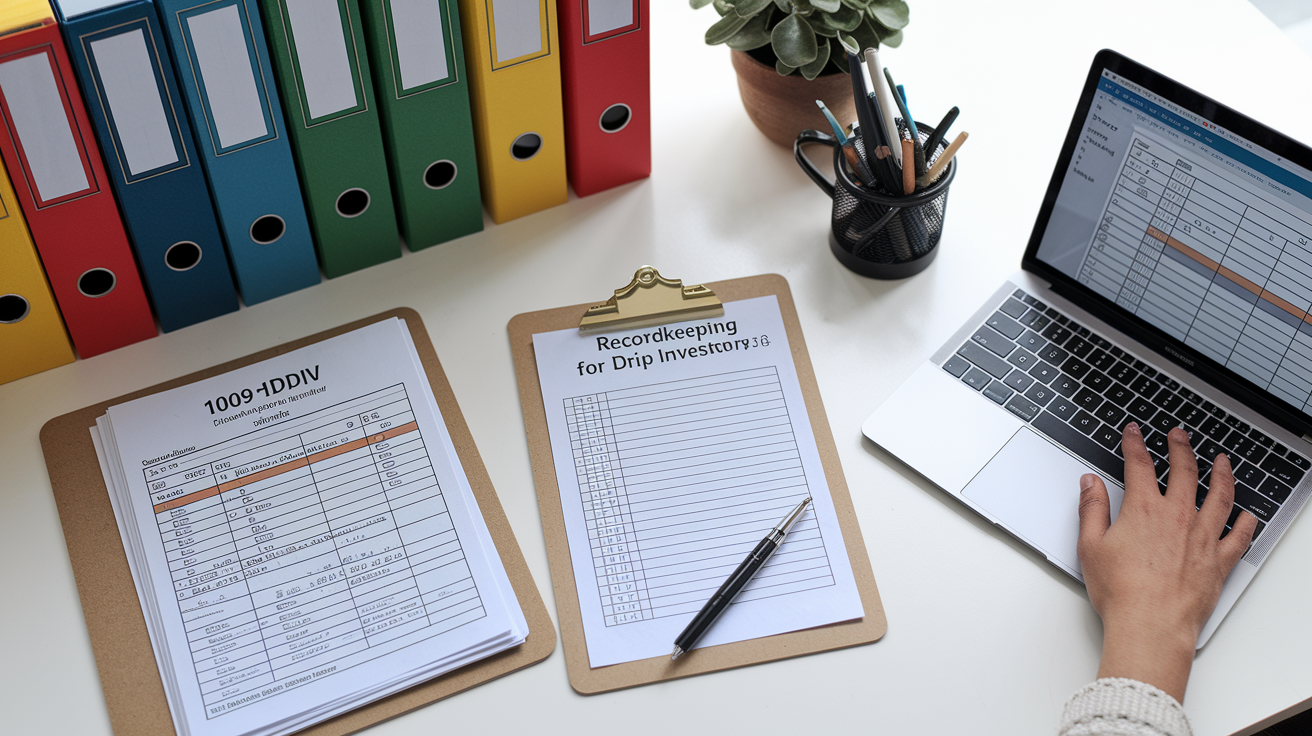
Save every Form 1099‑DIV and Form 1099‑B you receive. Keep all transaction confirmations from your broker or transfer agent that show the date, number of shares purchased, and the per‑share price for each reinvestment. Build a simple spreadsheet or use accounting software to log every DRIP event as it happens. That running log becomes your proof if the broker’s cost‑basis reporting is incomplete or if the IRS asks for documentation years later.
Hold onto these records for at least the entire time you own the position, plus three years after you file the tax return that reports the final sale. Some accountants recommend keeping records even longer if you have complex holdings or large gains. Gaps in your documentation can cost you money when you sell, because the IRS may disallow basis you can’t prove, turning a modest gain into a larger tax bill.
All Form 1099‑DIV statements, one for each year dividends were paid. All Form 1099‑B statements when you sell DRIP shares. Transaction confirmations showing date, shares acquired, and per‑share price for each reinvestment. Running spreadsheet or ledger with cumulative basis by lot. Correspondence or plan documents from transfer agents if you use a company‑sponsored DRIP. Backup records for any basis adjustments, discounts, or special circumstances like return‑of‑capital distributions.
Final Words
Reinvested dividends are taxable in the year they’re paid, even if you don’t get cash. Brokers report them on Form 1099‑DIV, and each reinvestment creates a new cost basis you must track.
Qualified dividends get lower tax rates; ordinary dividends follow your income bracket. When you sell DRIP shares, report gains on Form 1099‑B and Form 8949.
Keep tidy records, check your tax forms, and consider retirement accounts to avoid immediate tax. Understanding dividend reinvestment plan tax helps you plan and keep compounding working for you.
FAQ
Q: Do you pay tax on dividend reinvestment plans? Do I pay taxes on reinvested dividends? Do I have to pay tax on dividends that get reinvested?
A: You pay tax on reinvested dividends in the year they’re paid. The IRS treats them as cash used to buy shares; brokers report them on Form 1099‑DIV (Boxes 1a/1b). Qualified dividends get lower rates.
Q: What is the downside to reinvesting dividends?
A: The downside to reinvesting dividends is you pay tax now without getting cash, you add recordkeeping and extra tax lots, you may boost concentration, and you lose immediate cash flexibility for other needs.