

Think dividends are just spare cash? Think again.
Dividend reinvestment plans (DRIPs) take dividend payments and automatically buy more shares for you, including fractional pieces so every dollar works.
Over time that loop, where dividends buy shares that then pay dividends, creates compound growth, like a snowball gaining size.
This post explains how DRIPs work, the pros and cons of broker-managed versus company-run plans, and the simple steps to enroll so you can quietly build wealth without timing the market or needing big deposits.
How Dividend Reinvestment Plan Stocks Work and What Investors Should Know

A dividend reinvestment plan (DRIP) takes the cash dividends you earn and automatically buys more shares of the same company. No check arrives. No deposit hits your account. When a company pays its quarterly dividend, that cash goes straight into purchasing additional shares at the current market price, fractional shares included.
Say you own 100 shares of a company paying a $1 quarterly dividend. Stock’s trading at $25. Your $100 in dividends buys 4 new shares automatically. Now you own 104 shares. Next quarter, those 104 shares generate $104 in dividends. Stock’s risen to $26, so that buys 4 more shares. You’re at 108 shares. This keeps going, every dividend payment.
Fractional shares matter here. A stock trading at $10 that pays a $1 annual dividend in quarterly installments of 25 cents will purchase 0.025 shares each quarter (that quarter dollar divided by $10). Over years, those tiny fractional pieces add up and generate their own dividends, pushing compound growth forward without you needing to save up for full shares.
Most brokerage accounts handle DRIP execution automatically once you turn on the setting. The broker buys shares on the secondary market around the dividend payment date, often at an average price over a short window. Company-run DRIPs work differently. They buy shares directly from the company’s reserve through a transfer agent, and purchases might happen on a set date or over several days. Either way, reinvestment happens without you doing anything.
Benefits of dividend reinvestment:
Automatic reinvestment means you don’t manually redeploy dividends, which cuts the temptation to spend the cash elsewhere.
Fractional shares let every dollar of dividends work immediately, even when dividends don’t cover a full share price.
Compounding over each dividend cycle means you get more shares each quarter, which then pay larger dividends the following quarter.
Average-price purchasing smooths out market swings by spreading purchases across time instead of trying to time a single entry point.
Commission-free transactions are standard in most broker DRIPs, so reinvesting doesn’t chip away at your returns with trading fees.
Key Features of Dividend Reinvestment Plan Stocks and Why They Matter
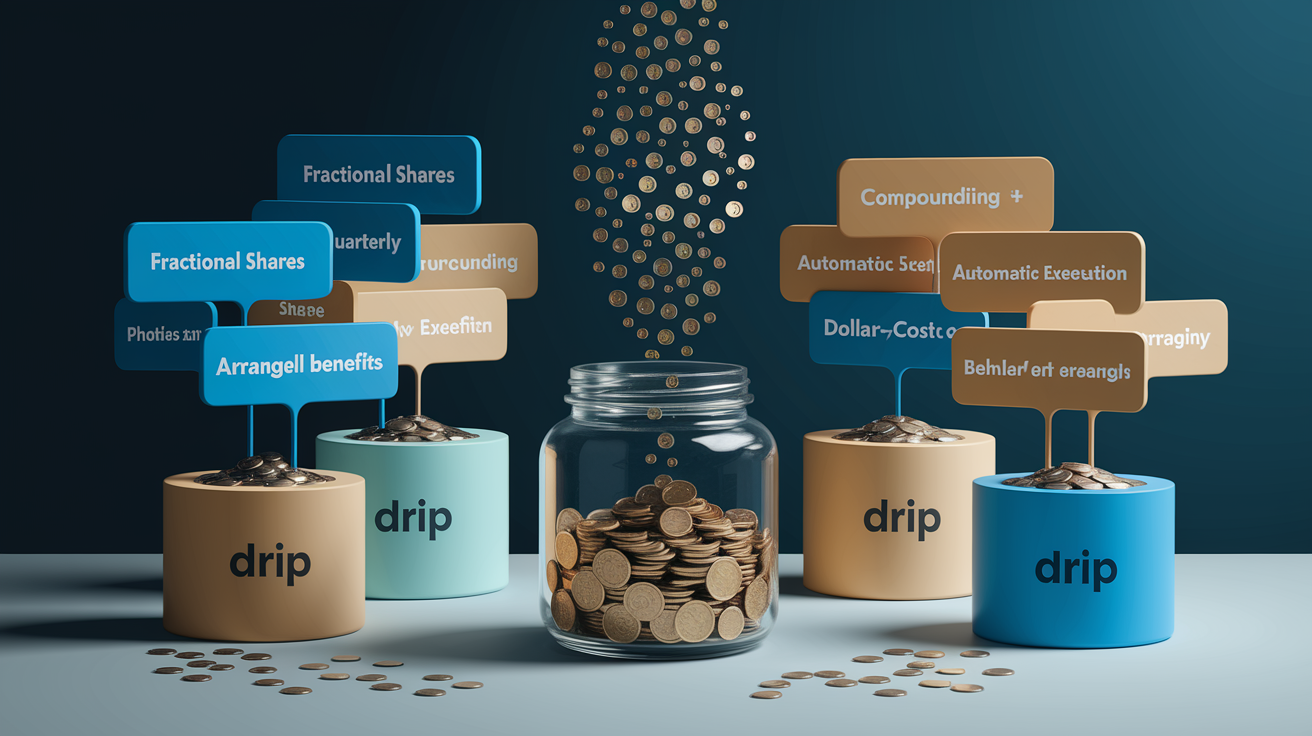
Dividend reinvestment plan stocks share a few defining traits that set them apart from other investing strategies. They allow fractional-share purchases, so every penny of your dividend goes to work buying stock, not sitting idle. Reinvestment happens on a predictable schedule (usually quarterly), locking in a disciplined accumulation pattern regardless of market conditions. The process is entirely automatic once you opt in, removing the risk that you’ll forget to redeploy the cash or decide to spend it instead. Over the long run, these pieces combine to build a much larger position than you could assemble by taking dividends in cash and reinvesting manually.
The compounding behavior is the real engine. Each reinvestment buys shares that pay dividends the next quarter, creating a snowball effect. At the same time, the average-price mechanics of DRIP purchases deliver a form of dollar-cost averaging. When share prices drop, your fixed dividend amount buys more shares. When prices rise, you buy fewer. Over many cycles, this tends to result in a lower average purchase price than if you’d tried to time a single lump-sum entry, and it smooths the psychological ups and downs of market swings.
| Feature | Why It Matters |
|---|---|
| Fractional shares | Every dollar of dividends purchases stock immediately, so no cash sits idle waiting for a full share price. |
| Compounding | New shares generate their own dividends, which buy more shares, creating exponential growth over time. |
| Purchase frequency | Quarterly reinvestment (or monthly for some companies) locks in consistent accumulation without manual intervention. |
| Automatic execution | Removes emotional decision-making and the risk of spending dividend cash on something other than investing. |
| Price averaging | Buying at different prices across cycles smooths volatility and tends to lower your average cost per share over time. |
| Behavioral benefits | Set-and-forget discipline prevents common mistakes like panic selling, dividend spending, or trying to time the market. |
Comparing Broker-Managed DRIPs vs Company-Run Dividend Reinvestment Plans

Not all dividend reinvestment plans operate the same way. The two main types are broker-managed DRIPs and company-run plans, and each comes with its own set of features, costs, and trade-offs. Understanding the difference helps you pick the setup that matches your priorities, whether that’s convenience, cost savings, or the ability to make extra contributions beyond your dividends.
Broker-managed DRIPs are the simpler option for most people. When you enable automatic reinvestment in your brokerage account, the broker buys shares for you on the secondary market around the dividend payment date. The shares show up in your account just like any other holding, and you can sell them instantly if you need to. Most brokers offer this service commission-free, and you can usually reinvest dividends from dozens of stocks with a single account setting. You get three choices most of the time: reinvest all dividends from all current and future holdings, reinvest only the dividends from stocks you currently own, or select specific stocks to reinvest while taking cash from others. This flexibility makes broker DRIPs easy to manage, especially if you own many dividend-paying companies and want to keep everything in one place.
Company-run DRIPs work through a transfer agent, and the shares are often purchased directly from the company’s own reserve rather than the open market. This can unlock a few unique perks. Some companies offer a discount on reinvested shares, usually in the 1% to 5% range, meaning your dividends buy slightly more stock than they would at market price. Many company plans also allow optional cash purchases, so you can add $50, $100, or more each month or quarter on top of your reinvested dividends, often without paying a commission. The downside is administrative overhead. You might need to open a separate account with the transfer agent, track multiple login credentials if you enroll in several company plans, and wait longer to sell shares since the transfer agent may batch transactions rather than execute them immediately. Some plans also require minimum shareholdings, such as owning at least one registered share before you can enroll, and a few charge service fees for optional cash purchases or account maintenance.
Broker-Managed DRIPs
Brokers handle the entire process for you, purchasing shares on the stock market when dividends arrive. Execution is fast. Shares settle into your account within a few business days, and fractional shares are standard. If you want to sell, you click a button and the shares are gone at the current market price, just like any other stock. Most platforms let you toggle reinvestment on and off for each holding individually, so if you want dividends from one stock but cash from another, it takes 30 seconds to adjust. This convenience is especially useful when you hold a mix of stocks, ETFs, and funds across multiple sectors. Everything stays under one roof, your cost basis is tracked automatically, and year-end tax reporting arrives in a single consolidated form. For someone managing a portfolio of ten or twenty dividend payers, broker DRIPs eliminate a lot of paperwork and mental overhead.
Company-Run DRIPs
Company-sponsored plans, sometimes called direct stock purchase programs or DSPs, are administered by a transfer agent such as Computershare or AST. When you enroll, the transfer agent maintains a separate record of your shares, and dividends are reinvested directly through the company. The big draw is the potential for discounted purchases. If a company offers a 3% discount on reinvested dividends and the stock’s trading at $50, your reinvested cash buys shares at $48.50, giving you an instant 3% boost. Optional cash contributions sweeten the deal further. You can set up automatic monthly debits from your bank account to purchase additional shares, sometimes for as little as $25 or $50 per transaction, with no brokerage commission.
The catch is complexity. Each company plan has its own rules, fees, and minimum investment thresholds. Some require you to already own at least one share registered in your name (not held in “street name” by your broker) before you can enroll. Selling shares held with a transfer agent can take longer and may incur fees, and managing accounts across multiple transfer agents means juggling logins, statements, and tax forms from several sources. For someone who wants to concentrate heavily in one or two companies and take advantage of discounted purchases, the effort can be worth it. For someone spreading capital across many stocks, broker DRIPs are usually the cleaner choice.
How to Enroll in Dividend Reinvestment Plan Stocks

Enrolling in a dividend reinvestment plan is straightforward once you understand the eligibility requirements and timing rules. First requirement: you must be a shareholder by the ex-dividend date, which is the cutoff date set by the company to determine who receives the next dividend payment. If you buy shares after the ex-dividend date, you won’t receive that dividend, so there’s nothing to reinvest. Most companies pay dividends quarterly, and the ex-dividend date usually falls one or two business days before the record date. If you’re planning to enroll in a DRIP, make sure you own shares before the ex-dividend date for the next payout.
Timing also matters when activating reinvestment. If you enable DRIP after the ex-dividend date but before the payment date, your enrollment might not take effect until the following dividend cycle. To avoid missing a reinvestment, activate DRIP as soon as you own the shares or at least a few days before the ex-dividend date. Broker platforms usually apply the setting immediately, but company-run plans can take a week or more to process enrollment paperwork, so plan ahead.
-
Confirm shareholder status. Verify that you own shares and that your purchase settled before the ex-dividend date. If you recently bought the stock, check your account to make sure the trade has cleared and the shares appear in your holdings.
-
Identify plan type. Decide whether you want a broker-managed DRIP or a company-run plan. If you already hold the stock in a brokerage account and prefer simplicity, stick with the broker option. If the company offers a discount or you want to make optional cash contributions, research the company’s direct plan through its investor relations page or transfer agent.
-
Check minimum investment requirements. Some company plans require you to own at least one share registered in your name or make an initial minimum investment, often $250 to $500, to enroll. Broker DRIPs usually have no minimums beyond owning the stock.
-
Enroll via broker settings or transfer agent forms. For broker DRIPs, log into your account, navigate to account settings or dividend preferences, and select automatic reinvestment for the stocks you want. For company plans, visit the company’s investor relations page or the transfer agent’s website, download the enrollment form, complete it, and submit it along with any required documentation.
-
Verify tax documentation and cost-basis tracking. Make sure your account has a correct Social Security number or tax ID on file. Reinvested dividends create new cost-basis entries, so confirm that your broker or transfer agent will provide year-end statements showing each reinvestment transaction. If using multiple company plans, keep your own spreadsheet tracking purchase dates, share quantities, and prices.
-
Confirm reinvestment activation before the next ex-dividend date. After enrolling, check your account or contact customer service to verify that the DRIP setting is active. If your first dividend payment is coming up, make sure the enrollment processed in time. If not, the dividend will be paid in cash, and reinvestment will begin with the next payment cycle.
Top Dividend Reinvestment Plan Stocks and Their Long-Term Performance Strengths
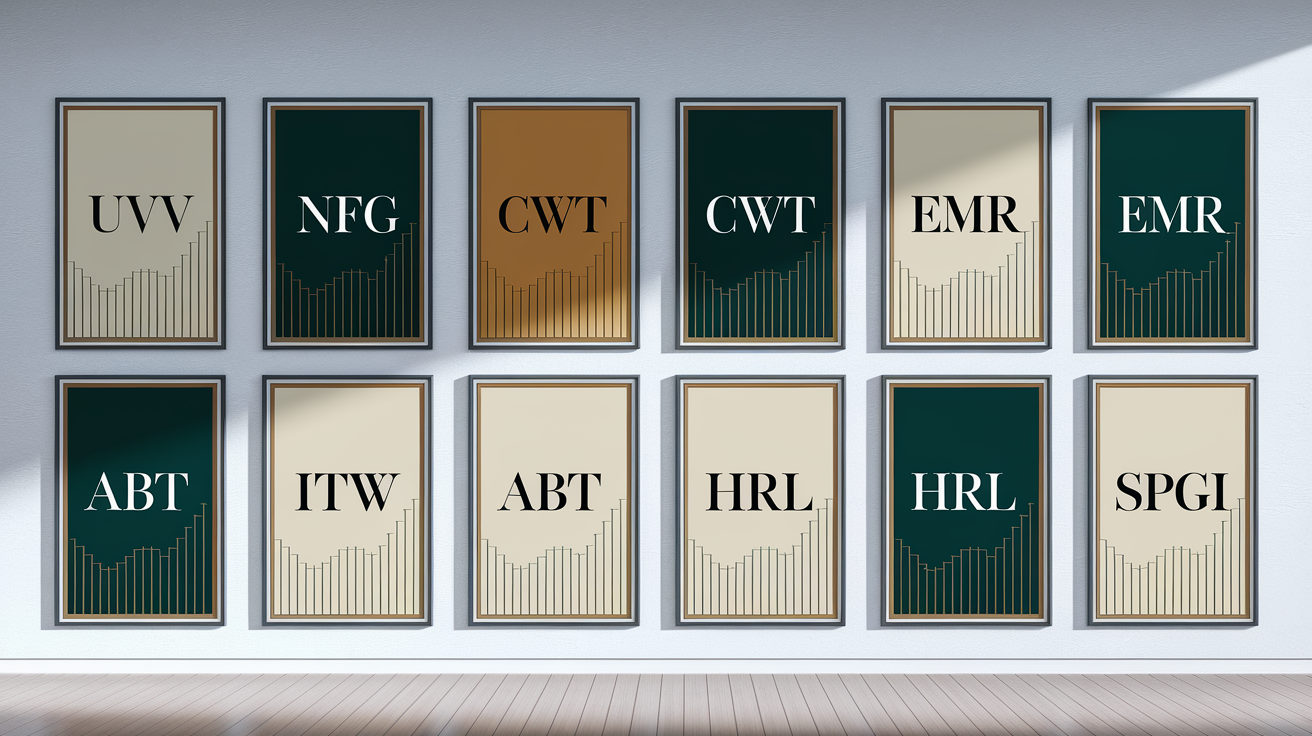
The most attractive dividend reinvestment plan stocks combine consistent dividend growth, financial stability, and DRIP accessibility. Companies with long histories of annual dividend increases, often called Dividend Champions, Dividend Aristocrats, or Dividend Kings, tend to offer DRIP-friendly programs because they understand that reinvestment attracts long-term, patient shareholders. These companies span utilities, industrials, consumer staples, financials, and healthcare, providing diversification across sectors that perform differently in various economic conditions. A portfolio of DRIP stocks built around high-quality dividend growers can deliver steady compounding with lower volatility than growth stocks or speculative plays.
Dividend Champions are companies that have raised their dividends for at least 25 consecutive years, a record that signals financial discipline, pricing power, and the ability to generate cash through recessions and expansions. Many of these companies offer direct purchase plans or participate in broker-operated DRIPs, making reinvestment easy and cost-effective. Expected five-year annual returns for top DRIP-compatible companies range from around 8% on the conservative end to 20% for high-growth dividend payers, though those projections depend on valuation, earnings growth, and payout sustainability. Stability across sectors is key. Utilities like National Fuel Gas provide essential services with regulated returns, industrials like Emerson Electric benefit from long product cycles and global infrastructure demand, consumer staples like Hormel Foods deliver recession-resistant revenue, and financials like S&P Global grow as capital markets expand.
Eight well-known companies with strong DRIP access and notable dividend metrics:
Universal Corporation (UVV) has 55 consecutive years of dividend increases, generated $861 million in revenue in the most recent quarter with adjusted earnings per share of $1.35, operates in the tobacco supply chain with global diversification.
National Fuel Gas (NFG) has 55 years of dividend increases, saw production grow 12% and earnings per share surge 24% in the latest fiscal quarter from $1.66 to $2.06, integrated natural gas utility serving the Northeast and Appalachian regions.
California Water Service (CWT) has 58 consecutive years of dividend increases, serves 2 million people across California and neighboring states, generated $311 million in revenue in the most recent quarter with $1.03 earnings per share.
Emerson Electric (EMR) has a 69-year dividend increase streak as a Dividend King, generated $4.35 billion in revenue in the latest quarter with adjusted earnings per share of $1.46, leading automation and process control technology.
Illinois Tool Works (ITW) is a Dividend King and Aristocrat, generated $15.9 billion in revenue last year, reported the most recent quarter revenue of $4.1 billion rising 4% year-over-year, diversified industrial conglomerate with engineered fasteners, welding equipment, and food equipment.
Abbott Laboratories (ABT) has 54 years of dividend increases, operates in 160 countries with 114,000 employees, generated $44 billion in 2025 sales, raised the quarterly dividend 6.8% to $0.63 in December 2025.
Hormel Foods (HRL) is a Dividend King with 60 consecutive years of increases, $13 billion market cap and $12 billion annual revenue, operates in 80 countries, reported the most recent quarter adjusted earnings per share of 32 cents and revenue of $3.19 billion up 1.6%.
S&P Global (SPGI) has 52 consecutive years of dividend increases as a Dividend King, generated over $15 billion in revenue, paid dividends continuously since 1937, reported the most recent quarter revenue of $3.92 billion up 9.2% year-over-year with adjusted earnings per share of $4.30.
For additional examples and current metrics like price-to-earnings ratios, dividend yields, and payout ratios, the full list of Dividend Champions is a useful resource at The Best DRIP Stocks.
Tax Implications of Reinvesting Dividends in DRIP Stocks

Reinvesting dividends doesn’t eliminate your tax liability. Even though you never see the cash hit your bank account, the IRS treats reinvested dividends as taxable income in the year they’re paid. This applies to taxable brokerage accounts. If you’re holding DRIP stocks in a tax-advantaged account like an IRA or 401(k), reinvested dividends grow tax-deferred or tax-free depending on the account type, and you don’t owe anything until you take distributions in retirement (or never, in the case of a Roth IRA).
In a taxable account, the tax rate on your reinvested dividends depends on whether they’re classified as qualified or nonqualified. Qualified dividends, which come from U.S. corporations or qualified foreign companies and meet holding-period requirements, are taxed at long-term capital gains rates of 0%, 15%, or 20%, depending on your taxable income and filing status. For most middle-income folks, the rate is 15%. Nonqualified dividends, also called ordinary dividends, are taxed at your regular income tax rate, which ranges from 10% to 37%. Most dividends from common stocks held for more than 60 days around the ex-dividend date qualify for the lower rates, but dividends from REITs, master limited partnerships, and some foreign companies often don’t.
Five key tax considerations for DRIP investors:
Qualified dividend tax rates of 0%, 15%, or 20% apply when dividends meet IRS holding-period and company requirements, significantly lowering the tax bite compared to ordinary income rates.
Nonqualified dividend tax rates range from 10% to 37%, matching your marginal income tax bracket, and apply to dividends that don’t meet qualified criteria or come from pass-through entities like REITs.
Stock dividend exception applies when a company pays dividends in additional shares without offering a cash alternative. Those stock dividends generally aren’t taxable until you sell the shares, though this is rare with most DRIPs.
Recordkeeping burden increases with each reinvestment transaction because every purchase creates a new cost-basis entry. At tax time, you’ll need to report each sale’s gain or loss, and tracking dozens or hundreds of micro-purchases can be tedious without good software or brokerage support.
Reinvestment tax timing means you owe taxes in the year the dividend is paid, even if you reinvest it immediately and don’t touch the cash. This can create a cash-flow pinch if you’re reinvesting large dividends but need liquidity to pay the tax bill, especially in high-income years.
Risks and Limitations of Dividend Reinvestment Plan Stocks

Dividend reinvestment plan stocks aren’t risk-free, and the automatic nature of DRIPs can amplify company-specific risk if you’re not paying attention. When you reinvest dividends, you’re concentrating more and more capital into the same company every quarter. If that company’s business deteriorates, cuts its dividend, or faces a permanent decline, reinvesting along the way means you bought more shares at higher prices before the fall. A company that performs well over decades will multiply your wealth through reinvestment. But a company that stumbles will multiply your losses. Diversification across multiple DRIP stocks, sectors, and asset classes is the most effective way to manage this concentration risk.
Liquidity is another consideration. Shares held in company-run DRIPs may take longer to sell than shares in a brokerage account. Transfer agents often batch sell orders and execute them on specific days rather than immediately, and you might not receive the exact market price you see when you place the order. If you need to liquidate shares quickly for an emergency or to rebalance your portfolio, the delay can be inconvenient or costly. Broker-held DRIP shares don’t have this problem since you can sell them instantly, but the temptation to trade frequently can undermine the long-term compounding that makes DRIPs work in the first place. Best approach: only reinvest dividends in companies you plan to hold for years, if not decades, and keep a separate cash cushion outside your DRIP holdings to cover short-term needs.
Administrative complexity can also become a burden, especially if you enroll in multiple company-run plans. Each transfer agent has its own website, login, fee structure, and statement format. At tax time, you’ll receive separate 1099 forms from each plan, and tracking cost basis across dozens of small reinvestment purchases becomes tedious. If you make optional cash contributions in addition to reinvested dividends, the recordkeeping multiplies. For someone managing ten or more DRIPs, the paperwork and mental overhead can outweigh the benefits of fractional-percentage discounts or commission savings. This is why many experienced DRIP investors consolidate everything into a single brokerage account with automatic reinvestment enabled, accepting slightly higher purchase prices in exchange for vastly simpler administration.
Using Dividend Reinvestment Plan Stocks for Long-Term Wealth Building

Dividend reinvestment plan stocks are one of the most effective tools for long-term wealth accumulation because they harness the power of compounding without requiring active management or perfect market timing. Reinvested dividends historically account for the majority of total stock market returns over multi-decade periods. A $10,000 investment in the S&P 500 in 1960 would’ve grown to approximately $1,035,827 by the end of 2024 from price appreciation alone. With dividends reinvested, that same $10,000 would be worth over $6.4 million, according to data from Morningstar and Hartford Funds. The difference between $1 million and $6.4 million is the compounding effect of reinvested dividends buying more shares, which then paid more dividends, which bought even more shares, decade after decade.
This makes DRIPs particularly well-suited for retirement planning and other long-term goals where the timeline is measured in decades rather than months or years. The passive nature of reinvestment removes the burden of deciding when to deploy cash or how much to add each period. As long as you select financially sound companies with durable competitive advantages and histories of consistent dividend growth, the compounding takes care of itself. The longer your time horizon, the more powerful the effect. An investor in their 30s or 40s who reinvests dividends consistently until retirement can build substantial wealth without needing to be a stock-picking genius or time the market. The strategy rewards patience and consistency, not cleverness.
Suitability for retirement planning is especially strong when you pair DRIPs with tax-advantaged accounts like IRAs. In a traditional or Roth IRA, reinvested dividends compound without triggering annual tax bills, allowing your wealth to grow faster than it would in a taxable account where you pay taxes on dividends every year even if you reinvest them. Once you reach retirement, you can switch from reinvestment mode to cash-distribution mode, using the dividends to supplement Social Security, pensions, or other income sources. By that point, your portfolio of quality dividend growers may be generating meaningful income without requiring you to sell shares.
Four practical behaviors for maximizing long-term results with DRIP stocks:
Regular contributions beyond reinvested dividends accelerate compounding. Adding $100, $200, or $500 per month to purchase additional shares magnifies the snowball effect, especially in the early years when your position is small and every new share has decades to compound.
Long time horizon is essential because compounding works slowly at first and then accelerates. The difference between 10 years and 30 years isn’t linear, it’s exponential, so the best results come from starting early and holding through multiple market cycles.
Focusing on quality means choosing companies with strong balance sheets, consistent earnings growth, and long dividend-increase streaks. A company that raises its dividend 6% per year for 30 years will deliver far better results than a high-yielding stock that cuts its payout halfway through.
Avoiding emotional decisions during market downturns protects your compounding. When stocks drop and dividends reinvest at lower prices, you’re buying more shares, which sets up larger gains when the market recovers, so resist the urge to stop reinvesting or sell during scary periods.
Final Words
in the action we showed how DRIPs automatically reinvest dividends, how fractional shares speed up compounding, and the differences between broker-managed and company-run plans.
We also covered simple enrollment steps, tax rules, reinvestment downsides like reduced liquidity and concentration risk, and practical uses of DRIPs for long-term saving.
If you want to start, try enabling automatic reinvestment on a few dividend-paying names and track cost basis. Using dividend reinvestment plan stocks can quietly boost growth over decades, with steady steps that add up.
FAQ
Q: Is it a good idea to reinvest dividends in stocks?
A: Reinvesting dividends in stocks is a smart way to grow wealth over time because dividends buy more shares and boost compounding. Tradeoff: less cash now and added company concentration risk.
Q: How much money do I need to make $1000 a month in dividends?
A: To make $1,000 a month in dividends you need about $12,000 a year in dividend income; at a 3% yield that’s ~$400,000, 4% about $300,000, 5% about $240,000.
Q: What are the best dividend reinvestment stocks?
A: The best dividend reinvestment stocks are reliable, dividend-growing companies that offer DRIP access; common examples include UVV, NFG, CWT, EMR, ITW, ABT, HRL, and SPGI—check yield and history.
Q: How much money do I need to invest to make $3,000 a month in dividends?
A: To make $3,000 a month in dividends you need about $36,000 a year; at a 3% yield that’s roughly $1.2 million, 4% about $900,000, 5% about $720,000.