

Think ETFs are tax-free? Not quite, but they can be far more tax-friendly than mutual funds.
This post explains how ETFs usually avoid big capital gains through in-kind swaps, how dividends and other distributions get taxed, and which tax forms your broker will send.
You’ll learn quick rules to spot tax-efficient funds and simple steps to keep records straight so you’re not surprised at filing time.
Thesis: knowing these basics gives you more control over when and how you pay tax on your ETF money.
How ETF Taxes Work: The Essentials

ETF tax efficiency means you pay less compared to other investments doing the same job. Most ETFs are built to minimize the capital gains you owe while you’re still holding the shares. You only pay tax on dividends or interest the fund throws off during the year, plus any gains the fund decides to distribute. When you finally sell your shares, you owe tax on the profit between what you paid and what you got. That sale is the main taxable moment you actually control, giving you more flexibility than a traditional mutual fund that might dump distributions on you every December whether you like it or not.
ETFs pull this off through something called in‑kind redemption. When big traders (authorized participants) want to cash out, the fund hands them a basket of the actual stocks or bonds inside instead of selling those securities for cash. That swap doesn’t trigger a taxable sale inside the fund. So you and the other shareholders don’t get smacked with a surprise capital gains bill at year end. Most broad‑market stock ETFs have gone years without distributing any capital gains at all. Almost no actively managed mutual fund can say the same.
Your tax job is pretty simple. Every year you’ll get a Form 1099‑DIV from your broker showing the dividends and any capital gains the ETF paid you. If you sold shares during the year, you’ll also get a Form 1099‑B listing the sale proceeds and your cost basis (what you originally paid). You copy those numbers onto Schedule D of your tax return to figure out what you owe. Even if you reinvest every dividend automatically, the IRS still treats those payments as taxable income in the year you receive them. Keep records of what you paid for your shares and any adjustments from reinvested distributions.
Turnover Ratios and Their Impact on ETF Tax Efficiency

Turnover measures how much of the fund’s portfolio trades in a year. A 50 percent turnover ratio means the manager replaced half the holdings over 12 months. Lower turnover generally means fewer taxable sales inside the fund, which keeps capital gains distributions small or zero. Index ETFs tracking the S&P 500 often have turnover below 5 percent because they only buy or sell when the index changes or when cash flows in. That low activity is one reason these funds stay tax friendly year after year.
Active ETFs that pick stocks or time the market can show turnover above 100 percent. The entire portfolio flips more than once a year. Each time the manager sells a winner, the fund realizes a capital gain that has to be distributed to shareholders by December. High turnover doesn’t automatically wreck tax efficiency if the manager uses in‑kind redemptions to offload appreciated shares or harvests losses to offset gains, but it does raise the risk of year‑end surprises. Bond ETFs with monthly rebalancing or sector‑rotation strategies can also show higher turnover, though many still distribute minimal gains because bonds often mature at par instead of being sold at a profit.
Check the fund’s prospectus or fact sheet for the turnover ratio. Anything under 25 percent signals a buy‑and‑hold approach. Above 75 percent suggests frequent trading that may generate taxable events even if you never sell a share.
Understanding Dividend Types: Qualified vs. Non‑Qualified
Dividends come in two tax flavors. Qualified dividends get the same low rates as long‑term capital gains: 0 percent, 15 percent, or 20 percent depending on your taxable income. Non‑qualified dividends (also called ordinary dividends) are taxed at your regular income tax rate, which can run as high as 37 percent federally. An ETF filled with U.S. stocks usually pays mostly qualified dividends. An ETF holding real estate investment trusts or bonds will pay mostly non‑qualified income because REITs and bond interest don’t qualify for the preferential rate.
Whether a dividend qualifies depends on IRS holding‑period rules. You have to own the ETF for more than 60 days during the 121‑day window centered on the ex‑dividend date, and the company paying the dividend has to be a U.S. corporation or a qualifying foreign firm. The ETF’s custodian tracks this automatically and reports the breakdown on your 1099‑DIV, so you don’t have to count days yourself. If you buy and sell frequently or hold an ETF for only a few weeks around a dividend, those payments will likely be classified as non‑qualified.
Four factors that determine qualification:
Holding period: you need to hold the ETF shares more than 60 days in the 121‑day window around the ex‑dividend date.
Source: the underlying stocks have to be U.S. corporations or qualified foreign entities.
Type of security: REIT dividends and bond interest almost never qualify.
Trading activity: rapid turnover or hedging strategies can disqualify otherwise eligible dividends.
ETF Distribution Categories and Their Tax Effects
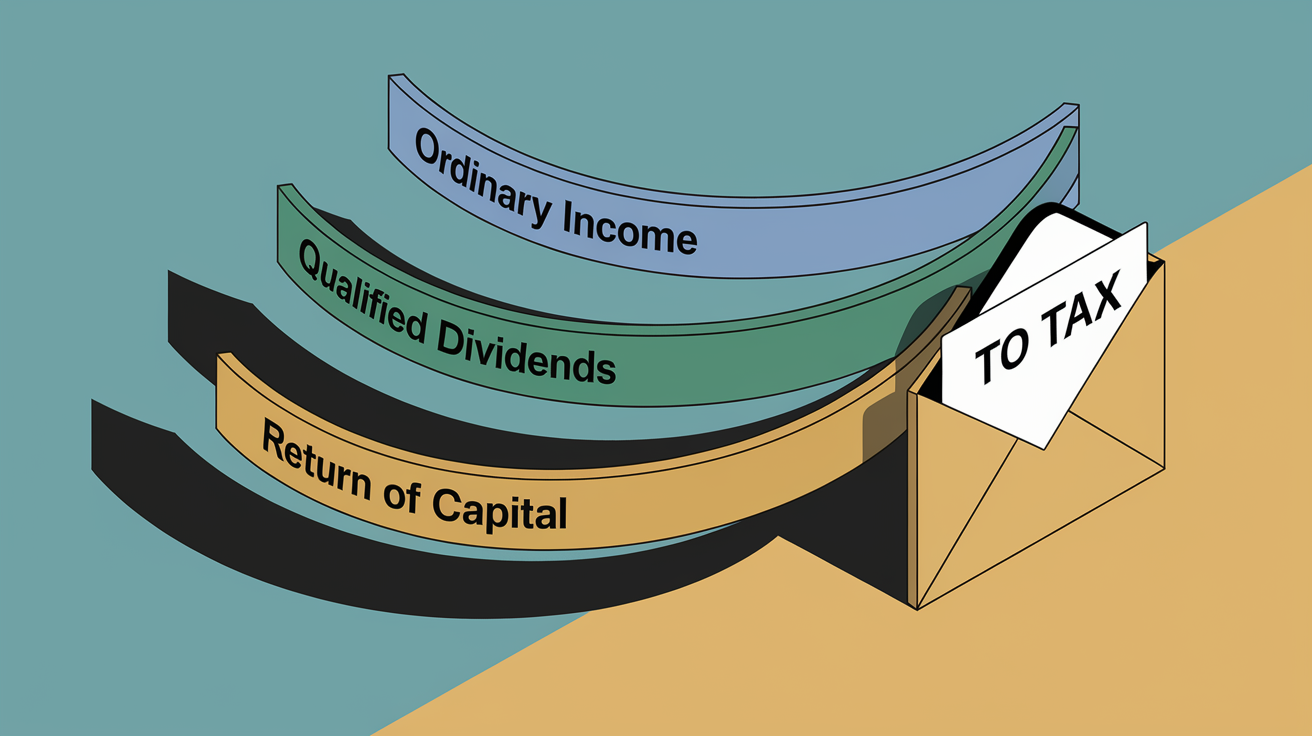
Ordinary income distributions include non‑qualified dividends and interest from bonds. These payments are taxed at your top marginal rate, up to 37 percent, and you owe tax in the year you receive them even if you reinvest. Bond ETFs holding Treasuries, corporates, or mortgage‑backed securities pay interest monthly or quarterly. Every dollar counts as ordinary income. REIT ETFs also distribute rental income and short‑term gains as ordinary income, making them less tax efficient in a taxable account than a stock index fund.
Qualified dividends and long‑term capital gains distributions get preferential rates. If your taxable income sits below the thresholds (roughly $48,000 for single filers and $96,000 for married couples in recent years), qualified dividends are taxed at 0 percent. Above those levels the rate steps to 15 percent, then 20 percent at the top bracket. Most broad U.S. stock ETFs pay a mix that’s 80 percent to 100 percent qualified, so you keep more of what the fund distributes.
Return of capital (ROC) isn’t taxed when you receive it. Instead, ROC lowers the cost basis of your shares, which increases the capital gain you’ll owe when you eventually sell. If you bought 100 shares at ten dollars each and the fund pays one dollar per share as ROC, your new basis drops to nine dollars per share. That means an extra dollar of taxable gain per share whenever you sell. ETFs using covered‑call strategies or certain commodity structures sometimes generate ROC. Your 1099‑DIV will show it as a separate line item so you can adjust your records.
Capital Gains Mechanics Inside ETFs

Capital gains happen when the fund sells a security for more than it paid. In a traditional mutual fund, redemptions force the manager to sell stocks to raise cash, often realizing gains that get distributed to all shareholders. ETFs sidestep this by letting authorized participants redeem shares in‑kind. The fund hands over actual stocks instead of cash. That exchange isn’t a sale for tax purposes. The authorized participant may later sell those stocks, but that tax bill belongs to them, not to you or the other ETF shareholders.
Even with in‑kind redemptions, an ETF can still realize gains if the portfolio manager decides to sell a position. Rebalancing, index changes, or a shift in strategy might require selling appreciated holdings. When that happens, the fund has to distribute at least 90 percent of the net realized gains to shareholders by year end to maintain its tax status as a regulated investment company. Broad‑market equity ETFs rarely hit this threshold because turnover stays low and in‑kind activity handles most flows. Niche funds are different.
Commodity ETFs, currency ETFs, and some bond funds generate more frequent capital gains. Futures‑based funds must mark contracts to market every December, realizing paper gains or losses that flow through to investors. Bond ETFs that actively trade credit or duration can realize gains when rates fall and prices rise. Precious‑metals funds structured as grantor trusts may treat gains as collectibles, taxed at a maximum 28 percent long‑term rate instead of the usual 20 percent. Always check the fund’s structure and historical distribution pattern before assuming zero capital gains.
ETF Tax Forms: 1099‑DIV, 1099‑B, and Schedule D

You’ll receive a 1099‑DIV from your brokerage by mid‑February (sometimes earlier) listing every ETF distribution you received in the prior calendar year. Box 1a shows total ordinary dividends. Box 1b breaks out the portion that qualifies for lower rates. Box 2a reports long‑term capital gain distributions, and box 2b shows any unrecaptured Section 1250 gain (rare for ETFs but common in REIT funds). Box 3 lists non‑dividend distributions, which is return of capital that lowers your basis. If the ETF is structured as a partnership, you’ll get a Schedule K‑1 instead of a 1099‑DIV, often weeks later, complicating early filing.
Form 1099‑B arrives if you sold any ETF shares during the year. It shows the sale date, the proceeds (what you received), and your cost basis (what you paid, adjusted for reinvested dividends and return of capital). Brokers now report cost basis directly to the IRS for shares bought after 2011, but you’re responsible for tracking basis on older shares and making adjustments. If you switched brokers or transferred shares, double‑check that the receiving broker has the correct basis. Missing or incorrect basis can trigger an IRS notice or cause you to overpay tax.
You summarize everything on Schedule D and the attached Form 8949. Short‑term gains and losses (from shares held one year or less) go in Part I. Long‑term gains and losses (more than one year) go in Part II. The totals flow to your Form 1040, where they combine with your other income to determine your final tax bill. Keep copies of all 1099 forms and your own purchase records in case you need to prove basis or holding period later.
| Form | Key Information |
|---|---|
| 1099‑DIV | Ordinary dividends, qualified dividends, capital gain distributions, return of capital |
| 1099‑B | Sale proceeds, cost basis, acquisition and sale dates |
| Schedule D | Summary of short‑term and long‑term capital gains and losses for your tax return |
Wash Sale Rules When Trading ETFs

The wash sale rule blocks you from claiming a loss if you buy a substantially identical security within 30 days before or after you sell at a loss. The IRS added this rule to stop investors from harvesting a tax loss on paper while keeping the same market position. If you trigger a wash sale, you can’t deduct the loss in the current year. Instead, the disallowed loss gets added to the cost basis of the replacement shares, deferring the tax benefit until you sell those new shares for good.
Two ETFs can be substantially identical even if they have different tickers and issuers. An ETF tracking the S&P 500 from Vanguard and one from BlackRock both deliver nearly identical returns and exposure. Selling one at a loss and immediately buying the other will likely trigger the rule. The same applies to funds tracking the Nasdaq‑100, the Russell 2000, or any other narrow index. Broader differences, such as swapping a total U.S. stock market ETF for an S&P 500 ETF, may pass because the small‑cap sleeve in the total market fund changes the risk and return profile enough to avoid “substantial” identity. The IRS has never published a bright‑line test, though.
The 30‑day window runs in both directions. If you buy shares on December 15 and sell at a loss on January 10, that’s a wash sale because the purchase happened within 30 days before the sale. If you sell on December 15 and repurchase on January 5, that’s also a wash sale. To harvest a loss cleanly, wait 31 calendar days after the sale before buying back the same or a substantially identical ETF. Or buy a different fund immediately and stay in a similar but not identical position.
Tax‑Loss Harvesting Strategies with ETFs

Tax‑loss harvesting means selling an investment at a loss to offset capital gains elsewhere in your portfolio or to deduct up to three thousand dollars against ordinary income each year. ETFs make this simple because you can sell one fund in the morning and buy a similar but not identical replacement in the afternoon, keeping your market exposure while locking in the tax benefit. Losses you can’t use this year carry forward indefinitely. Even a small harvest today can save tax dollars in future years when you sell winners.
Here’s the basic process. First, review your brokerage statement to spot any ETFs trading below your purchase price. Compare each position’s current value to your cost basis (including reinvested dividends). If you see a meaningful loss, at least a few hundred dollars, it may be worth harvesting. Second, sell the shares and realize the loss. Confirm with your broker that you’re selling specific tax lots if you have multiple purchase dates, so you capture the largest loss. Third, immediately buy a different ETF that covers the same general market but isn’t substantially identical. For example, swap an S&P 500 ETF for a total U.S. market ETF, or trade a large‑cap growth fund for a broad large‑cap blend. Fourth, wait at least 31 days before buying back the original ETF if you prefer it. Or simply hold the replacement long term.
Common mistakes include buying the replacement too soon (triggering a wash sale), forgetting that the loss adds to the new position’s basis (deferring rather than eliminating tax), and harvesting losses in a tax‑deferred account like an IRA where the tax benefit is wasted. Track your trades carefully and avoid repurchasing the identical fund in another account, such as a spouse’s brokerage or a 401(k). The IRS applies wash sale rules across all accounts you control.
Final Words
You learned how ETF taxes work, why low turnover helps, the difference between qualified and non-qualified dividends, the types of distributions, how in-kind moves cut capital gains, and which tax forms and wash sale rules matter. We also covered practical tax-loss harvesting steps.
When evaluating etf tax efficiency dividends distributions and tax reporting, keep good records, watch turnover, and use simple replacements when harvesting losses. Small, steady steps can lower tax surprises and keep your investing on track.
FAQ
Q: What makes ETFs more tax-efficient than mutual funds?
A: ETFs are more tax-efficient than mutual funds because they use in-kind creation and redemption to avoid most capital gains distributions, though you still owe tax on dividends and any distributions the fund makes.
Q: How are ETF distributions taxed?
A: ETF distributions are taxed based on type: qualified dividends get lower long-term capital gains rates, non-qualified dividends at ordinary income rates, capital gain distributions as capital gains, and return of capital lowers your cost basis.
Q: What tax forms do ETF investors receive and why?
A: ETF investors generally receive Form 1099-DIV for dividends and capital gain distributions, Form 1099-B for share sales and proceeds, and use Schedule D to summarize gains and losses on the tax return.
Q: How does portfolio turnover affect ETF taxes?
A: Portfolio turnover affects ETF taxes because higher turnover creates more taxable events; ETFs often reduce realized gains with in-kind redemptions, while high-turnover active ETFs may generate more taxable distributions.
Q: When do ETFs still generate capital gains?
A: ETFs still generate capital gains when the fund sells appreciated securities to meet redemptions, during high turnover, or in sectors like commodities and bonds that force more taxable trades.
Q: What’s the difference between qualified and non-qualified dividends in ETFs?
A: The difference is that qualified dividends face lower long-term capital gains rates, while non-qualified dividends are taxed at ordinary income rates; ETFs report which type is passed through to you.
Q: What is a return of capital and how does it affect taxes?
A: A return of capital is a distribution that is not immediately taxable income; it reduces your ETF cost basis, delaying tax until you sell and changing the eventual gain or loss calculation.
Q: How do wash sale rules apply to ETF trading?
A: Wash sale rules apply to ETF trading by disallowing a loss if you buy a substantially identical security within 30 days; ETFs tracking the same index can trigger the rule, so choose a different fund when replacing positions.
Q: How can I use ETFs for tax-loss harvesting?
A: You can use ETFs for tax-loss harvesting by selling a losing ETF to realize a loss and buying a similar but not substantially identical ETF to keep exposure; losses offset gains and up to $3,000 of ordinary income.
Q: What should I track for tax filing with ETFs?
A: You should track dividend types and dates, cost basis, trade confirmations, sales proceeds, and 1099 forms so you can match entries on 1099-DIV and 1099-B for accurate reporting.