

Think $1,000 can’t move the needle? Think again.
Held ten years, $1,000 grows to about $1,629 at 5%, $1,967 at 7%, and $2,594 at 10% thanks to compound returns (your gains earning gains).
This post gives a simple calculator and clear steps so you can see how rate, compounding frequency, fees, taxes, and monthly contributions change those totals.
By the end you’ll know realistic outcomes and a small plan you can start this week.
How 000 Grows Over 10 Years at 5%, 7%, and 10%
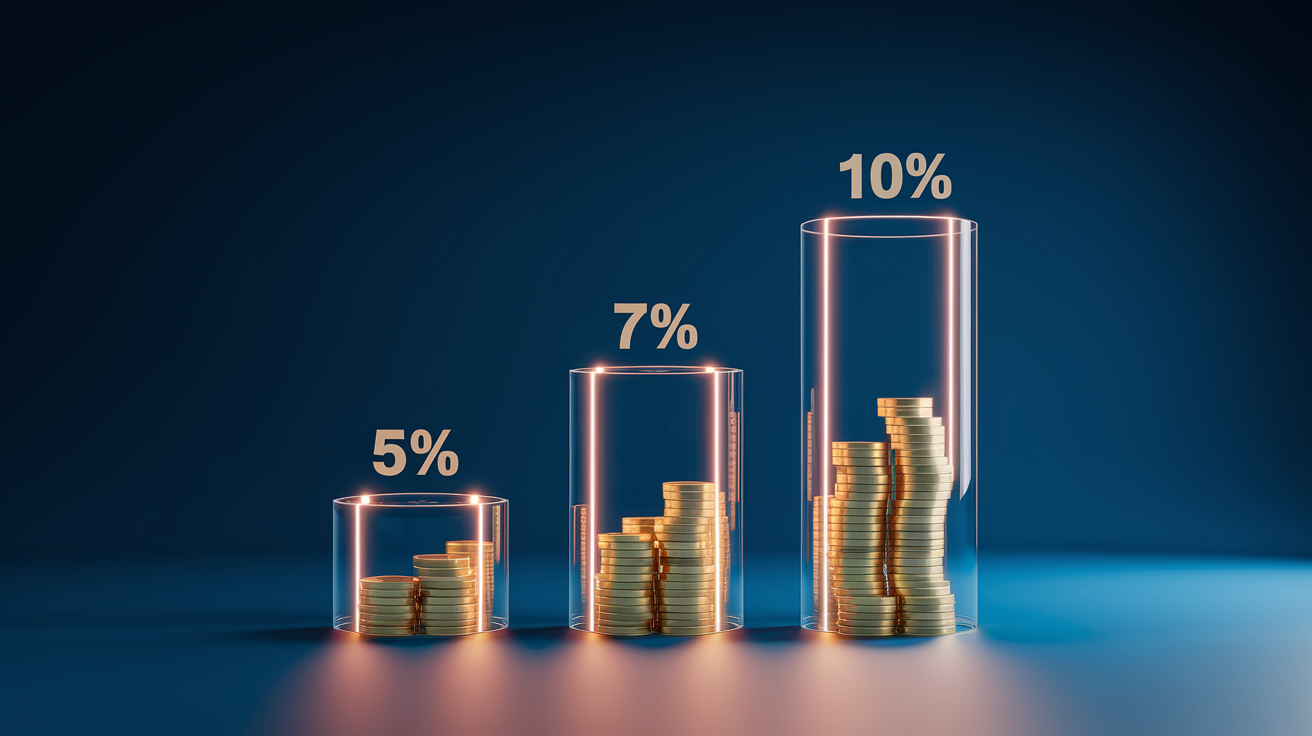
A $1,000 investment held for 10 years grows to $1,629 at 5% annual returns, $1,967 at 7%, and $2,594 at 10%. These numbers reflect yearly compounding where each year’s gains join the principal and earn their own returns the next year. The longer you wait, the bigger the jump.
Historical market data shows the S&P 500 averaging roughly 9.5% per year over nearly a century. That sits between the 7% and 10% scenarios in the table below, offering a realistic middle ground for long-term stock investors. Conservative savers or bond portfolios often land closer to 5%, while riskier portfolios sometimes hit or exceed 10% in strong decades.
| Initial Amount | Rate | Final Value After 10 Years | Notes |
|---|---|---|---|
| $1,000 | 5% | $1,629 | Conservative bond or savings rate |
| $1,000 | 7% | $1,967 | Common rule of thumb estimate for balanced portfolios |
| $1,000 | 10% | $2,594 | Near long term S&P 500 average; higher risk |
The gap between 5% and 10% might look small at first glance. But over 10 years, that difference between the high and low scenario is nearly a thousand dollars. That spread grows even wider if you start with more money or keep adding to it each month.
Core Concepts Behind Compound Growth

Compounding means your returns earn their own returns. Picture a $100 deposit earning 6% in year one. You end up with $106. In year two, that full $106 earns another 6%, bringing you to about $112. Year three applies 6% to $112, landing you near $119. Each cycle, the base gets bigger, so the dollar amount added each year climbs even if the percentage stays the same.
This acceleration is why time matters so much. The first few years add modest dollars. By year eight or nine, each 6% bump delivers several times what it did in year one. The final year of a 10 year stretch often contributes more growth than the first two or three years combined.
Starting early or holding on during downturns gives compound growth room to stack gains on gains. That’s where the real distance shows up between someone who invests for three years versus someone who hangs in for ten.
Applying the Compound Interest Formula to 10 Year Calculations

The compound interest formula is A = P(1 + r/n)^(n·t), where A is the ending amount, P is the starting principal, r is the annual rate as a decimal (so 7% becomes 0.07), n is the number of times interest compounds per year, and t is the number of years. For a simple annual compounding scenario, n equals 1. If you’re working with monthly compounding, n becomes 12. Daily compounding sets n to 365.
Step by Step Calculation Example
Here’s how you calculate the future value of $1,000 at 7% compounded annually for 10 years:
Plug in the numbers: A = 1,000(1 + 0.07/1)^(1·10)
Simplify inside the parentheses: (1.07)^10 = 1.967
Multiply by principal: 1,000 × 1.967 = $1,967
If you switched to monthly compounding, you’d use n = 12, making the formula A = 1,000(1 + 0.07/12)^(12·10). The exponent becomes 120 instead of 10, and the inside parentheses shrink slightly because you’re dividing 0.07 by 12. The final value inches up to around $2,001. The more often compounding happens, the more growth you capture, though the difference between monthly and annual is usually just a few percent over a decade.
Rate of Return Scenarios and Their Impact on 10 Year Outcomes

The rate you earn shapes your final balance more than almost any other input. A 5% return feels safe and steady, especially in a bond heavy portfolio or a high yield savings account. A 10% return sits near the S&P 500’s long term average of 9.5%, but it carries the risk of big short term drops. A 7% return splits the middle, often cited as a reasonable assumption for a balanced mix of stocks and bonds over many decades.
Using the Rule of 72, a 7% return doubles your money roughly every 8 years (72 ÷ 7 ≈ 10.3, but in practice it’s closer to 10 years). At 10%, doubling happens in about 7.2 years. At 5%, it takes roughly 14 years. Over a full decade, those differences stack up fast.
| Rate | Approx Value After 10 Years (per $1,000) | Notes |
|---|---|---|
| 5% | $1,629 | Lower volatility, slower growth |
| 7% | $1,967 | Common planning estimate for balanced portfolios |
| 10% | $2,594 | Higher potential, higher short term swings |
Even a one or two percentage point shift changes the outcome by hundreds of dollars on just a $1,000 start. The same effect scales up if you start with $10,000 or $50,000. That’s why matching your expected return to your actual holdings matters. If you’re in a savings account earning 4%, assuming 10% will leave you disappointed. If you’re in a stock heavy portfolio, assuming 5% might make you over save or under invest.
Monthly Contributions and Compounded Growth Over 10 Years

Adding a fixed amount each month turns a single lump sum into a stream of new deposits that each begin compounding on their own timeline. A $1,000 starting balance at 7% annual returns grows to $1,967 in 10 years with no additional money. If you add $50 every month over the same period, you deposit an extra $6,000 in total, but the final balance jumps to around $9,156. The interest earned on those monthly deposits alone contributes over $2,000.
This is how regular investing builds wealth faster than most people expect. Each monthly deposit starts earning returns immediately. The earlier deposits have more time to compound than the later ones. A deposit made in month one compounds for nearly 10 full years, while a deposit made in month 119 only compounds for one month before the decade ends.
Example: Adding $50 or $100 Per Month
Here’s how monthly contributions change the 10 year outcome for a $1,000 starting balance:
At 5% with $50 monthly: final balance around $8,017 (total deposits $7,000, interest earned roughly $1,017)
At 7% with $50 monthly: final balance around $9,156 (total deposits $7,000, interest earned roughly $2,156)
At 10% with $100 monthly: final balance around $21,037 (total deposits $13,000, interest earned roughly $8,037)
Doubling your monthly contribution from $50 to $100 doesn’t quite double the final balance, but it moves the needle significantly. The compounding effect on contributions is why people who start small and stay consistent often end up with more than people who make one big deposit and walk away.
Compounding Frequency and Its Effect on 10 Year Growth

Compounding frequency describes how often your gains get added to the principal and start earning their own returns. Annual compounding happens once per year. Monthly compounding happens 12 times per year. Daily compounding happens 365 times per year. The more frequent the compounding, the more opportunities gains have to snowball.
The difference between annual and daily compounding is usually small, a few percent over 10 years, but it adds up. A $1,000 deposit at 7% compounded annually becomes $1,967 after 10 years. The same deposit compounded daily becomes around $2,013. That extra $46 isn’t life changing, but on a $10,000 starting balance it becomes $460, and on larger amounts it keeps scaling.
| Frequency | Compounding Periods | Effect After 10 Years |
|---|---|---|
| Annual | 1 per year | Baseline growth, simplest calculation |
| Monthly | 12 per year | Slightly higher than annual, common in savings accounts |
| Daily | 365 per year | Highest growth, typical in high yield accounts and CDs |
Most bank accounts and brokerage statements list the compounding frequency in the fine print. If it doesn’t say, assume monthly for savings accounts and annual for most investment accounts that report annual percentage yield.
Risks, Fees, and Taxes That Influence 10 Year Compound Growth

Compounding works in reverse when fees or taxes chip away at your balance. A 1% annual management fee might sound small, but over 10 years it shaves hundreds of dollars off a $1,000 starting balance. If your portfolio earns 7% gross but charges a 1% fee, your net return drops to 6%, and your ending balance falls from $1,967 to $1,791. That $176 difference is pure drag from the fee.
Taxes hit harder if you’re investing in a taxable account. Every time you sell a stock or mutual fund for a gain, you owe capital gains tax on the profit. If you hold in a tax deferred account like a traditional IRA or 401(k), taxes wait until you withdraw the money in retirement. A Roth IRA skips taxes entirely on the growth if you follow the rules. The compounding effect inside a tax sheltered account can add thousands of dollars compared to paying taxes every year.
Whole life insurance policies grow cash value at roughly 3% to 5% annually, but the returns are layered with insurance costs, surrender charges, and commissions. A $3,000 annual premium might only put $2,000 toward cash value in the early years. After 10 years at 3% growth, that cash value might reach $23,000, but you paid in $30,000. Traditional investments at 7% would have turned that same $30,000 into over $41,000 without the insurance wrapper.
Rule of 72 for Quick 10 Year Growth Estimates
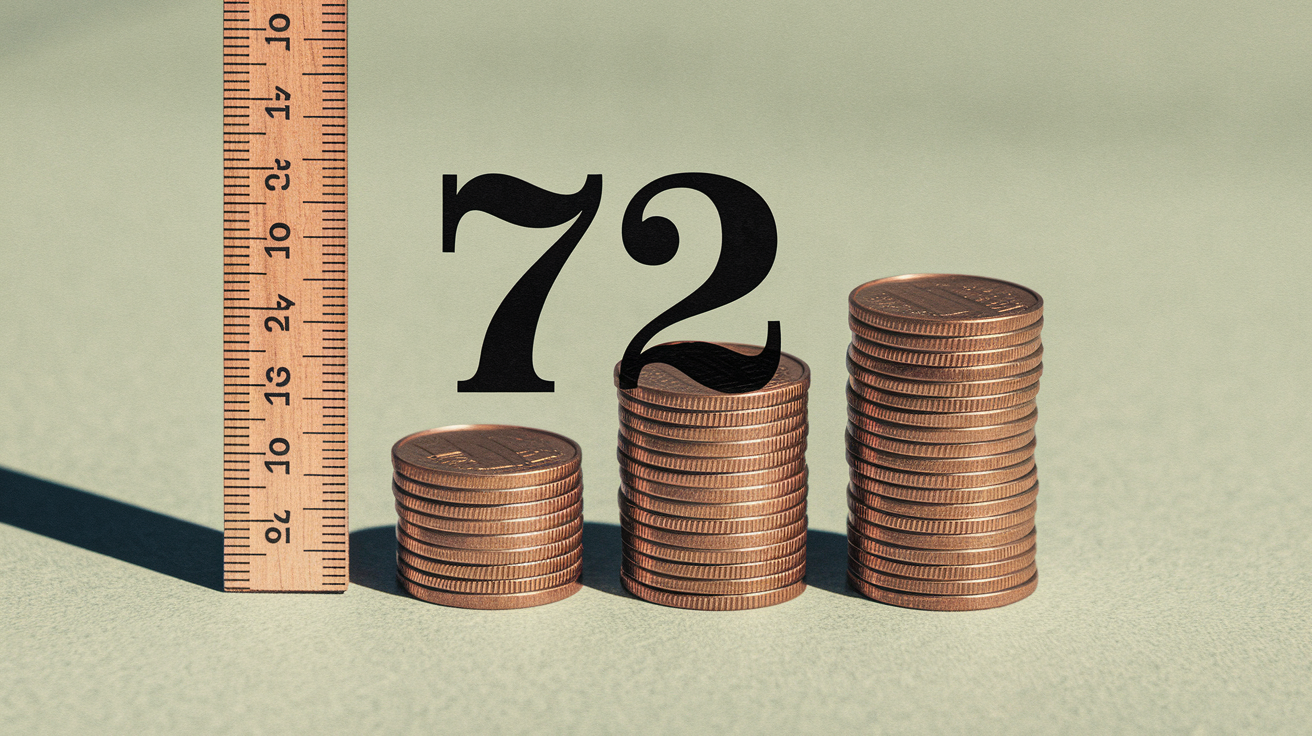
The Rule of 72 gives you a fast way to estimate how long it takes for money to double at a given annual return. Divide 72 by your expected rate, and the answer is roughly the number of years needed to double. At 7%, that’s 72 ÷ 7 ≈ 10 years. At 10%, it’s 72 ÷ 10 ≈ 7 years. At 5%, it’s 72 ÷ 5 ≈ 14 years.
This rule isn’t exact, but it’s close enough for planning and conversation. It helps you set realistic expectations without pulling out a calculator or memorizing formulas. If someone says they’re earning 8% on a stock portfolio, you can quickly estimate their money doubles every 9 years and triples in about 14 years.
Pick your expected annual return as a whole number (for example, 6%).
Divide 72 by that number (72 ÷ 6 = 12).
The result is the approximate number of years needed to double your money (12 years at 6%).
Over 10 years, the Rule of 72 tells you whether you’re on track for close to a double (rates near 7%) or something slower (rates near 5%). It’s a helpful gut check when someone pitches a product or when you’re deciding between a bond fund earning 4% and a stock fund targeting 9%.
Modeling Your Own 10 Year Projection

Online compound return calculators let you plug in your starting balance, expected rate, time horizon, and monthly contribution to see a year by year breakdown of growth. Most tools update the numbers instantly as you adjust the sliders or input fields, making it easy to test different scenarios side by side. You can compare what happens if you start with $500 versus $1,000, or if you add $25 per month versus $100.
The visual outputs, bar charts showing year by year growth and pie charts breaking down principal, contributions, and interest, help you see how much of the final balance came from your deposits versus compounding. If the interest slice of the pie is small, you either need more time, a higher rate, or bigger contributions. If the interest slice dominates, compounding is doing heavy lifting.
What Inputs Matter Most
Here’s what to focus on when building your own projection:
Starting deposit amount. This is the baseline that compounds from day one, so even small increases here add up over 10 years.
Expected annual return. Be realistic based on your actual investments, not best case scenarios or marketing pitches.
Contribution frequency and amount. Monthly deposits compound faster than annual ones because each deposit starts earning sooner.
Compounding frequency. Daily or monthly compounding beats annual, though the difference is modest unless you’re working with large balances.
Run a few versions with conservative, moderate, and optimistic return assumptions. If your plan only works at 10% and you’re invested in bonds, you’re setting yourself up for disappointment. If it works at 5% but you’re in stocks, you might end up with more than you need, which is a nice problem to have.
Final Words
We started in the action with clear 10-year outcomes for $1,000 at 5%, 7%, and 10% and a quick table to show the differences.
Then we walked through the ideas that matter: how compounding builds on gains, the formula, monthly contributions, compounding frequency, and the real drag from fees and taxes.
Try your own numbers with a simple calculator — seeing 000 over 10 years using compound returns makes the power clear.
Small, steady steps really add up.
FAQ
Q: How much is $10,000 compound interest for 10 years?
A: A $10,000 investment compounded for 10 years grows to approximately $16,289 at 5%, $19,672 at 7%, or $25,937 at 10% annual returns. The final amount depends heavily on your rate of return and compounding frequency, with higher rates and more frequent compounding producing larger totals.
Q: What did Warren Buffett say about compound interest?
A: Warren Buffett calls compound interest one of the most powerful forces in investing, emphasizing patience and long holding periods. He built much of his wealth by letting investments compound over decades rather than chasing quick gains, demonstrating how small differences in return rates create massive differences over time.
Q: What is the compound interest on $100,000 for 25 years?
A: A $100,000 investment compounded for 25 years grows to approximately $338,635 at 5%, $542,743 at 7%, or $1,083,471 at 10% annual returns. The dramatic differences show why even small rate improvements matter enormously over long periods, though higher returns typically carry higher risk.
Q: How much money will I have if I have $100,000 invested at 5% for 15 years?
A: A $100,000 investment at 5% annual compound interest for 15 years grows to approximately $207,893, assuming annual compounding and no withdrawals. Adding regular monthly contributions would significantly increase this total, and more frequent compounding (like daily or monthly) would add a modest boost to your final value.