
You don’t need thousands to start building long-term wealth.
With just $500, ETFs give instant diversification, tiny fees, and fractional shares so every dollar can work.
This post lays out seven ETFs that fit a $500 plan, explains why each matters, and shows one simple mix you can set up today.
You’ll get clear steps, the risks to watch, and a practical rule-of-thumb so you can start investing without guessing or chasing the next hot stock.
ETF Picks That Best Match a $500 Long-Term Investment

ETFs work well for a $500 investment because you get instant diversification, pay almost nothing in fees, and most brokers now let you buy fractional shares. For someone starting with $500, ETFs remove the stress of picking individual companies. You’re not betting everything on two or three stocks. You can set up the purchase in ten minutes, turn on automatic dividend reinvestment, and let it sit for the next decade.
Here are seven ETFs that fit a $500 plan, each covering different ground. Vanguard S&P 500 ETF (VOO) tracks the 500 largest U.S. companies and charges 0.03 percent per year. Vanguard Growth ETF (VUG) focuses on companies with strong revenue growth, weighted heavily toward technology at around 63 percent. It’s returned 874 percent since 2004 while the S&P 500 delivered 490 percent over the same stretch. Vanguard High Dividend Yield ETF (VYM) currently yields 2.4 percent and holds companies with high forecast dividends, no REITs. Schwab U.S. Dividend Equity ETF (SCHD) targets quality dividend growers with low fees. iShares Core MSCI Total International Stock ETF (IXUS) covers developed and emerging markets outside the U.S. Invesco QQQ Trust (QQQ) tracks the Nasdaq 100 for concentrated exposure to the largest non-financial companies. Vanguard Total Stock Market ETF (VTI) owns the entire U.S. stock market in one fund.
Cost matters when you start with $500. Even a small percentage adds up. VOO’s 0.03 percent expense ratio costs you about 15 cents per year on a $500 position. VUG’s 0.11 percent ratio runs around 55 cents. Over thirty years those nickels compound into real money saved or lost, so stick with funds charging under 0.20 percent annually unless there’s a clear reason to pay more.
| ETF Name | Ticker | Category | Expense Ratio | Why It Fits a $500 Long-Term Plan |
|---|---|---|---|---|
| Vanguard S&P 500 ETF | VOO | Broad U.S. Large-Cap | 0.03% | Rock-bottom cost, tracks U.S. economy, proven long-term track record |
| Vanguard Growth ETF | VUG | U.S. Growth Stocks | 0.11% | Tilts toward tech and high-growth companies, strong historical returns |
| Vanguard High Dividend Yield ETF | VYM | U.S. Dividend | 0.06% | Steady income stream you can reinvest, lower volatility than pure growth |
| Schwab U.S. Dividend Equity ETF | SCHD | U.S. Quality Dividend | 0.06% | Screens for dividend quality and growth, cheap, good for DRIP |
| iShares Core MSCI Total International Stock ETF | IXUS | International Developed & Emerging | 0.07% | Diversifies beyond U.S. borders, spreads risk across global economies |
| Invesco QQQ Trust | QQQ | U.S. Tech-Heavy Large-Cap | 0.20% | Concentrated bet on innovation leaders, higher volatility but strong long-term gains |
| Vanguard Total Stock Market ETF | VTI | Total U.S. Stock Market | 0.03% | Owns everything in the U.S. market in one fund, ultimate simplicity |
Building a Beginner-Friendly ETF Portfolio With $500

Small portfolios still benefit from allocation rules. The habits you build with $500 set the foundation for every dollar you add later. Splitting your money across growth, broad market, and income ETFs teaches you to think in percentages instead of chasing whatever fund spiked last month. It smooths out the ride when one category has a bad year and another holds steady or climbs.
One way to structure your $500 is 50 percent into a broad market fund like VOO for core exposure to the U.S. economy, 30 percent into a growth fund like VUG to capture faster-growing companies, and 20 percent into a dividend fund like VYM for steady income and a psychological anchor when markets drop. That mix gives you upside from growth stocks, broad diversification from the S&P 500, and a small stream of dividends you can reinvest. If you’re more comfortable with less volatility, flip the weights. Put 60 percent into VOO and split the rest between VYM and a bond ETF.
If you put the full $500 into VYM at its current 2.4 percent yield, you collect around 12 dollars per year before taxes. If you put $500 into VUG and it grows at 10 percent annually (lower than its historical pace but more realistic going forward), your position doubles to about 1,000 dollars in roughly 7.2 years. Neither scenario accounts for additional contributions, so imagine the acceleration when you add even 50 dollars per month on top of that base.
Growth allocation can be 20 to 40 percent for young investors with long timelines who can handle short-term swings. Income allocation runs 10 to 30 percent if you want steady dividends to reinvest or if you sleep better knowing part of your return is cash. Core index allocation sits at 40 to 70 percent in a fund like VOO or VTI to anchor your portfolio with broad, proven exposure. Ask yourself if a 20 percent drop would make you panic-sell or if you’d stay calm and keep contributing. The longer you can leave the money untouched, the higher the growth weighting you can handle.
Understanding Low-Cost and Index ETFs for Small Long-Term Investors
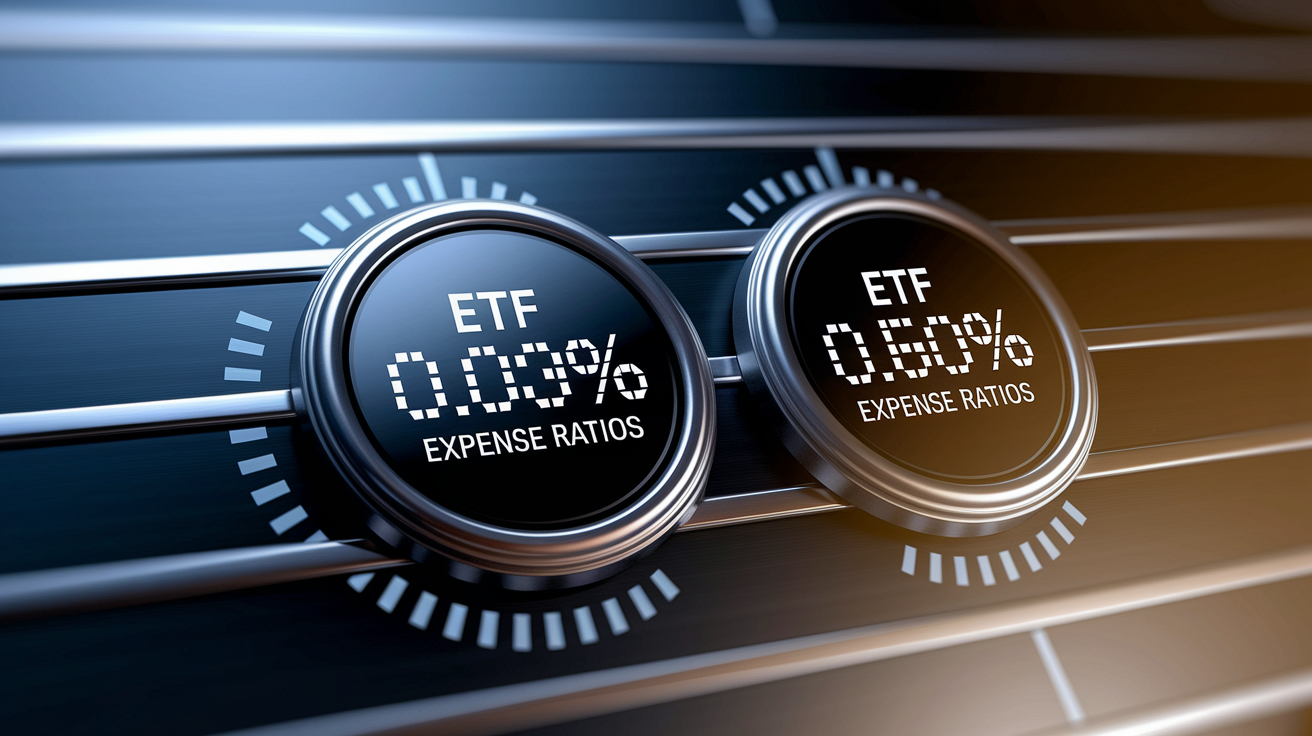
Cost matters more for small accounts because percentage fees compound against you just like gains compound for you. If you start with $500 and pay an extra 0.50 percent per year in fees compared to a cheaper fund, that half-percent difference costs you hundreds of dollars over three decades even if both funds track the same index. Every dollar you pay in fees is a dollar that never gets to grow. When you only have $500 to invest, protecting those dollars from unnecessary costs is one of the few factors you control completely.
VOO charges 0.03 percent per year, which works out to about 15 cents annually on a $500 position. VUG charges 0.11 percent, roughly 55 cents per year on the same amount. That 40-cent difference feels tiny today. But if both funds return 10 percent annually and you never add another dollar, the cheaper fund will be worth about 50 dollars more after twenty years just from the fee savings alone. When you do add money every month, the gap widens faster.
Tracking error describes how closely an ETF follows its benchmark index. A good index ETF will lag its benchmark by roughly its expense ratio and nothing more. If VOO charges 0.03 percent and the S&P 500 returns 10 percent in a given year, you should see close to 9.97 percent after fees. Higher tracking error means the fund’s poorly managed or holding cash at the wrong times. Stick with large, established index funds from Vanguard, Schwab, or BlackRock to avoid this headache.
Evaluating Dividend and Income ETFs for Long-Term Compounding

VYM currently yields 2.4 percent and has averaged around 3.0 percent over the past ten years, with a spike during COVID skewing that average higher. If you invest $500 into VYM, you collect about 12 dollars per year in dividends before taxes. That might not sound like much. But reinvesting those dividends every quarter buys you more shares, which then pay more dividends, which buy even more shares. Over twenty years that snowball can add 30 to 40 percent to your total return compared to taking the dividends as cash.
The top holdings in VYM show you what kind of companies you’re buying. Broadcom makes up 8.69 percent of the fund, JPMorgan Chase is 4.06 percent, ExxonMobil sits at 2.34 percent, Johnson & Johnson at 2.32 percent, and Walmart at 2.24 percent. Large, mature businesses that generate steady cash and return a chunk of it to shareholders. The risk is that dividend-heavy portfolios can get overweight in a few sectors like financials, energy, consumer staples. If one of those sectors has a rough decade, your income stream takes a hit.
Every dividend payout buys more shares automatically, compounding your income and your account value without you lifting a finger. Broad market funds like VOO yield around 1.5 percent. Dividend funds like VYM and SCHD typically yield 2 to 4 percent. High-yield funds can push above 4 percent but carry higher risk. Dividend ETFs often tilt toward financials, utilities, and energy, so pairing them with a growth or total market fund balances things out. A 2.4 percent yield sounds low, but if the fund also appreciates 6 percent per year, your total annual return is over 8 percent before reinvestment kicks in.
Growth ETFs and Their Role in a $500 Long-Term Strategy

VUG has delivered 874 percent cumulative return since its January 2004 launch, compared to 490 percent for the S&P 500 over the same stretch. That outperformance comes from its heavy tilt toward technology at around 63 percent of the fund and companies with above-average revenue and earnings growth. Tech giants like Apple, Microsoft, and Nvidia dominate the top holdings, so when those names run, VUG runs harder than a broad index. When tech sells off, VUG drops faster too.
Historical annual returns for VUG have hit around 16 percent in some periods, but expecting that pace to continue would be a mistake. Growth stocks are priced for perfection. When interest rates rise or earnings disappoint, the multiples compress fast. A more realistic assumption is 10 percent annually, which still doubles your $500 to about 1,000 dollars in roughly 7.2 years. If you can handle watching your account swing 20 or 30 percent in a bad year without selling, growth ETFs belong in your portfolio.
Volatility is the price you pay for higher returns. In 2022, VUG dropped over 30 percent as the Fed hiked rates and tech valuations reset. Investors who panicked and sold locked in the loss. Investors who stayed put or added money during the dip have since recovered and then some. That’s the pattern with growth funds. Sharp drops, long climbs, and a lot of noise in between. If your timeline is ten years or more and you keep adding money on a schedule, the volatility smooths out.
Using International and Sector ETFs for Broader Long-Term Diversification

U.S.-only ETFs like VOO, VUG, and VYM leave you exposed to one country’s economic cycle, currency, and political risk. Adding an international fund spreads that risk across Europe, Japan, emerging markets in Asia and Latin America, and other regions that don’t always move in sync with the U.S. If American stocks stall for a decade (it’s happened before), international holdings give you a better shot at positive returns. The trade is that international stocks have lagged U.S. stocks for the past fifteen years, so this is about balance and insurance, not chasing recent performance.
Sector ETFs let you tilt toward industries you think will outperform or fill gaps your core funds miss. A $500 portfolio doesn’t need sector funds right away, but as you add money over time you might layer in a healthcare fund, an energy fund, or a financials fund to adjust your exposure without selling your core positions. The risk is that narrow sector bets can backfire hard if you pick the wrong timing or the wrong industry.
International developed markets funds like IXUS or VEA cover Europe, Japan, Canada, and Australia with stable economies and mature companies. Emerging markets funds like VWO or IEMG include China, India, Brazil, and other fast-growing but higher-risk economies. Energy sector funds like XLE or VDE give you oil, gas, and renewable energy exposure, which tends to do well when inflation runs hot. Technology sector funds like VGT or XLK concentrate your bet on software, semiconductors, and tech services if you want more tech than a broad index already holds. Healthcare sector funds like VHT or XLV cover pharmaceuticals, biotech, and medical devices, offering some defense during recessions since people still need medicine.
Practical Steps to Buy ETFs With $500

Buying your first ETF takes about ten minutes once you have an account open. Start by choosing a commission-free platform like Fidelity, Schwab, or Vanguard so you don’t pay trade fees that eat into your $500. Most brokers let you open an account online with no minimum deposit, though some funds have purchase minimums, usually $1 for ETFs when fractional shares are enabled. If your broker doesn’t offer fractional shares, you’ll need to buy whole shares, which means you might not deploy the full $500 in one fund if the share price doesn’t divide evenly.
Once your account’s funded, search for the ETF ticker, for example VOO or VUG, in the broker’s trade window. You’ll see the current share price and an option to enter the number of shares or the dollar amount you want to invest. Choose a market order if you’re buying during trading hours and the price is stable, or use a limit order if you want to set a maximum price you’re willing to pay. After the trade settles, usually one business day, the shares appear in your account and you officially own a slice of hundreds of companies.
The last step is enabling dividend reinvestment (DRIP) in your account settings. Most brokers let you toggle this on for each holding. When DRIP’s active, any dividends your ETF pays automatically buy more shares, including fractional shares, instead of sitting as cash. Over decades, reinvested dividends can add 30 to 40 percent to your total return, so turn this on and forget about it.
Open a commission-free brokerage account and link your bank to transfer $500. Search the ETF ticker in the trade window and confirm the share price fits your budget. Place a market order or limit order if you want price control for the dollar amount or number of shares. Enable automatic dividend reinvestment in your account settings so every payout buys more shares.
Sample ETF Allocations for a $500 Long-Term Portfolio

Different allocations fit different risk levels and timelines. A conservative portfolio prioritizes steady returns and lower volatility, accepting slower growth in exchange for smoother rides during market drops. A balanced portfolio splits the difference, mixing growth and stability in roughly equal weight. A growth portfolio swings for higher returns by leaning into stocks with more upside and more risk.
If you’re starting with $500 and plan to hold for twenty years or more, a growth-heavy allocation makes sense because you have time to recover from downturns. If you’re older, closer to needing the money, or just uncomfortable with big swings, dial up the broad market and dividend funds and dial down the pure growth. The key is picking an allocation you can stick with when the market drops 20 percent, because selling in a panic is the fastest way to turn a temporary loss into a permanent one.
Combining VUG for growth, VYM for income, and VOO for broad exposure is one way to cover all the bases. Another option is to skip VOO and put everything into VTI (total U.S. stock market) as your core, then layer a small slice of international or a bond fund if you want even more diversification. There’s no perfect answer, just trade-offs between simplicity, cost, and how much you want to tinker.
| Portfolio Type | ETF Mix | % Allocation | Why This Works |
|---|---|---|---|
| Conservative | 60% VOO, 30% VYM, 10% AGG (bond ETF) | 60 / 30 / 10 | Lower volatility, steady dividends, small bond cushion for bad years |
| Balanced | 50% VOO, 30% VUG, 20% IXUS | 50 / 30 / 20 | Mix of growth and stability, international diversification, moderate risk |
| Growth | 40% VUG, 40% VTI, 20% QQQ | 40 / 40 / 20 | Tilted toward high-growth stocks, accepts higher swings for better long-term upside |
Tax Efficiency and Fees That Matter for a Small Long-Term ETF Portfolio

ETFs are generally more tax efficient than mutual funds because of how they handle redemptions and distributions, but you still owe taxes on dividends each year if you hold the fund in a taxable brokerage account. Qualified dividends, most U.S. stock dividends, get taxed at the lower long-term capital gains rate, while interest and some foreign dividends are taxed as ordinary income. If your $500 is inside a Roth IRA, you skip all of this and pay zero taxes on growth or dividends as long as you follow the withdrawal rules.
Fee drag is the slow leak that costs you more than you realize. A fund charging 0.50 percent per year doesn’t sound bad until you compare it to one charging 0.03 percent. On a $500 investment, the difference is only about $2.35 per year, but when you keep adding money and compounding for thirty years, that gap becomes thousands of dollars. VOO at 0.03 percent costs you about 15 cents per year on a $500 position. VUG at 0.11 percent runs around 55 cents. Those numbers scale as your balance grows, so a fund charging 0.03 percent on $50,000 costs you $15 per year while a 0.50 percent fund costs $250.
Keep ETFs in a Roth IRA or traditional IRA when possible to defer or eliminate taxes on dividends and capital gains. Favor ETFs over mutual funds in taxable accounts because ETFs trigger fewer taxable events. Watch out for funds that distribute short-term capital gains, which are taxed at your ordinary income rate and can surprise you at year-end.
Long-Term Maintenance: Rebalancing and Periodic Review for a $500 ETF Portfolio

Buy-and-hold doesn’t mean buy-and-ignore. Once or twice a year, check your allocation to see if one fund has grown so much that it now makes up 60 percent of your portfolio when you wanted 40 percent. If that happens, your risk profile has drifted and you might want to rebalance by adding new money to the lagging funds or selling a bit of the winner and buying the loser. For a $500 account, rebalancing is less urgent because transaction costs, even at zero commission, and tax implications matter more as a percentage of your total. Wait until you have at least a few thousand dollars before you start trimming and shifting.
Your main job in the early years is to keep contributing. Adding $50 or $100 per month matters more than tweaking your allocation when you’re starting with $500. Set up automatic transfers so the money moves from your checking account to your brokerage and buys more shares every month without you thinking about it. That habit turns market drops into buying opportunities and removes the emotional decision of whether this month is a good time to invest.
Set up automatic monthly transfers so you buy shares consistently regardless of market conditions. Check once per year to see if any fund has drifted more than 10 percentage points from your target. ETF providers occasionally lower fees or merge funds, so make sure you’re still in the cheapest version of your chosen strategy. Growth funds can become even more tech-heavy over time. If that makes you uncomfortable, add a value or dividend fund to balance it. Log in once a year to confirm DRIP is still turned on and dividends are buying new shares instead of piling up as cash.
Final Words
Start by picking a simple mix: a low-cost core ETF like VOO, a growth piece like VUG, or an income option like VYM. Keep the plan small and focused.
Set a regular contribution, enable dividend reinvestment, and check fees, tiny costs matter on $500. Rebalance lightly each year and avoid checking prices daily.
If you want the best ETFs to buy with $500 for long term, aim for VOO, VUG, or VYM, stick with your mix, and give it time to grow.
FAQ
Q: What should I invest $500 in right now?
A: If you have $500 right now, invest it in low-cost, diversified ETFs like VOO (S&P 500), VUG (growth), or VYM (dividend), chosen to match your timeline and risk tolerance.
Q: What ETF is a strong buy for long term?
A: A common long-term ETF pick is a low-cost S&P 500 ETF such as VOO; its 0.03% fee and broad exposure make it a solid core holding, though market risk still applies.
Q: What ETF does Warren Buffett recommend for S&P 500?
A: Warren Buffett recommends a low-cost S&P 500 index fund, commonly a Vanguard S&P 500 ETF like VOO, for broad-market exposure and long-term growth based on his public advice.
Q: What is the 7% rule in ETF?
A: The 7% rule in ETF is a rough planning idea that stocks deliver about 7% annual returns over long periods. It helps set expectations but is not guaranteed.