

Which is smarter: an ETF that quietly reinvests dividends for you, or one that pays cash you can see?
Both help your money grow, but they work very differently.
This post cuts through the noise and compares accumulating (Acc) shares that compound inside the fund with distributing shares that send cash to your broker and can be set to reinvest automatically.
You’ll get the simple pros and cons, the tax and fee tradeoffs, and clear rules of thumb for which to pick based on your needs.
How Dividend Reinvestment Works in ETF Investing

Dividend reinvestment is when you take cash dividends and automatically buy more shares of the same ETF instead of pocketing the money. There are two main ways this plays out.
Most U.S. ETFs are distributing funds. They send dividends to your brokerage account, and if you’ve switched on a DRIP (Dividend Reinvestment Plan), your broker uses that cash to buy more shares for you. Often fractional ones. Accumulating ETFs work differently. Common in Europe, with tickers that end in “Acc,” these funds reinvest dividends internally. You never see cash. The value just compounds inside the ETF.
Almost every major U.S. broker supports automatic dividend reinvestment. Vanguard, Fidelity, Schwab, Interactive Brokers, E*TRADE, Robinhood. And most handle fractional shares now, so a $37 dividend can buy 1.8 shares if one share costs $20. No leftover cash sitting around doing nothing. If your broker doesn’t do fractional DRIP, those extra cents pile up until you can buy a whole share.
You can flip DRIP on or off whenever you want. Per ETF, or account wide.
Reinvestment timing follows the usual dividend calendar. The record date is when the fund checks who owns shares and gets the dividend. The ex-dividend date (ex-date) is typically one business day before that. If you buy on or after the ex-date, you won’t get the upcoming dividend. The seller does. On the payable date, cash hits your account or DRIP fires and buys new shares. Since trades settle in two business days (T+2), you need to own the ETF at least two days before the record date to qualify.
Here’s how ETF dividend reinvestment actually works:
- Ex-date price drop. On the ex-date, the ETF’s price usually falls by roughly the dividend amount. A $50 fund paying $1.50 might drop to $48.50 at open.
- Distribution receipt. Cash lands in your brokerage account on the payable date. Or accumulating ETFs reinvest it internally, so you see nothing.
- DRIP execution. If DRIP is on, your broker uses the dividend cash to buy shares at the current market price (or NAV in some structures) on or shortly after the payable date.
- Fractional shares. If the dividend doesn’t buy whole shares, fractional shares get created if the broker supports it. Otherwise cash sits until next time.
- Tax reporting. In the U.S., dividends are taxable income in the year you receive them. Even when reinvested. You still owe tax on the distribution. DRIP doesn’t defer it.
Key ETF Types for Dividend Reinvestment and How They Differ
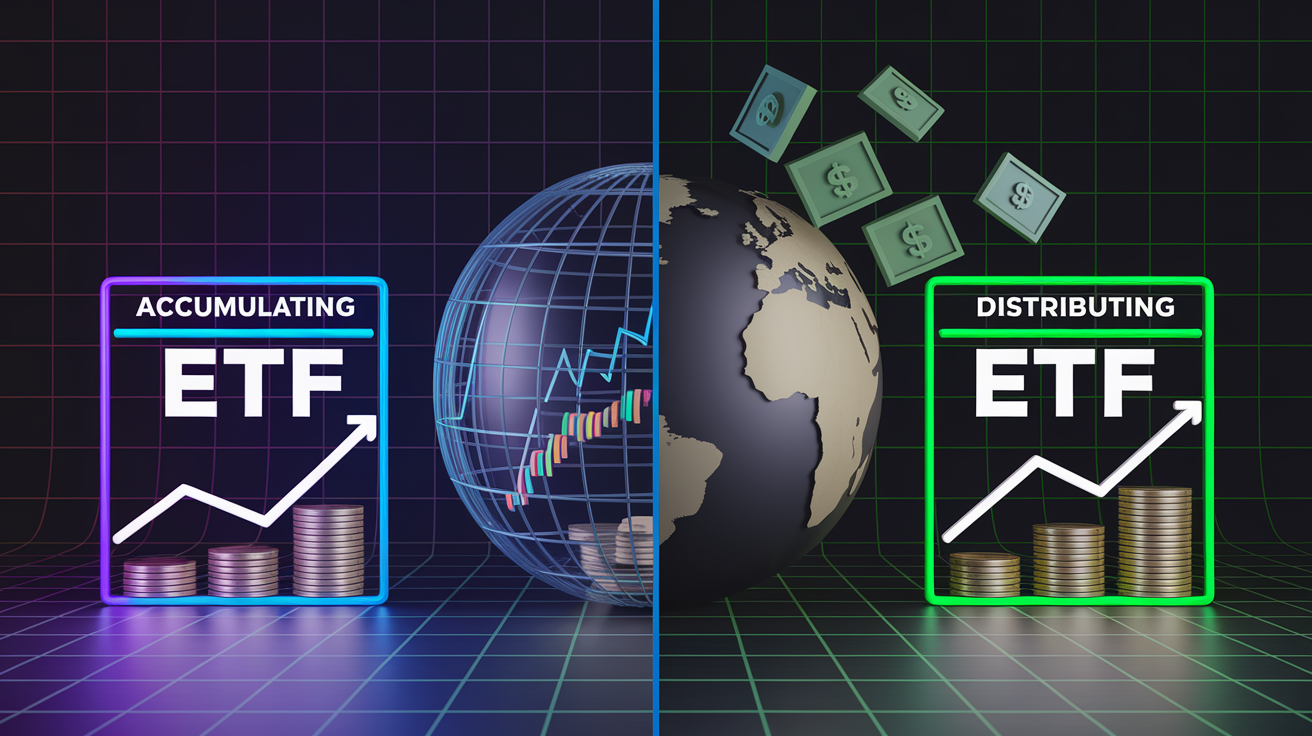
Accumulating ETFs reinvest dividends automatically at the fund level. No cash ever gets paid to you. These share classes are common in Europe and usually have “Acc” or “A” in the ticker. Dividend income stays inside the fund and compounds into the ETF’s net asset value. Vanguard FTSE All-World UCITS ETF Accumulating (VWRP, TER around 0.22%) and iShares Core MSCI World UCITS ETF Acc (IWDA, TER around 0.20%) are examples. You never see a dividend payment. The fund just grows. Accumulating ETFs are useful if you don’t need income and want fewer tax events and less reinvestment hassle.
Distributing ETFs pay dividends to your account as cash. Then you can manually reinvest or turn on a broker DRIP to do it for you. Nearly all U.S. ETFs use this structure. As of June 2024, examples include Vanguard Total World Stock ETF (VT, expense ratio around 0.07%, SEC yield around 1.6%), Vanguard High Dividend Yield ETF (VYM, 0.06%, roughly 3.2% yield), Schwab U.S. Dividend Equity ETF (SCHD, 0.06%, roughly 3.5% yield), and Vanguard Dividend Appreciation ETF (VIG, 0.06%, roughly 1.6% yield). With distributing shares you control reinvestment each period. You can override it if you need cash. The tradeoff is that each dividend creates a taxable event and a new tax lot when reinvested.
| ETF Type | Reinvestment Method | Typical Regions |
|---|---|---|
| Accumulating (Acc) | Internal, no cash distribution | Europe, some Asia-Pacific funds |
| Distributing (Dist / standard) | Cash paid out, broker DRIP available | U.S., Canada, Australia |
| Distributing with registry DRP | Registry reinvests at NAV, issuer creates units | Australia (ASX-listed ETFs via CHESS) |
| Physical commodity ETFs | No dividends (no income from holdings) | Global (e.g., gold, silver ETFs) |
How to Set Up Dividend Reinvestment (DRIP) for ETFs Through Your Brokerage

Most major brokerages support DRIP enrollment for listed ETFs. And many let you reinvest fractional shares, which means even small dividends get put to work right away. Vanguard, Fidelity, Schwab, Interactive Brokers, E*TRADE, and Robinhood all offer one-click DRIP activation. Fractional shares matter. If an ETF costs $200 per share and you get a $75 dividend, the broker will buy 0.375 shares instead of leaving $75 sitting there. Without fractional support, that $75 waits until it builds up with the next dividend or you add more cash to buy a full share.
Some brokers let you turn on DRIP for all holdings at once. Account-wide setting. Others require you to enable it per ETF. Account-wide is faster but less flexible. If one fund is for income and another for growth, you might want DRIP on only one. Per-security settings give you that control. A few custodial brokers that don’t use direct registry holding (CHESS in Australia, for example) may block access to issuer-run dividend reinvestment plans. In that case you rely entirely on the broker’s own DRIP feature.
After you turn on DRIP, check your next dividend payment to make sure it worked. Look for additional shares (or fractional shares) purchased on the payable date. Not a cash deposit. Your broker statement will show a new tax lot with the reinvestment date and price. Keep those records. Each reinvested dividend creates a separate cost basis entry that you’ll need when you sell shares or figure out capital gains. If the statement shows cash instead of shares, double-check your DRIP settings or reach out to support.
Step-by-step DRIP enrollment (typical broker process):
- Log into your brokerage account using your username and password.
- Go to Positions or Holdings (often under an “Accounts” or “Portfolio” tab).
- Find the ETF you want to reinvest in your current holdings list.
- Click the reinvestment toggle or link (Schwab shows a “Reinvest?” column with Yes/No. Other brokers have a settings icon or “Manage Dividends” link).
- Select “Yes” or “Enable” to turn on automatic dividend reinvestment for that security.
- Confirm fractional-share eligibility by reviewing account settings or calling support if the interface doesn’t make it clear.
- Save and verify by checking that the setting appears active. Then watch the next dividend to confirm shares were purchased instead of cash deposited.
Popular Dividend ETFs Suitable for Reinvestment Strategies
U.S. listed ETFs that pay regular dividends and work well with broker DRIPs include broad-market funds, high-yield specialists, and dividend-growth portfolios. Vanguard Total World Stock ETF (VT) offers global diversification with an expense ratio around 0.07 percent and an SEC yield near 1.6 percent as of June 2024. It’s a simple one-fund option for reinvestment. Vanguard High Dividend Yield ETF (VYM) and Schwab U.S. Dividend Equity ETF (SCHD) both have expense ratios around 0.06 percent and trailing yields above 3 percent (VYM around 3.2 percent, SCHD around 3.5 percent as of mid-2024). Popular choices for income-focused reinvestment.
European accumulating share classes remove the need for broker DRIP by reinvesting inside the fund. Vanguard FTSE All-World UCITS ETF Accumulating (VWRP) has a total expense ratio near 0.22 percent and holds global equities, compounding dividends internally. iShares Core MSCI World UCITS ETF Acc (IWDA) tracks developed markets with a TER around 0.20 percent. These “Acc” funds suit long-term investors who don’t need cash flow and want fewer tax events or simpler recordkeeping. The tradeoff is that accumulating ETFs may still trigger tax obligations depending on your country of residence and local rules for deemed distributions.
Expense ratios matter for compounding. A 0.20 percent annual fee versus 0.06 percent on a $100,000 holding costs you an extra $140 per year (0.14 percent times $100,000 equals $140). Over 20 years at 7 percent annual return, that 0.14 percent drag on a $100,000 starting balance cuts your ending portfolio by roughly $6,000. Fees compound against your returns every year. Lower expense ratios leave more dividend dollars working for you.
| ETF | Structure (Acc/Dist) | Expense Ratio | Yield (June 2024) | Reinvestment Method |
|---|---|---|---|---|
| VT | Distributing | ~0.07% | ~1.6% | Broker DRIP |
| VYM | Distributing | ~0.06% | ~3.2% | Broker DRIP |
| SCHD | Distributing | ~0.06% | ~3.5% | Broker DRIP |
| VIG | Distributing | ~0.06% | ~1.6% | Broker DRIP |
| VWRP | Accumulating | ~0.22% | N/A (reinvests internally) | Fund-level automatic |
| IWDA | Accumulating | ~0.20% | N/A (reinvests internally) | Fund-level automatic |
The Tax Side of Dividend Reinvestment in ETFs

In the United States, dividends are taxable income in the year they’re paid. Even if you reinvest them through a DRIP. Your broker will report all ETF distributions on Form 1099-DIV, showing ordinary dividends, qualified dividends, and any capital gains distributions. You owe federal income tax on that amount whether you took it as cash or used it to buy more shares. Qualified dividends get preferential tax rates (0 percent, 15 percent, or 20 percent depending on your income bracket). Non-qualified dividends are taxed as ordinary income at your marginal rate. Reinvesting doesn’t defer the tax. It just means you pay tax on money you never held as cash.
Every time a DRIP purchase happens, your broker creates a new tax lot with its own cost basis and purchase date. If you turn on DRIP on an ETF for five years and it pays quarterly, you’ll have 20 separate lots. Each with a different price and date. When you sell shares, your broker will use a cost basis method (default is usually first-in-first-out, or you can choose specific identification) to calculate your capital gain or loss. Keeping track of these lots is automatic at most brokers, but it’s smart to download and save annual statements. If you ever move accounts or need to report wash sales or tax-loss harvest, those records become critical.
In tax-advantaged retirement accounts like traditional IRAs and Roth IRAs, dividend reinvestment works differently for tax purposes. Dividends in a traditional IRA aren’t taxed when paid, and reinvesting them has no immediate tax consequence. You’ll pay ordinary income tax on withdrawals in retirement. In a Roth IRA, dividends and reinvestment are also tax-free. And if you follow the rules (age 59½ and account open five years), all future withdrawals including gains are tax-free. For these accounts, DRIP is pure compounding with no annual 1099-DIV reporting, which simplifies things significantly.
Non-U.S. investors face additional layers. If you’re a foreign investor holding U.S. ETFs, the U.S. typically withholds 30 percent of dividends (or a lower treaty rate if your country has a tax agreement with the U.S.). That withholding applies whether you reinvest or take cash. Accumulating ETFs domiciled outside the U.S. may not trigger withholding on internal reinvestment, but local tax rules vary. Some countries tax deemed or undistributed income annually. Check with a tax advisor in your country to understand reporting for accumulating share classes and any reclaim procedures for foreign withholding taxes.
Dividend Reinvestment Timing, Pricing, and ETF Distribution Mechanics

ETF dividend schedules revolve around three key dates that determine who gets paid and when reinvestment happens. The ex-dividend date (ex-date) is the cutoff. If you buy the ETF on or after that date, you won’t receive the upcoming dividend. The record date, usually one business day after the ex-date, is when the fund checks its list of shareholders to see who qualifies. The payable date (payment date) is when cash hits your account or DRIP fires. Because trades take two business days to settle (T+2), you must own the ETF at least two days before the record date to be on the books in time.
On the ex-date, the ETF’s market price typically drops by approximately the amount of the distribution. If an ETF closes at $50 and declares a $2 dividend, the next trading day (the ex-date) it will usually open near $48. You’re not losing money. You’re getting $2 in cash (or reinvestment) and the fund’s value dropped by $2 per share. In broker DRIPs, reinvestment usually happens at the market price on or shortly after the payable date. In some registry based dividend reinvestment plans (common on ASX-listed Australian ETFs), the reinvestment price is the closing net asset value (NAV) on the ex-date, and the fund issues new units directly to participants.
ETF dividend reinvestment timeline:
- Ex-date. Price drops by dividend amount. If you buy today you won’t get this dividend.
- Record date. Fund takes a snapshot of shareholders. Typically one day after ex-date.
- Payable date. Cash distributed to shareholders or DRIP fires and buys additional shares.
- Settlement. Your reinvested shares appear in your account. Fractional shares show up immediately if supported. Whole shares settle in T+2.
Compounding Growth When Reinvesting ETF Dividends

Reinvesting dividends turns small quarterly payments into long-term portfolio growth. If you get $100 in dividends each quarter and reinvest at a 5 percent annual return, after ten years you’ll have contributed $4,000 in dividends and ended with roughly $5,200. The extra $1,200 is compounding at work. That example assumes the dividend stays flat and the ETF grows at a steady rate. Real results vary with market performance and dividend changes, but the principle holds. The sooner you reinvest and the longer you let it compound, the bigger the snowball.
Fractional shares boost compounding by eliminating cash drag. If your dividend is $87 and one ETF share costs $50, fractional DRIP buys 1.74 shares immediately. Without fractional support, $37 sits idle until the next dividend or you add cash for a full share. That delay costs you time in the market. Small amounts left uninvested add up over years. Most modern brokers handle fractional reinvestment automatically, so there’s no reason to leave dividends as cash.
| Scenario | 10-Year Ending Value |
|---|---|
| $100/quarter dividend, reinvested at 5% annual return | ~$5,200 |
| $100/quarter dividend, taken as cash (not reinvested) | $4,000 (contributions only) |
| $100/quarter dividend, reinvested at 7% annual return | ~$5,800 |
Practical Issues: Fractional Shares, DRIP Limitations, and Cost Impact

Not all brokers support fractional share dividend reinvestment. And if yours doesn’t, small dividends will pile up as cash until you have enough to buy a whole share. If an ETF costs $300 per share and you receive a $45 dividend, that $45 sits uninvested until the next distribution brings the total above $300. Over years, that idle cash drags down your compounding. If fractional shares matter to you, confirm support before opening an account or turning on DRIP.
Broker DRIP purchases typically have no commission or brokerage fee. One of the big advantages over manually reinvesting. Manual reinvestment might cost $0 to trade at most discount brokers today, but you still face bid-ask spread and the hassle of placing orders. DRIP fires automatically at market price (or NAV in registry plans) with no extra cost and no action required. The only ongoing cost is the ETF’s expense ratio, which applies whether you reinvest or not. That’s why a 0.06 percent expense ratio beats 0.20 percent for long-term compounding. The difference compounds against your returns every year.
Some brokers act as custodians and don’t hold shares in your name on the fund’s registry, which can block access to issuer-run dividend reinvestment plans. This is common with international or app based brokers that use an omnibus custody structure. In those cases, you rely on the broker’s own DRIP feature. It usually works the same way, but you won’t have direct registry access for things like shareholder voting or issuer communications. If that matters to you, choose a broker that offers direct registry holding (CHESS sponsorship in Australia, for example).
Portfolio Strategy: Allocating and Rebalancing with Dividend Reinvestment ETFs
Dividend reinvestment fits naturally into a long-term buy and hold strategy, but it affects how and when you rebalance your portfolio. If you’re reinvesting dividends from a high-yield ETF every quarter, that fund’s allocation in your portfolio will grow faster than lower-yield or growth-focused ETFs, even if price performance is similar. Over years, you may drift away from your target asset allocation. One simple rule is to check your allocation once or twice a year and trim positions that have grown too large. Redirect new contributions to lagging asset classes instead of turning on DRIP everywhere.
Income-focused ETFs come in many flavors. Dividend growth (VIG), high yield (VYM, SCHD), covered-call funds, preferred-securities ETFs, and real estate investment trust (REIT) ETFs. Each has different risk and return profiles. High-yield ETFs often hold value stocks or slower-growth companies that pay more cash. Dividend-growth ETFs hold companies that raise dividends over time but may start with lower yields. Covered-call ETFs use options to generate extra income but cap upside. Mixing these types with broad-market or growth ETFs creates diversification across income sources and market segments.
Retirees and income-focused investors often prefer distributing ETFs with quarterly or monthly payouts, even if they reinvest some or all of the cash. Seeing regular distributions helps with budgeting and gives you flexibility to take some as spending money and reinvest the rest. Accumulating ETFs are better for investors who don’t need cash flow and want fewer decisions. Everything compounds inside the fund automatically. Match your reinvestment approach to your cash flow needs and time horizon.
Best practice rules for dividend reinvestment and portfolio balance:
- Set a target allocation for dividend ETFs versus growth or international funds and review it annually.
- Turn on DRIP during accumulation years (when you’re adding money) to get maximum compounding with zero effort.
- Turn off DRIP selectively in retirement if you need cash flow from specific funds. Leave it on for others you want to grow.
- Watch expense ratios and yields together. A 0.10 percent lower fee is worth more over decades than a 0.2 percent higher yield in most cases.
- Rebalance with new contributions rather than selling positions. If a dividend ETF has grown too large, send fresh money elsewhere until the mix resets.
Final Words
In the action, you learned how ETF dividends are paid or reinvested, the difference between accumulating and distributing share classes, and how broker DRIPs and fractional shares work with ex-date, record date, and payable date timing.
You also saw how to turn on DRIP at common brokers, how tax and expense rules affect results, and how reinvesting boosts compounding over time. Next steps: pick a sensible ETF mix, enable automatic reinvestment, and check tax reporting each year.
If you want steady, hands-off growth, a dividend reinvestment etf approach is a simple way to keep money working for you.
FAQ
Q: Are there ETFs that reinvest dividends?
A: ETFs that reinvest dividends are accumulating (Acc) ETFs, which keep payouts inside the fund, and broker DRIPs, which automatically buy extra shares (often fractional) when a fund pays a dividend.
Q: How much money do you need to make $100,000 a year in dividends?
A: To make $100,000 a year in dividends you generally need about $2.0–$3.3 million, depending on yield: $2.0M at 5%, $2.5M at 4%, and $3.33M at 3%.
Q: What is the downside to reinvesting dividends?
A: The downside to reinvesting dividends is you still owe taxes on payouts, you get no cash for spending, you may increase concentration risk, and you lose timing control to rebalance or buy elsewhere.
Q: How to earn $1000 a month in dividends?
A: To earn $1,000 a month in dividends aim for $12,000 a year — roughly $300,000 at a 4% yield — then build that capital with dividend ETFs, steady contributions, and DRIP to compound returns.