

What if I told you building real wealth is more about steady habits than clever stock picks?
Investing is simply putting money to work so it can grow over time, using things like stocks, bonds, and funds.
This guide walks you through the core ideas: set goals, match your time horizon, pick the right account, and keep a spread-out mix that helps you sleep at night.
Follow these simple principles and you can let time and compounding (earnings on earnings) do the heavy lifting.
Core Principles for Beginner Investors

Investing is when you use money to buy assets that can grow over time. Stocks, bonds, funds. Unlike saving, where your cash sits safe but earns almost nothing, investing puts your money to work. The goal? Returns that beat inflation and build actual wealth. You’re buying a piece of a company, lending to a government, or getting exposure to a basket of assets that can appreciate over the years.
Why does this matter? Because long-term stock market growth has beaten savings accounts and inflation for decades. Over the past 90 years, the S&P 500 averaged around 7 percent annual returns after inflation. A dollar invested decades ago is worth many times more today. Not just from growth, but from compounding. Reinvested earnings piling up, year after year. Time is your biggest advantage. Start early, even with small amounts, and you give your money more years to grow and bounce back from dips.
Four steps to get started:
- Set clear goals. Retirement, house down payment, education fund.
- Know your time horizon. How many years until you need the money?
- Pick an account. Brokerage, IRA, employer 401(k).
- Go diversified. Low-cost index funds or ETFs that cover many companies.
You don’t need thousands of dollars or expert knowledge. Many online brokerages let you open an account with no minimum. You can buy fractional shares for a few bucks. Just start. Stay consistent. Let time and compounding do the work.
Understanding Risk and Return

Risk and return go together. Higher potential returns? Higher risk. That means bigger price swings, up or down. Stocks can deliver strong gains over time but might drop 20 percent or more in a rough year. Bonds are steadier, safer, but usually produce smaller returns. Nothing’s completely risk-free. Understanding this tradeoff helps you pick assets that match your goals and comfort level.
Your risk tolerance depends on your age, income stability, savings, and how you handle losses emotionally. If a 15 percent portfolio drop would keep you awake or make you sell in a panic, you probably want more bonds and fewer stocks. But if you can stay calm during turbulence and don’t need the money soon, you can take on more risk for higher long-term returns.
Time horizon matters most when choosing risk. Investing for a goal 20 or 30 years away, like retirement? Short-term volatility doesn’t matter because you have decades to recover. Need the money in two or three years? A safer mix with more bonds or cash makes sense. You don’t have time to wait out a major drop. Match your risk to your timeline and you’ll make decisions that fit both your goals and your ability to sleep at night.
The Power of Compound Growth

Compounding is when your earnings generate their own earnings. Snowball effect over time. You earn a return, reinvest those gains, and start earning returns on both your original money and the profits you’ve already made. This cycle repeats year after year. The longer it runs, the more powerful it gets. Your money works for you. Then the money your money made starts working too.
Long-term compounding creates exponential growth, not linear. Invest $1,000 at 7 percent per year and you’ll have around $1,967 after 10 years. After 30 years? Roughly $7,612. Same annual return, but each year’s gains built on all the previous years. Small contributions add up big when compounded over decades.
| Years Invested | Approx. Growth Factor (at 7%) |
|---|---|
| 10 years | ~2x |
| 20 years | ~4x |
| 30 years | ~7.6x |
| 40 years | ~15x |
Starting early matters. An investor who begins at 25 and puts in $200 a month until 65 ends up with far more wealth than someone who waits until 35 and contributes $300 a month, even if the later starter invests for the same number of years. The earlier investor gave compounding more time. Time in the market beats trying to time the market. Even modest amounts grow into significant sums when you let compounding run.
Key Asset Classes Explained

Stocks
Stocks represent ownership in a company. Buy a share and you own a small piece of that business. You benefit if the company grows and becomes more valuable. Stocks offer the highest growth potential, with historical average annual returns around 10 percent before inflation. But they’re also the most volatile. Prices can drop sharply during recessions, earnings misses, or broader sell-offs. If you can handle the swings and have a long time horizon, stocks are a core wealth builder.
Bonds
Bonds are loans you make to a company, government, or municipality. In exchange, the issuer pays you interest at regular intervals and returns your original investment when the bond matures. Bonds are safer and less volatile than stocks. Good for income and stability. The tradeoff? Lower potential returns. They’re subject to interest rate risk, meaning their value falls when rates rise. Still, they cushion a diversified portfolio, especially for investors nearing retirement or anyone uncomfortable with heavy stock exposure.
Mutual Funds
Mutual funds pool money from many investors to buy a diversified collection of stocks, bonds, or both. A professional manager picks and manages the holdings, aiming to meet the fund’s objective. Growth, income, balanced. Mutual funds make it easy to own hundreds of securities in one investment. That spreads risk and reduces the impact of any single company’s poor performance. Downside? Actively managed funds often charge higher fees and many fail to beat simple index benchmarks over time.
ETFs
ETFs work like mutual funds in that they hold a basket of stocks or bonds. But they trade on stock exchanges like individual stocks. Most ETFs track an index, like the S&P 500. Broad diversification at very low cost. You can buy and sell shares throughout the trading day. Because they’re usually passively managed, fees are typically much lower than actively managed mutual funds. For beginners, low-cost ETFs are one of the simplest ways to build a diversified portfolio quickly.
Three quick comparisons:
- Risk level: Stocks highest, bonds lowest. Mutual funds and ETFs depend on what they hold.
- Costs: ETFs usually cheapest, actively managed mutual funds often priciest.
- Liquidity: Stocks and ETFs trade instantly during market hours. Mutual funds price once per day at market close.
Diversification and Why It Protects Your Portfolio

Diversification means spreading your money across different assets, industries, and geographies. No single investment can wreck your portfolio. When one stock or sector tanks, others might hold steady or even rise. That reduces your overall loss. Diversification doesn’t guarantee profit or eliminate risk completely, but it smooths out the ride and protects you from the worst-case scenario of betting everything on one company.
Different assets don’t all move together. Bonds often rise when stocks fall. International stocks can perform well when U.S. stocks struggle. Real estate and commodities react to different forces than tech stocks. By holding a mix, you capture growth from multiple sources while limiting damage from any single bad bet. Don’t put all your eggs in one basket. Old phrase, but true.
For long-term stability, diversification is essential. Even experienced investors use it to manage risk. Beginners benefit more, because spreading investments across many companies and asset types reduces the need to predict which single stock or sector will win. A diversified portfolio lets you participate in overall market growth without requiring you to be right about every individual pick.
Basics of Asset Allocation

Asset allocation is dividing your investment dollars among different asset classes. Typically stocks, bonds, and cash. Based on your age, goals, and risk tolerance. A common approach is the 60/40 split. 60 percent stocks for growth, 40 percent bonds for stability. Younger investors often go more aggressive. 80 or 90 percent stocks. They have decades to recover from downturns. Older investors approaching retirement usually shift toward more bonds. Protecting wealth they’ve already built and reducing exposure to big swings.
Your allocation should reflect your time horizon and comfort with risk. If you’re 25 and saving for retirement in 40 years, a stock-heavy allocation makes sense. Short-term drops don’t matter and you want maximum growth. If you’re 60 and planning to retire in five years, a bond-heavy allocation protects you from a market crash right before you need to start withdrawing. There’s no one-size-fits-all answer. But the principle is the same. Longer time horizons support more risk. Shorter horizons demand more safety.
Rebalancing periodically keeps your risk level on target. If stocks surge and your 60/40 portfolio becomes 75/25, you’re taking on more risk than planned. Sell some stocks, buy bonds, bring it back to 60/40. Lock in gains and maintain your strategy.
How to Build a Simple Starter Portfolio

Building your first portfolio doesn’t require complexity or expensive advisors. A simple, diversified approach using low-cost index funds or ETFs can deliver strong long-term results with minimal effort.
Five steps to create a basic starter portfolio:
- Open an investment account. Brokerage, IRA, or employer 401(k).
- Decide on an asset allocation that fits your age and risk tolerance. Example: 70 percent stocks, 30 percent bonds.
- Choose one or two broad index funds or ETFs. Like a total U.S. stock market fund and a total bond market fund.
- Set up automatic monthly contributions. Invest consistently without thinking about it.
- Rebalance once or twice a year to keep your allocation on track.
This keeps costs low, eliminates the need to pick individual stocks, and gives you exposure to thousands of companies in a few simple transactions. Automatic contributions are especially powerful. They remove emotion and procrastination. Whether the market’s up or down, your money goes in on schedule. Over time that consistency builds serious wealth. If your employer offers a 401(k) match, contribute at least enough to capture the full match. It’s free money and an instant return.
Setting Financial Goals Before You Invest
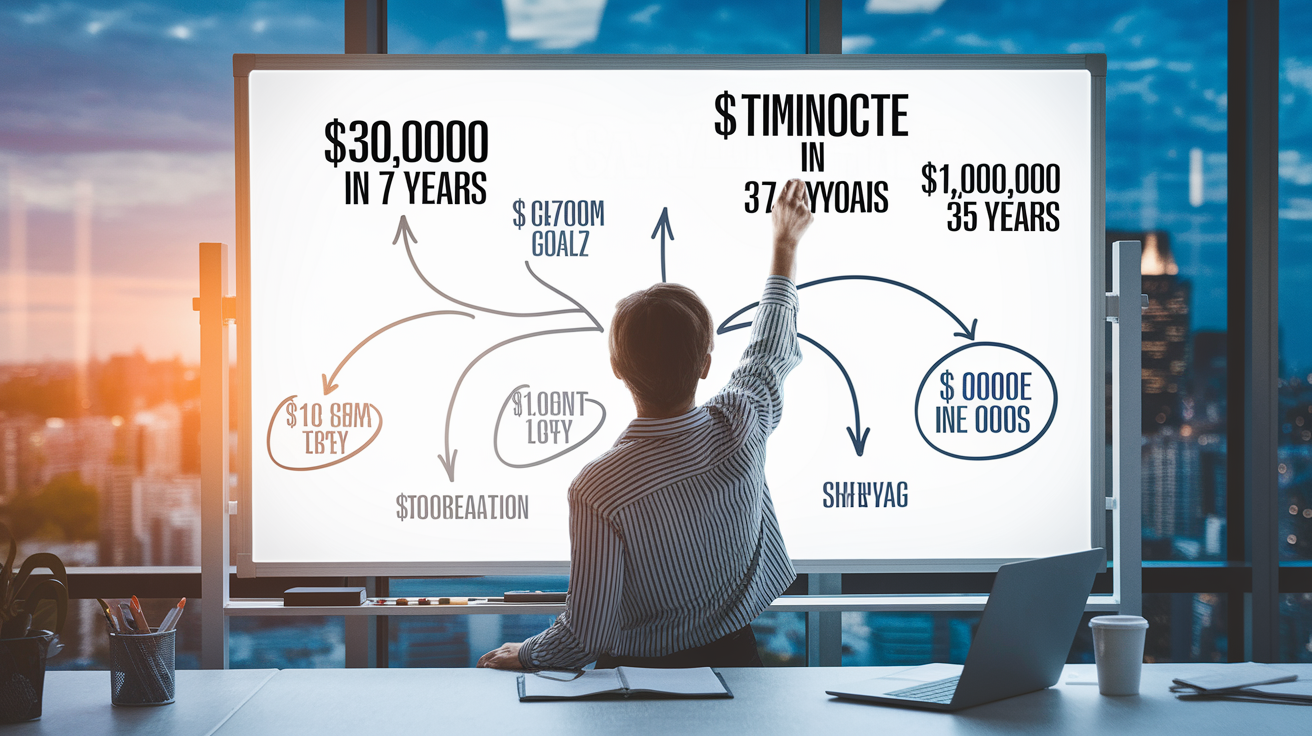
Your financial goals determine how you should invest. A goal shapes your time horizon, your acceptable risk level, and the types of accounts and assets you choose. Common categories include short-term goals like saving for a car or vacation in one to three years, mid-term goals like a house down payment in five to ten years, and long-term goals like retirement in 20 or 30 years. Each calls for a different strategy.
Short-term goals need safety and liquidity. If you’ll need the money soon, you can’t afford to lose 20 percent in a downturn. Keep those funds in high-yield savings accounts, money market funds, or short-term bonds. Mid-term goals can tolerate a bit more risk. A balanced mix of stocks and bonds makes sense. Long-term goals, especially retirement, benefit most from growth. A stock-heavy allocation is usually appropriate because you have time to ride out volatility and benefit from compounding.
Write down your goals and assign a dollar amount and timeline to each. Instead of vaguely wanting to “save for the future,” you know you need $30,000 in seven years for a down payment and $1,000,000 in 35 years for retirement. Those specific targets guide how much you contribute each month and how you allocate your money. Clear goals keep you disciplined when markets get scary and help you stay focused on what actually matters.
Choosing the Right Investment Account
The type of account you use can significantly affect your long-term returns because of taxes and fees. A standard brokerage account offers total flexibility. You can deposit and withdraw money anytime, invest in almost any asset, and there are no contribution limits. Downside? You pay taxes on dividends, interest, and capital gains each year. That can reduce your net returns. Brokerage accounts work well for goals outside of retirement or once you’ve maxed out tax-advantaged options.
Tax-advantaged retirement accounts like IRAs and 401(k)s are designed to help long-term growth by deferring or eliminating taxes. Traditional IRAs and 401(k)s let you contribute pre-tax dollars, reducing your taxable income today. Your investments grow tax-deferred until you withdraw in retirement. Roth IRAs and Roth 401(k)s work the opposite way. You contribute after-tax dollars now, but all future growth and withdrawals are tax-free. Both types have annual contribution limits and rules about when you can take money out without penalties. But the tax savings over decades can add tens of thousands of dollars to your final balance.
If your employer offers a 401(k) with a company match, start there. The match is an immediate return, often 50 or 100 percent on your contributions up to a certain percentage of salary. After capturing the full match, consider opening an IRA for additional contributions and more investment choices. If you have money left over, return to the 401(k) or use a taxable brokerage account for flexibility. Prioritize accounts that give you the biggest tax advantage and the longest time for compounding to work.
Common Beginner Mistakes to Avoid

New investors often stumble into predictable traps. Cost them money and confidence. Recognizing these mistakes early can save you years of frustration and missed returns.
Six common pitfalls to watch out for:
- Timing the market: Trying to buy at the bottom and sell at the top almost never works. Consistent investing beats attempts to predict short-term moves.
- Panic selling during downturns: Selling when the market drops locks in losses and misses the recovery. Staying invested through volatility is how long-term wealth gets built.
- Lack of diversification: Putting too much into one stock or one sector exposes you to unnecessary risk. Spread your money across many assets.
- Ignoring fees: High expense ratios and advisory fees compound negatively over time. Favor low-cost index funds and ETFs.
- Chasing hot stocks or trends: Buying whatever’s popular or surging often means buying at a peak. Stick to a diversified plan instead of chasing headlines.
- Not starting early enough: Procrastination is expensive. Even small contributions grow significantly when you give them decades to compound.
Final Words
Start taking action: set clear goals, pick the right account, choose a simple mix of low-cost funds, and set up regular contributions. You’ve seen why risk, compounding, asset classes, allocation, diversification, and common mistakes all matter.
Next, build that starter portfolio, automate contributions, and check in once a year to rebalance if needed.
Keep the fundamentals of investing as your guide — stay steady, avoid panic, and let time work for you. You’re on the right track.
FAQ
Q: What are the fundamentals of investment?
A: The fundamentals of investment are using money to buy assets that can grow or produce income, spreading risk across holdings, matching choices to your goals and timeline, and keeping costs low.
Q: What if I invest $1000 a month for 5 years?
A: Investing $1,000 a month for five years builds a sizable balance; the final amount depends on the average return, while regular contributions and compounding boost growth and good saving habits.
Q: What are the 5 P’s of investing?
A: The five P’s of investing are a simple checklist: purpose (your goal), plan (asset mix), patience (time horizon), price (cost and value), and protection (risk controls).
Q: What is Warren Buffett’s 90/10 rule?
A: Warren Buffett’s 90/10 rule recommends roughly 90% in a low-cost broad stock index (like the S&P 500) and 10% in short-term bonds to keep investing simple and reduce volatility.