

What if your “tax-friendly” ETF is quietly costing you thousands over decades?
Taxes matter most in taxable accounts because small differences compound over time.
Here’s a short, practical way to check three things that really move the tax needle.
Look at turnover (how often the fund changes holdings), distributions (what and how often it pays), and structure (the legal setup that decides tax rules).
Do this before you buy, and you’ll know which ETFs are likely to leave more after-tax money in your account.
Core Methods to Evaluate ETF Tax Efficiency in Taxable Accounts

Tax efficiency matters in taxable accounts because even small percentage differences compound over decades. ETFs accounted for just 0.17% of capital gains distributions in 2023 despite holding roughly 29% of U.S. managed fund assets. That’s a structural advantage keeping more of your money working instead of paying taxes. Most mutual funds must sell securities to meet redemptions, creating taxable events for all shareholders whether they sold or not.
ETFs achieve this through two structural features: low turnover from index construction and in-kind creation and redemption mechanics. When an Authorized Participant redeems ETF shares, the fund typically delivers a basket of securities instead of cash. No need to sell holdings and realize capital gains. Passive equity ETFs that track broad indexes rarely distribute capital gains, and when they do the amounts are small. That structural difference translates into higher after-tax returns over time, especially in taxable brokerage accounts where every distribution triggers a tax bill.
Before buying an ETF for a taxable account, evaluate the fund using a consistent set of criteria that reveal how likely it is to generate taxable events. The following seven steps provide a practical method:
-
Review fund legal structure. Confirm whether the ETF is an open-end registered investment company, a limited partnership, a grantor trust, or an exchange-traded note. Open-end index ETFs are generally the most tax-efficient.
-
Check turnover ratio. Look in the prospectus or annual report for the portfolio turnover rate over the past one, three, and five years. Flag funds with turnover above 50% as potentially tax-inefficient.
-
Examine past capital gains distributions. Review the fund’s distribution history for the past three to five years. Look for any year-end capital gains distributions and note the dollar amount per share.
-
Look at Morningstar Tax Cost metric. This shows the difference between pre-tax and after-tax returns over ten years. Lower numbers indicate better tax efficiency.
-
Verify dividend character. Check the fund’s tax documents or 1099-DIV forms to see what percentage of dividends are classified as qualified versus ordinary. Qualified dividends receive preferential tax rates.
-
Assess creation and redemption mechanics. Confirm the fund uses in-kind transactions with Authorized Participants. You’ll typically find this in the prospectus under “Purchase and Sale of Fund Shares.”
-
Compare with a known tax-efficient peer. Identify an ETF with similar exposure and compare turnover, distribution history, and tax cost to set a benchmark for what efficient looks like in that asset class.
ETF Structures and Their Tax Impacts

The in-kind creation and redemption process is the primary reason ETFs generate fewer taxable events than mutual funds. When an Authorized Participant wants to redeem ETF shares, the fund delivers a basket of portfolio securities instead of cash. This avoids the need for the fund manager to sell holdings, which would realize capital gains and distribute them to all shareholders. Mutual funds must sell securities to raise cash when investors redeem shares. Those sales often trigger capital gains that are passed through to remaining shareholders, even those who held steady. The difference in redemption mechanics insulates ETF investors from the tax consequences of other investors’ decisions.
Not all ETF structures are equally tax-efficient. Open-end ETFs that use in-kind redemptions and track broad indexes are the most favorable for taxable accounts. Exchange-traded notes generate no income distributions because they’re unsecured debt instruments, but they carry issuer credit risk and gains on sale are still taxable. Grantor trusts, often used for physically backed precious metals like gold and silver, are taxed like collectibles. Long-term gains get taxed at up to 28% instead of the standard 20% capital gains rate. Commodity ETPs structured as limited partnerships follow the 60/40 tax rule, where 60% of gains are taxed as long-term (up to 20%) and 40% as short-term (up to 37%). That produces a blended maximum rate of 26.8% regardless of how long you hold the fund. These partnerships also issue Schedule K-1 forms, which arrive later than 1099s and complicate tax filing.
Futures-based ETPs and grantor trusts tend to be less tax-efficient in taxable accounts. A commodity ETP structured as a limited partnership marks futures contracts to market at year-end, creating realized gains or losses that are distributed to shareholders following the 60/40 split. A precious-metal grantor trust holding physical gold will produce a collectibles gain when you sell, taxed at up to 28% for long-term holdings and up to 37% for short-term. If your goal is to minimize taxable events, favor open-end ETFs that use in-kind redemptions and avoid structures that require K-1 reporting or carry collectibles tax treatment.
Tax Metrics and Tax Drag Drivers

Tax metrics reveal how much of an ETF’s return is lost to taxes each year. The tax-cost ratio measures the difference between a fund’s pre-tax return and its after-tax return over a ten-year period, accounting for both capital gains distributions and dividend taxes. A fund with a tax cost of 2.12%, like the average active U.S. large-cap mutual fund for the decade ending December 31, 2022, means investors give up 2.12 percentage points of annual return to taxes. On a $100,000 portfolio compounded at 10% annually over ten years, that 2.12% annual tax drag results in an after-tax value of $213,506 instead of $259,374. That’s a loss of $45,869. Distribution frequency also matters because more frequent distributions mean more taxable events, even if the total yield is the same. A bond ETF that pays interest monthly creates twelve taxable events per year, while an equity ETF that distributes dividends quarterly creates four.
Trading activity inside the fund drives tax drag. Higher turnover typically generates more realized capital gains because the fund manager is selling appreciated holdings and booking profits. Turnover above 50% annually is a warning sign that the fund may distribute capital gains to shareholders. Tracking error, the difference between the ETF’s return and its benchmark’s return, can also signal excessive trading or sampling practices that increase turnover. Yield composition plays a role as well. A high-dividend ETF that produces mostly qualified dividends will be more tax-efficient than one producing ordinary dividends taxed at rates up to 37%. Bond ETFs and REITs tend to produce ordinary income, which is taxed at your highest marginal rate rather than the preferential long-term capital gains rate of up to 20%. Even expense ratios indirectly affect after-tax returns because higher fees reduce pre-tax performance, leaving less to compound over time.
To estimate a fund’s tax drag before investing, combine the expected yield with the likely tax treatment of that yield, then add any expected capital gains distributions. Use the following six metrics as a starting point:
• Tax-cost ratio. The annualized difference between pre-tax and after-tax returns over ten years
• Distribution frequency. How often the fund pays dividends or interest, creating taxable events
• Tracking error. Larger deviations from the benchmark can indicate higher turnover and realized gains
• Dividend character. The split between qualified dividends (taxed at 0/15/20%) and ordinary dividends (taxed up to 37%)
• Expected yield composition. Whether income comes from interest, dividends, or capital gains
• Expense ratio impact on taxable yield. Higher fees reduce the net income available to distribute and compound
Where to Find ETF Tax Data Before Investing

Start with the fund’s prospectus, annual report, and tax documents. All available on the ETF provider’s website. The prospectus describes the fund’s legal structure, creation and redemption mechanics, and turnover ratio. The annual report includes a detailed list of portfolio holdings and the actual turnover figure for the past fiscal year. Tax documents and distribution notices published by the fund show the history of capital gains distributions, dividend payments, and the character of those distributions. Many asset managers publish distribution estimates in the fourth quarter before year-end distributions are finalized, giving taxable investors time to make placement or harvesting decisions.
Form 1099-DIV reports the dividends you received and breaks them into qualified and ordinary income, along with any capital gains distributions. Form 1099-B reports proceeds and cost basis when you sell ETF shares, which determines your taxable gain or loss. Limited partnerships issue Schedule K-1 instead of 1099 forms, and K-1s often arrive weeks after other tax forms, delaying filing. ETFs and Taxes: What You Need to Know explains the different tax forms associated with ETF structures, including K-1s for partnerships and 1099s for open-end funds. If an ETF issues a K-1, that’s a signal it may be less suitable for a taxable account unless you have a specific tax reason to hold it there.
| Document | Shows | Why It Matters |
|---|---|---|
| Prospectus & Annual Report | Legal structure, turnover ratio, creation/redemption mechanics, portfolio holdings | Confirms whether the fund uses in-kind redemptions and reveals trading activity that can generate capital gains |
| Tax Documents & Distribution Notices | History of capital gains and dividend distributions, character of income (qualified vs ordinary), distribution estimates | Shows past taxable events and helps predict future distributions; fourth-quarter estimates let you plan before year-end |
| 1099-DIV, 1099-B, Schedule K-1 | Actual taxable income and gains reported to the IRS; qualified vs ordinary dividend split; cost basis and sale proceeds | Determines your tax liability; K-1 forms signal partnership structure and later filing deadlines |
Comparing Tax-Efficient vs Tax-Inefficient ETFs

ETFs produced less than 1% of total fund capital gains distributions in both 2022 and 2023 despite holding roughly 29% of U.S. managed fund assets by the end of 2023. That statistical disparity reflects the structural advantage of in-kind redemptions and low-turnover index strategies. How Are ETFs Tax Efficient? provides data showing how ETFs avoid the capital gains distributions that mutual funds regularly generate, even when both funds track similar indexes. Active mutual funds had an average annual tax cost of 2.12% for the ten years ending December 31, 2022, while passive equity ETFs in the same period often had tax costs near zero. That difference compounds over decades and can represent tens of thousands of dollars in a taxable account.
Commodity and precious-metal ETPs often produce higher taxable events because of their legal structures and required distribution rules. A broad U.S. equity index ETF structured as an open-end fund with in-kind redemptions rarely distributes capital gains and generates mostly qualified dividends. An actively managed equity ETF with turnover above 100% will distribute more capital gains, though still fewer than a comparable mutual fund. A commodity ETP structured as a limited partnership follows the 60/40 rule and issues a K-1, creating a blended tax rate of up to 26.8% on gains regardless of holding period. A precious-metal trust holding physical gold is taxed like a collectible, with long-term gains taxed at up to 28% instead of 20%. The structural differences mean the asset class and legal wrapper determine much of the tax efficiency before you even consider the fund’s management style.
| ETF Type | Structure | Typical Capital Gains Distributions | Tax Treatment |
|---|---|---|---|
| Broad U.S. Equity Index ETF | Open-end, in-kind redemption | Rare or zero over five years | Qualified dividends (0/15/20%); long-term gains on sale (up to 20%) |
| Active Equity ETF | Open-end, may use in-kind | Occasional, depends on turnover | Mix of qualified and ordinary dividends; potential capital gains distributions |
| Commodity ETP (LP) | Limited partnership | Annual mark-to-market distributions | 60/40 rule: blended rate up to 26.8%; issues K-1 |
| Precious Metal Trust (Grantor) | Grantor trust holding physical metal | No distributions; gain on sale | Collectibles tax: long-term up to 28%, short-term up to 37% |
Dividend Tax Treatment’s Role in ETF Tax Efficiency

Dividend classification directly affects your after-tax return. Qualified dividends receive preferential tax rates of 0%, 15%, or 20% depending on your income, while ordinary dividends are taxed at your highest marginal rate, which can be as high as 37%. An equity ETF that produces mostly qualified dividends will deliver higher after-tax income than a bond ETF producing ordinary interest, even if both funds yield the same percentage. Funds are required to distribute at least 90% of net investment income annually, so dividend-focused equity ETFs and bond ETFs will generate taxable income every year regardless of whether you sell shares.
Bond ETFs pay interest that’s almost always classified as ordinary income and taxed at your highest rate. REITs also produce mostly ordinary income because they’re required to distribute at least 90% of taxable income to shareholders. High-yield bond ETFs and REIT ETFs are therefore less tax-efficient than broad equity index ETFs in taxable accounts. When evaluating an ETF’s tax efficiency, check the fund’s tax documents or annual report to see what percentage of distributions were qualified versus ordinary in recent years. A fund’s yield matters less than the character of that yield when you’re trying to minimize tax drag.
Key dividend classifications to review before investing:
• Qualified dividends. Taxed at long-term capital gains rates of 0%, 15%, or 20%; typical of U.S. equity ETFs
• Ordinary dividends. Taxed at ordinary income rates up to 37%; common in bond ETFs, REIT ETFs, and some foreign equity funds
• Interest income. Almost always taxed as ordinary income; produced by bond ETFs and money market funds
• Return of capital. Not immediately taxable but reduces your cost basis, creating a larger capital gain when you sell
Best Practices for ETF Placement in Taxable vs Tax-Advantaged Accounts

Place tax-efficient assets in taxable accounts and tax-inefficient assets in tax-advantaged accounts like IRAs and 401(k)s. Passive equity ETFs that use in-kind redemptions, produce qualified dividends, and rarely distribute capital gains belong in taxable accounts where their structural advantages shine. Tax-managed ETFs and municipal bond ETFs also work well in taxable accounts because they’re designed to minimize or eliminate federal tax liability. Municipal bond interest is generally exempt from federal income tax, making these funds ideal for taxable accounts if you’re in a high tax bracket.
Hold tax-inefficient assets in IRAs and other tax-deferred or tax-exempt accounts. High-yield bond ETFs, REIT ETFs, commodity ETPs structured as limited partnerships, and precious-metal grantor trusts all generate ordinary income, K-1 forms, or collectibles gains that are taxed at higher rates. Holding these assets in a traditional IRA or 401(k) eliminates the annual tax drag, and you pay ordinary income tax only when you withdraw in retirement. In a Roth IRA, qualified withdrawals are entirely tax-free. Asset location, the decision of which account holds which asset, can add 0.5 to 1 percentage point or more to annual after-tax returns without changing your asset allocation.
Six practical asset placement rules for taxable and tax-advantaged accounts:
• Taxable accounts: Broad U.S. and international equity index ETFs with low turnover and qualified dividends
• Taxable accounts: Tax-managed ETFs designed to minimize distributions
• Taxable accounts: Municipal bond ETFs if you’re in a high federal tax bracket
• Tax-advantaged accounts: High-yield bond ETFs and other funds producing ordinary interest income
• Tax-advantaged accounts: REIT ETFs that distribute mostly ordinary income
• Tax-advantaged accounts: Commodity ETPs, precious-metal trusts, and any fund that issues Schedule K-1
Checklist for Evaluating ETF Tax Efficiency Before Purchase
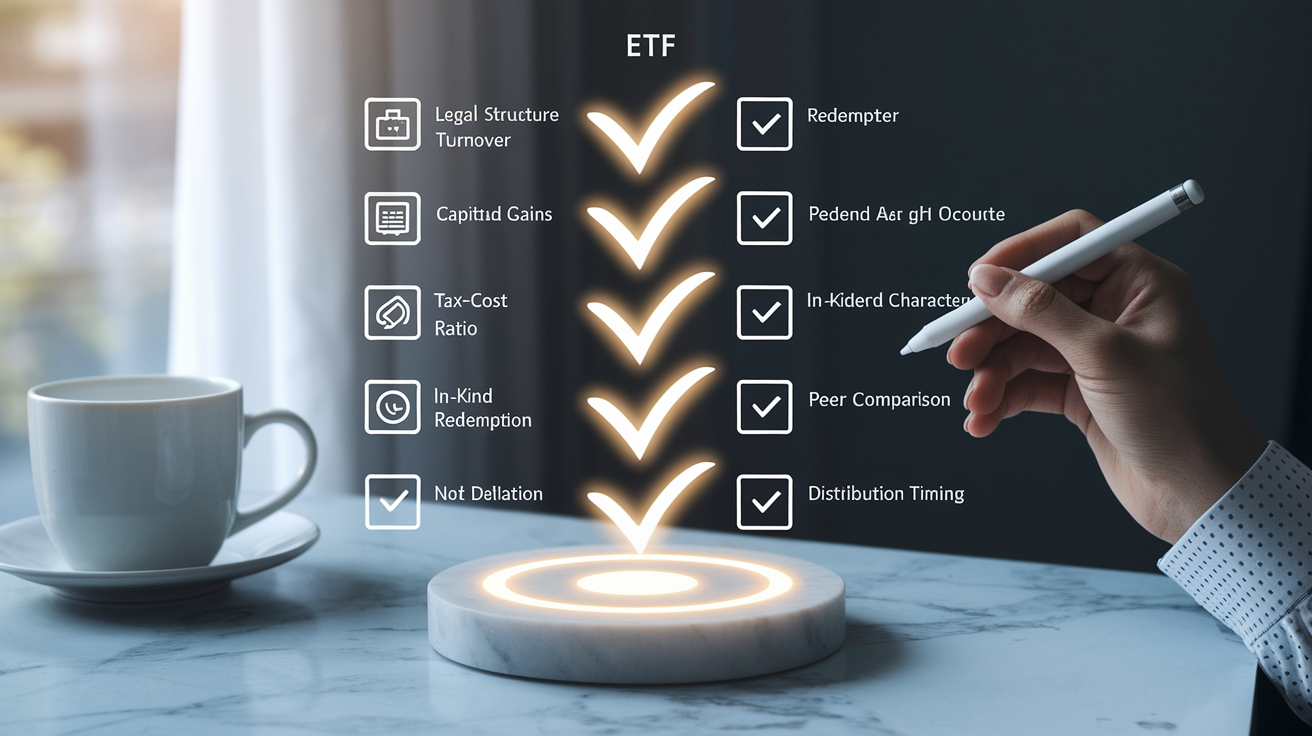
Before buying an ETF for a taxable account, work through a short checklist to assess tax efficiency. Start by confirming the fund’s legal structure in the prospectus. Open-end ETFs that use in-kind creation and redemption are typically the most tax-efficient, while limited partnerships and grantor trusts carry higher tax burdens. Next, pull the fund’s turnover ratio from the annual report and compare it to peers. Turnover above 50% is a warning that the fund may distribute capital gains. Review the past three to five years of distribution history on the fund’s website or in the annual tax notice to see whether the fund has distributed capital gains and how often it pays dividends.
Check the Morningstar Tax Cost metric or calculate the difference between the fund’s pre-tax and after-tax returns over ten years. Lower tax cost means more of the return stays in your account. Verify dividend character by reviewing the fund’s 1099-DIV or tax summary to see what percentage of dividends are classified as qualified versus ordinary. Assess the creation and redemption mechanics to confirm the fund uses in-kind transactions, which reduce realized gains. Compare the fund’s tax profile to a known tax-efficient peer in the same asset class to set a benchmark. Check whether the fund publishes distribution estimates in the fourth quarter. 3 Tax-Efficient ETF Strategies explains how advance notice of distributions can help you time purchases or sales to avoid unexpected tax bills.
Use the following checklist before committing capital to an ETF in a taxable account:
- Confirm legal structure. Open-end, limited partnership, grantor trust, or ETN; open-end index funds are preferred.
- Record turnover ratio. Look for one, three, and five-year figures; flag funds with turnover above 50%.
- Review capital gains distribution history. Check the past three to five years for any year-end distributions.
- Check tax-cost metric. Use Morningstar or the fund’s reported pre and post-tax return differential.
- Verify dividend character. See what percentage of dividends are qualified versus ordinary on the 1099-DIV or tax summary.
- Assess creation/redemption mechanics. Confirm the fund uses in-kind transactions with Authorized Participants.
- Compare to a tax-efficient peer. Benchmark turnover, distribution history, and tax cost against a similar fund.
- Note distribution timing. Check if the fund publishes Q4 distribution estimates and plan purchases or sales accordingly.
This checklist is most valuable for taxable accounts where every distribution and realized gain creates a tax bill. In tax-advantaged accounts like IRAs, tax efficiency matters less because gains and income are either tax-deferred or tax-exempt, so you can hold less tax-efficient ETFs without immediate consequences.
Final Words
in the action we ran through simple ways to evaluate an ETF’s tax fit for a taxable account.
You learned the main checks: turnover, past capital gains, Morningstar tax-cost, dividend type, and creation/redemption mechanics.
We compared structures, showed where to find the data, and gave a practical checklist to follow.
If you want a quick next step on how to assess tax efficiency of an etf for taxable accounts, use the 7-step checklist above.
A little homework now helps your money grow more quietly later.
FAQ
Q: How to determine if an ETF is tax-efficient?
A: To determine if an ETF is tax-efficient, check its structure, turnover ratio, past capital gains distributions, Morningstar Tax Cost metric, dividend classification, and whether it uses in‑kind creation/redemption.
Q: What is the 7% rule in ETF?
A: The 7% rule in ETFs is not a formal industry standard; people sometimes use it as an informal cutoff for acceptable annual distributions or tracking differences, so always check how the source defines it.
Q: What is the 3 5 10 rule for ETFs?
A: The 3‑5‑10 rule for ETFs means reviewing performance, turnover, and distribution history across 3, 5, and 10 year periods to spot consistency and tax behavior before investing.
Q: Should you hold ETFs in a taxable account?
A: You can hold ETFs in a taxable account because many are tax-efficient via in‑kind redemptions, but place tax-inefficient assets (REITs, high‑yield bonds, commodity or precious‑metal trusts) in tax‑advantaged accounts when possible.