

Who says you have to sell to rebalance?
You don’t. Not with a $500 account and steady deposits.
If you add small amounts, you can rebalance by directing each new contribution to the asset that’s underweight.
That avoids sales, taxes, and trading fees.
Here’s the simple plan: set a dollar trigger (about $50 or 10%), write targets in dollars, and put your next $25 or $50 deposit into whatever is behind.
Use fractional shares or commission-free ETFs so every dollar works.
This is a low cost, practical approach, but adjust for your timeline and tax situation.
Immediate Steps to Rebalance a $500 Portfolio Using Small Contributions

First, compare your target allocation to what you actually own. Write it down in dollars, not percentages. If you’re aiming for 60% stocks and 40% bonds on $500, you should have $300 in stocks and $200 in bonds. Check your current balances and figure out the gap. Stocks climbed to $350 and bonds are sitting at $150? You’re off by $50.
Don’t sell. Just send your next contribution to whatever’s too low. You deposit $25 every two weeks? Put the next two straight into bonds. That’s $50 total, which closes the gap without triggering a sale, a tax event, or a trading fee. On a $500 account, a $50 drift is a 10% swing, and that’s a practical place to draw the line. Annual rebalancing is the standard move, but you can stretch it to every two or three years if contributions are keeping things roughly on track.
Set a simple threshold so you’re not rebalancing every time the market hiccups. A useful rule for $500 is to act only when drift exceeds $50 or 10 percentage points. Below that, the effort and possible friction outweigh the benefit.
Quick rebalancing checklist:
- Calculate target dollar amounts for each asset (multiply $500 by each target percentage).
- Measure drift in dollars and percent (current balance minus target, then divide by target).
- Check if drift exceeds your $50 threshold (or ±10%).
- Direct your next contribution entirely to whatever’s underweight.
- Review again at your next deposit or once per year, whichever comes first.
Setting Target Asset Allocation for a $500 Portfolio

Pick an allocation that fits how much risk you can stomach and how long you’ve got until you need the money. A 60/40 mix is a common moderate starting point. For $500, that’s $300 in stocks and $200 in bonds. Got decades before retirement and you sleep fine during market drops? An 80/20 split ($400 stocks, $100 bonds) tilts more aggressive. Need steadier income and less volatility? A 70/30 split ($350 stocks, $150 bonds) lands in the middle.
Once you choose your target, write it down in dollars. Percentages are easier to remember, but dollars tell you exactly what to buy or sell. Without rebalancing, your allocation will drift. A 60/40 portfolio left alone for decades can end up 97% stocks. That’s an actual historical example from a Vanguard study starting in 1926. Way more risk than you signed up for, which is why checking and rebalancing matters even on small accounts.
| Target Allocation | Dollar Amount (on $500) |
|---|---|
| 60% stocks / 40% bonds | $300 stocks / $200 bonds |
| 70% stocks / 30% bonds | $350 stocks / $150 bonds |
| 80% stocks / 20% bonds | $400 stocks / $100 bonds |
Using Contribution-Based Rebalancing to Avoid Selling

When you’ve got new money to add, put it where it’s needed most. Stocks are ahead of target and bonds are behind? Send the entire deposit into bonds. This avoids selling anything, which means no capital gains tax in a taxable account and no trading fees. On a $500 portfolio, a $25 monthly deposit equals 5% of your total. A $50 deposit? That’s 10%. Those percentages are big enough to shift your allocation meaningfully without triggering a sale.
Let’s say your target is $300 stocks and $200 bonds, but stocks climbed to $325 and bonds fell to $175. You’re $25 off on each side. Your next $25 contribution goes entirely to bonds. New totals: $325 stocks, $200 bonds, portfolio of $525. Stocks are now 61.9% and bonds are 38.1%, much closer to your 60/40 target. If the drift is bigger (say, $350 stocks and $150 bonds), you’re $50 off. Direct the next two $25 contributions to bonds, and you’re back in range without selling a single share.
This approach is especially useful when you’re making regular deposits, whether weekly, biweekly, or monthly. Each deposit becomes a small rebalancing event. You still check the overall allocation occasionally (once a year is fine), but most of the rebalancing happens automatically as you invest new money into whatever’s lagging. It’s simple, it’s cheap, and it keeps you from overthinking tiny price movements.
Threshold and Calendar Rebalancing Methods for Small Portfolios

You can rebalance on a schedule (calendar method) or when your allocation drifts beyond a set limit (threshold method). The calendar method means picking a date, checking once a year, and rebalancing if needed. Annual rebalancing is backed by research as a reasonable default. Rebalancing every two to three years can perform just as well and cuts down on effort and trading friction. For most small portfolios, once a year is plenty.
The threshold method triggers a rebalance when an asset class moves too far from target. A common rule is the 5/25 rule: rebalance when an asset is off by 5 percentage points absolute or 25% relative. On a $500 portfolio, that can mean very small dollar amounts. A more practical band for tiny accounts is ±10 percentage points or about $50. Your target for stocks is 60% ($300) and stocks hit 70% ($350)? That’s a $50 drift and a reasonable trigger. If stocks only move to 62% ($310), you’re $10 off, which isn’t worth the hassle.
A hybrid approach combines both: check on a fixed schedule (quarterly or annually) and only act if drift exceeds your threshold. You can also use a contribution trigger. If you’ve accumulated new deposits equal to 5% to 10% of your portfolio ($25 to $50 on $500), that’s a good moment to check allocation and direct the money where it’s needed.
Common rebalancing triggers:
- Threshold: Act when drift exceeds ±$50 or ±10% on a $500 account.
- Calendar: Check once per year and rebalance if outside tolerance.
- Hybrid: Review quarterly or at each deposit, trade only if drift crosses threshold.
- Contribution: Use deposits of $25 to $50 (5 to 10% of portfolio) as rebalancing events by directing funds to underweight assets.
Fractional Shares, ETFs, and Commission-Free Trading for Rebalancing Precision

Fractional shares let you buy a precise dollar amount of a stock or ETF, even if the share price is $50 or $200. You’ve got $10 to invest and the ETF costs $100 per share? You can buy 0.1 shares. This is a game changer for small portfolios because you can put every dollar to work without waiting to accumulate enough cash for a full share. Most major brokers and fund platforms now offer fractional shares at no extra cost.
Commission-free trading removes the other big barrier. If your broker charges $5 per trade, selling $50 of stock costs you 10% in fees, which wipes out any rebalancing benefit. Zero-commission platforms let you trade without that penalty. Pair commission-free trading with fractional shares, and you can rebalance a $500 portfolio in $10 or $25 increments without friction. Even so, selling is still rarely necessary if you’re adding money regularly. Use fractional shares to direct new contributions precisely, and save actual trades for annual checkups or large drifts.
Key benefits of fractional shares:
- Invest every dollar without leftover cash sitting idle.
- Rebalance in small increments (even $5 or $10 at a time).
- Avoid waiting to save up for a full share, which can delay rebalancing for weeks or months.
Step-by-Step Example: Rebalancing a $500 Portfolio with Monthly Deposits

Start with a $500 portfolio targeting 60% stocks ($300) and 40% bonds ($200). After a few months, stocks rise to $350 and bonds fall to $150. Your allocation is now 70/30, which is $50 off target on each side. You contribute $25 per month. Instead of selling $50 of stocks, you’ll use the next two deposits to fix it.
Month one: your portfolio is $350 stocks, $150 bonds, total $500. You add $25 and put it all into bonds. New balances: $350 stocks, $175 bonds, total $525. Stocks are now 66.7%, bonds are 33.3%. You’re closer, but still outside your target band.
Month two: you add another $25 to bonds. New balances: $350 stocks, $200 bonds, total $550. Stocks are now 63.6%, bonds are 36.4%. You’re within a few percentage points of 60/40, and you didn’t sell anything. Want to tighten it further? Put a portion of the next deposit into bonds and the rest into stocks, or wait until the next check and see if market movement brought you closer on its own.
Four-step contribution rebalancing sequence:
- Calculate drift by subtracting current balances from target dollar amounts.
- Choose contribution direction by identifying which asset is furthest below target.
- Apply the deposit entirely to the underweight asset (or split if multiple assets are low).
- Recalculate percentages after the deposit and repeat next month if still outside tolerance.
Minimizing Trading Costs, Taxes, and Avoidable Errors
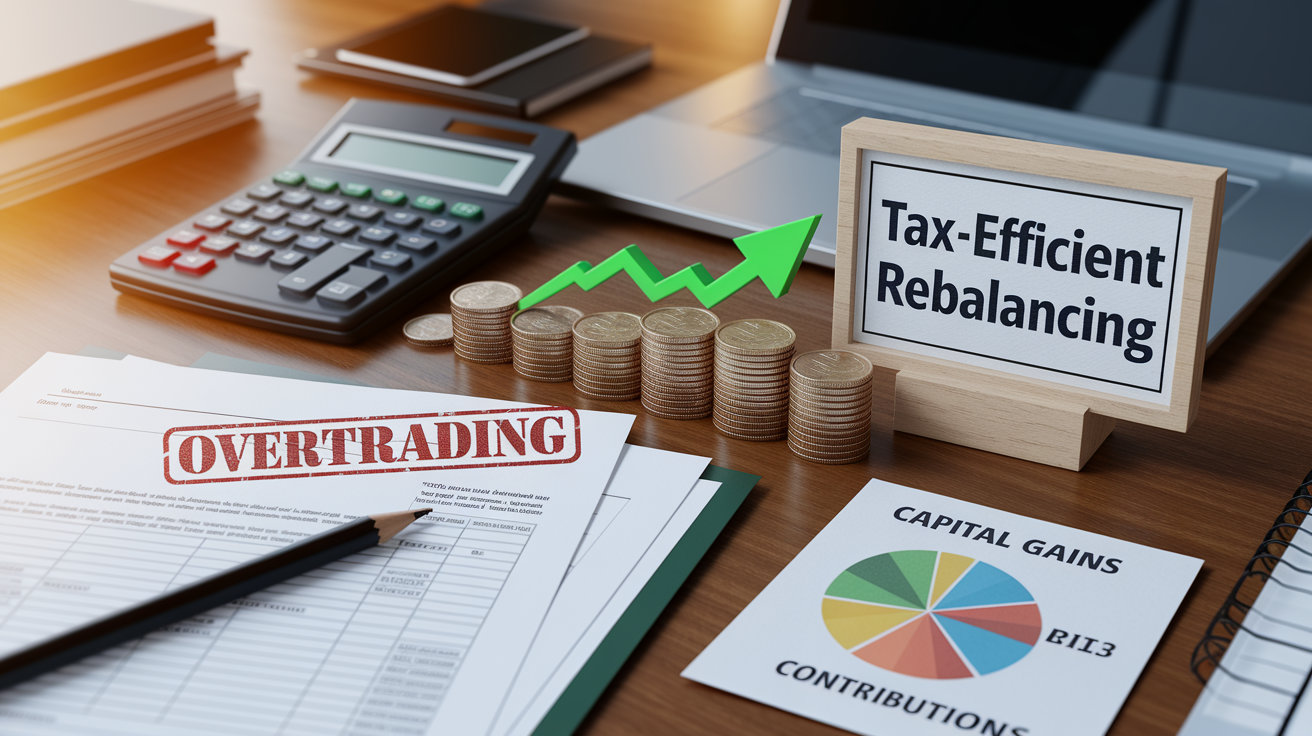
Selling winners creates taxable capital gains if you hold the account in a taxable brokerage account. On a $500 portfolio, a $50 gain might generate $7 to $15 in federal tax depending on your bracket and whether the gain is short-term or long-term. That’s 1% to 3% of your portfolio, which can erase the benefit of rebalancing. If you must sell, do it inside a tax-advantaged account like an IRA or 401(k) where gains aren’t taxed. If your entire portfolio is in a taxable account, rebalancing with new contributions is almost always the better move.
Avoid short-term capital gains by waiting at least one year before selling any investment. Short-term gains are taxed as ordinary income, which is usually higher than the long-term rate. If you do need to sell in a taxable account, use shares with the highest cost basis (the price you paid) to minimize the taxable gain. Many brokers let you choose which tax lot to sell. Picking the highest-cost shares can cut your tax bill significantly.
Common rebalancing pitfalls to avoid:
- Overtrading: Rebalancing every time the market moves 2% wastes time and racks up unnecessary transaction costs, even on commission-free platforms (bid-ask spreads still exist).
- Ignoring taxes: Selling in a taxable account without considering capital gains can cost you more than the rebalancing saves.
- Chasing precision: Trying to hit 60.00% exactly isn’t worth it. A band of 58% to 62% is close enough and saves effort.
- Trading with high spreads: Some thinly traded ETFs have wide bid-ask spreads. On a $50 trade, a 0.5% spread costs you $0.25, which adds up if you trade often.
Simple Allocation Templates and Scaling as Portfolio Grows
When your portfolio is small, keep it simple. Use one or two low-cost, broad-market funds. A total stock market ETF plus a total bond market ETF covers most of what you need. As your balance grows above $2,000 or $3,000, you can add narrower slices like international stocks, small-cap stocks, or REITs. More holdings mean more rebalancing work, so only add complexity when the portfolio size justifies it.
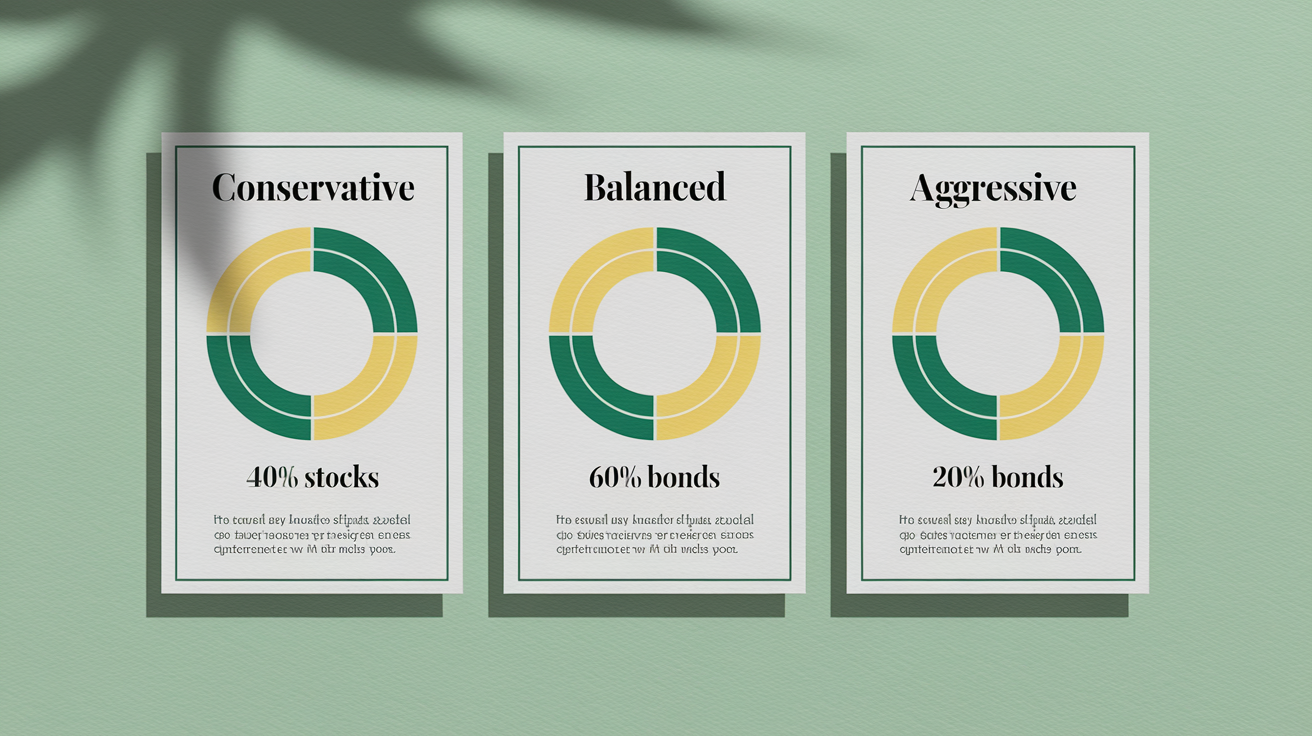
Pick a model that fits your timeline and risk comfort. Conservative tilts more to bonds and makes sense if you need the money in five years or less. Balanced splits the middle and works for medium timelines (10 to 20 years). Aggressive leans into stocks and suits long timelines (20+ years) where short-term drops won’t force you to sell at a loss. As your portfolio grows, you can adjust the allocation gradually (for example, shift from 80/20 to 70/30 as you approach retirement), but you don’t need to change the basic structure every year.
| Model | Stock % | Bond % | Notes |
|---|---|---|---|
| Conservative | 40% | 60% | Lower volatility; suitable for short timelines or low risk tolerance |
| Balanced | 60% | 40% | Moderate risk; common default for medium timelines |
| Aggressive | 80% | 20% | Higher growth potential; best for long timelines and comfort with swings |
Final Words
See drift? First, check your target dollar amounts versus current holdings, measure the dollar and percent drift, and compare it to a practical $50 trigger. If it’s past the band, direct new deposits to the underweight asset.
Use contribution-only rebalancing and fractional shares to avoid selling, fees, and tax events. Recheck at each deposit or on a yearly cadence and only trade when it matters.
Practicing how to rebalance a $500 portfolio with small contributions makes this a simple habit. Small, steady moves keep your mix on track and reduce stress.
FAQ
Q: How can I rebalance my portfolio without paying capital gains?
A: Rebalancing your portfolio without paying capital gains is done by directing new contributions to underweight assets, using tax-advantaged accounts, or buying fractional shares instead of selling winners to avoid taxable gains.
Q: How to turn $500 into more money?
A: Turning $500 into more money means investing in low-cost, diversified funds or ETFs, making small monthly deposits, using fractional shares, and avoiding high fees and risky single-stock bets for steady growth.
Q: What is the 5 25 rule of rebalancing?
A: The 5/25 rule of rebalancing means you rebalance when an allocation moves by 5 percentage points or by 25% relative to its target; for a 60% stock target, rebalance near about 65% or 75%.
Q: What is the 15 * 15 * 15 rule?
A: The 15×15×15 rule isn’t a standard rebalancing rule; meanings vary. Commonly it refers to a 15 percentage-point drift, a 15% relative band, or a 15-month review—check the original source before applying.