

Think you need thousands to start investing?
Waiting to save more often costs you years of growth that $500 could already start earning.
$500 is enough to begin investing in index funds because ETFs, fractional shares, and commission free brokers let you buy a diversified, low-cost slice of the market right away.
Start now, add small monthly amounts, and compounding (small gains stacking over time) does the heavy lifting.
Here’s the quick plan.
Why $500 Is Enough to Begin Investing in Index Funds

$500 is enough to start investing in index funds. You don’t need thousands sitting in the bank, and waiting around to save more just costs you years of growth you won’t get back. The barrier is lower than most people think. Plenty of brokerages are happy to take you on with a small balance.
The mechanics are pretty simple. ETFs let you buy a single share for maybe $50 or $100, and lots of brokers now offer fractional shares so you can invest whatever dollar amount you’ve got. Traditional mutual funds used to demand $1,000 or $3,000 minimums a decade ago, but ETFs changed that. If you’ve got $500 today, you can own a piece of thousands of companies through one cheap fund.
Here’s what you can do with your $500 right now:
Open a brokerage account with a platform that offers commission free ETF trading and no account minimums. Choose a broad index fund (S&P 500 or total stock market ETF works) with an expense ratio under 0.10 percent. Deposit your $500 and place your first buy. You can do a market order during trading hours or a limit order if you want to control the price. Turn on automatic dividend reinvestment so every payout buys more shares without you doing anything. Set up a small recurring transfer, even $25 or $50 a month, to keep building over time.
Starting early beats starting big. Compound growth rewards time in the market, not the size of your first deposit. A $500 investment today grows alongside your income, your knowledge, your confidence. The goal isn’t to time a perfect entry or compete with someone who dropped $10,000. The goal is to build a financial foundation that works for decades, and $500 is a real first step.
Minimum Investment Requirements for Index Funds
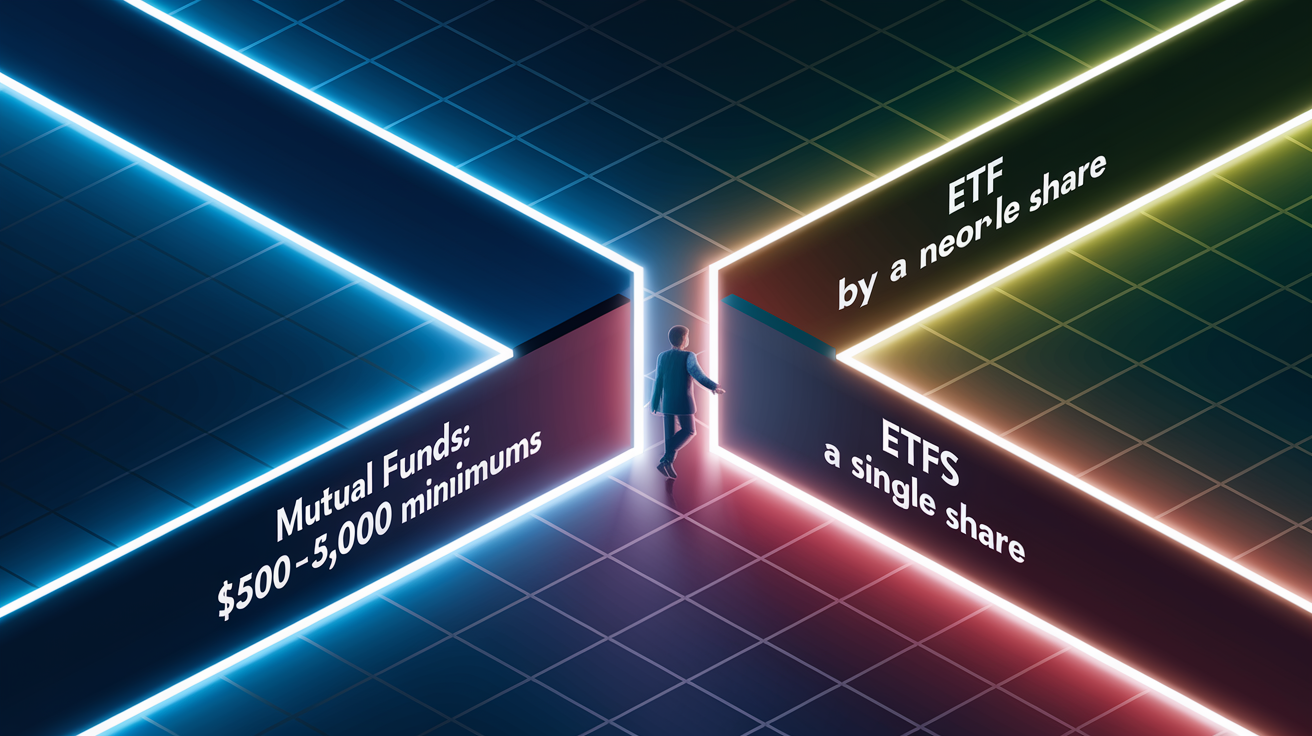
Traditional index mutual funds often set minimums between $500 and $3,000 per fund. Vanguard’s index mutual funds usually require $3,000 to open. Fidelity offers some funds with a $0 minimum, but others sit at $2,500. These minimums exist because mutual funds pool investor money and manage accounts individually, which creates overhead. If you only have $500, a lot of mutual funds will just turn you away.
ETFs solve this. An ETF trades like a stock, so the only minimum is the price of a single share. If an S&P 500 ETF trades at $450 per share, you can buy one share with $500 and have $50 left over. Fractional share programs go further. Brokers like Fidelity, Schwab, and Robinhood let you invest any dollar amount, so your full $500 can go to work even if a share costs $485. You’ll own 1.03 shares instead of leaving cash sitting there.
This shift means $500 isn’t a barrier anymore. You can access the same diversified index funds that large investors use, pay the same low fees, and start compounding returns right away. Account minimums at most major brokerages are $0, and the fund minimums for ETFs are basically whatever you can afford to spend on a single share or fraction.
Choosing a Platform to Invest Your First $500

Most major brokerages now offer commission free trading on ETFs, which means you won’t pay a fee every time you buy or sell. Fidelity, Charles Schwab, Vanguard, and E*TRADE all dropped trading commissions for stocks and ETFs in recent years. This matters when you’re starting with $500 because a $5 or $10 trade fee would eat 1 to 2 percent of your balance immediately. Commission free access keeps your full deposit invested.
Opening an account is straightforward. You’ll provide personal info (name, address, Social Security number), answer a few questions about your job and finances, and link a bank account to move money. The process usually takes 10 to 20 minutes, and most platforms approve new accounts within one business day. A lot of brokers also offer educational tools, research screeners, and mobile apps that make it easy to check your investment and place trades from your phone.
Account type matters for taxes. A taxable brokerage account gives you total flexibility to pull money out anytime, but you’ll owe taxes on dividends each year and capital gains when you sell. A traditional IRA lets you deduct contributions from your taxable income (if you qualify) and defer taxes until retirement, but pulling money out before age 59½ usually triggers a 10 percent penalty. A Roth IRA takes after tax contributions, grows tax free, and lets you withdraw in retirement without owing anything. If you can lock up the $500 until retirement, an IRA often makes sense. If you might need the money sooner, start with a taxable account and keep it simple.
Costs, Fees, and What They Mean When Starting With $500
Fees cut directly into your returns, and when you’re starting with $500, even small percentages add up over time. An expense ratio is the annual fee a fund charges, shown as a percentage of your investment. If you put $500 in an ETF with a 0.03 percent expense ratio, you’ll pay about 15 cents per year. If the same fund charged 1.00 percent, you’d pay $5 annually. That difference sounds tiny today, but over 30 years the higher fee fund could cost you thousands in lost compounding.
Index funds are known for low expense ratios because they just track a benchmark instead of paying analysts to pick stocks. Lots of broad market ETFs charge between 0.03 and 0.10 percent. Actively managed mutual funds often charge 0.50 to 1.50 percent or more, and some tack on sales loads (upfront or back end fees) on top. For a $500 starter, those extra costs are a bad deal.
Here are the common fees to watch:
Expense ratio, the fund’s annual management fee, gets deducted automatically from the fund’s returns. Trading commissions are per trade fees some brokers charge (now $0 at most major platforms for ETFs). Account maintenance fees are monthly or annual charges some brokers put on small accounts (skip brokers that charge these). Sales loads are one time charges when you buy or sell certain mutual funds (stick to no load funds and ETFs).
Check your broker’s fee schedule and the fund’s prospectus before you put money in. A fund with a 0.03 percent expense ratio and $0 commissions will let your $500 grow without friction. A fund with a 1.00 percent ratio and a $20 account fee will quietly drain your balance month after month.
Recommended Index Funds for Small Beginners
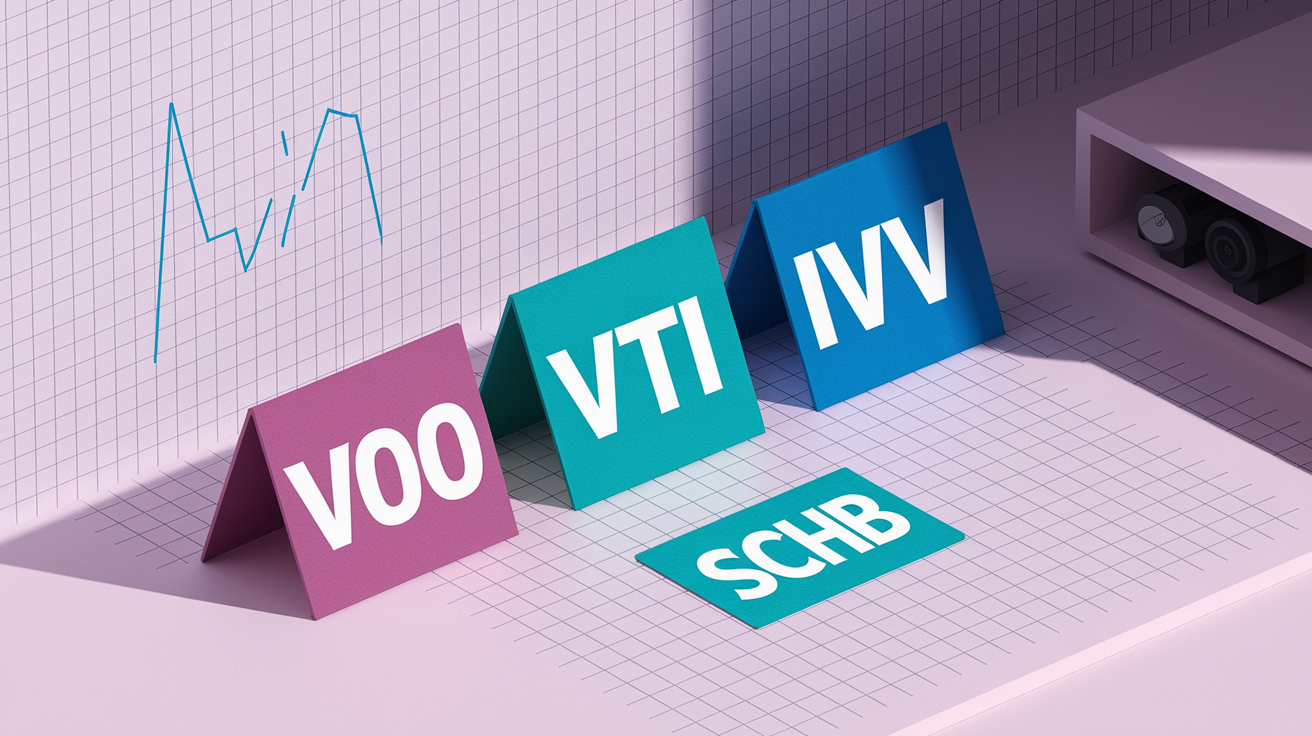
Broad market index funds offer the simplest path to diversification. An S&P 500 fund gives you ownership in 500 of the largest U.S. companies. A total stock market fund goes wider, holding 3,000 or more stocks across every size and sector. An international fund adds exposure outside the United States. All three are passive, cheap, and built for beginners who want to own the market instead of trying to beat it.
These funds come as both mutual funds and ETFs. For a $500 starting balance, ETFs make the most sense because they don’t have fund level minimums and trade commission free at most brokers. You can buy one share, hold it for decades, reinvest dividends, and add more money whenever you’re ready. The expense ratios are nearly the same whether you pick the mutual fund or ETF version, but the ETF gives you more flexibility with a small account.
Below are four widely recommended index funds for beginners. Each offers broad diversification, rock bottom fees, and a long track record.
| Fund Name | Type | Typical Expense Ratio |
|---|---|---|
| Vanguard S&P 500 ETF (VOO) | U.S. Large Cap | 0.03% |
| Vanguard Total Stock Market ETF (VTI) | U.S. Total Market | 0.03% |
| iShares Core S&P 500 ETF (IVV) | U.S. Large Cap | 0.03% |
| Schwab U.S. Broad Market ETF (SCHB) | U.S. Total Market | 0.03% |
Pick one of these funds, invest your $500, and you’ll own a slice of the U.S. economy. If you want international exposure later, you can add a fund like Vanguard Total International Stock ETF (VXUS) with your next deposit. Starting simple keeps decision fatigue low and gets your money working right away.
Dollar Cost Averaging When Starting With $500

Dollar cost averaging means putting in a fixed dollar amount on a regular schedule, no matter what the share price is doing. If you invest $500 today and then add $50 every month, you’ll buy more shares when prices are low and fewer shares when prices are high. Over time, this smooths your average purchase price and takes away the pressure to time the market. It also builds a habit, which matters more than any single lump sum.
Even small monthly contributions add up. If you invest your $500 and then put in $100 per month for 30 years at an average annual return of 7 percent, you’d end up with roughly $122,000. The $500 kickstart gets things rolling, but the $100 per month discipline does the heavy lifting. Starting with $500 and doing nothing else still beats waiting two years to save $1,500, because those two years of market growth are gone forever.
Here are three example monthly contribution levels and what they do:
$25 per month keeps you in the game and builds the investing habit without wrecking a tight budget. $50 to $100 per month adds real growth over time and works for most entry level budgets. $200 or more per month speeds up compounding and can turn a modest start into a six figure portfolio within a couple of decades.
Set up an automatic transfer from your bank to your brokerage on the same day each month. Treat it like a bill. The $500 gives you immediate market exposure, and the recurring deposits turn that single decision into a long term wealth building system.
Step by Step Plan to Invest Your First $500

Here’s a simple roadmap you can follow this week to turn $500 into your first index fund investment.
Choose a brokerage that offers commission free ETF trading and no account minimums. Fidelity, Schwab, Vanguard, or E*TRADE are all solid starting points.
Open an account online by entering your personal info, Social Security number, and bank details. Decide whether you want a taxable account or an IRA based on your timeline and tax situation.
Fund the account by linking your checking account and starting an electronic transfer of $500. This usually takes one to three business days to clear.
Research and pick one broad index fund. A total stock market ETF like VTI or an S&P 500 ETF like VOO are both beginner friendly and cheap.
Place a market order during trading hours to buy shares right away at the current price, or use a limit order if you want to set the maximum price you’re willing to pay.
Turn on automatic dividend reinvestment in your account settings so every dividend payment buys more shares without you doing anything.
Set up a recurring monthly transfer of any amount you can stick with ($25, $50, or $100) to keep building your position and take advantage of dollar cost averaging over time.
Final Words
Start now: $500 is enough to begin investing in index funds.
We walked through why (fractional shares, no-minimum ETFs), typical minimums and fees, how to pick a platform, fund choices, dollar-cost averaging, and a simple step-by-step plan to get your money working.
If you still wonder, is $500 enough to start investing in index funds? Yes, with smart choices and ongoing deposits it gets you in the game and starts compounding. Small start, steady habit. You’ve got this.
FAQ
Q: What if I invested $500 a month in S&P 500?
A: Investing $500 a month in the S&P 500 would likely build substantial savings over decades through compound growth and dollar-cost averaging, but returns vary and losses can happen; keep a long-term plan.
Q: How much money is needed to start an index fund?
A: The amount needed to start an index fund depends: ETFs (exchange-traded funds, trade like stocks) need only one share or fractional shares, while many mutual index funds have minimums around $500–$3,000.
Q: Is $500 a good amount to start investing?
A: A $500 start is a good amount: it’s enough to buy ETFs or fractional shares (partial shares) and begin compounding, though growth is slower unless you add regular contributions.
Q: What should I invest $500 in right now?
A: With $500 right now you should consider a low-cost broad-market ETF (trades like a stock) such as an S&P 500 or total-market fund, or a target-date fund (automated mix), matched to your timeline and risk.