

Putting your extra cash in the stock market before fixing high-interest debt is one of the biggest money mistakes people keep making.
A simple order helps: emergency fund first, then capture the employer match, pay off high-rate debt, and only after that fund a Roth IRA, HSA, or 401(k).
That sequence reduces the chance you’ll borrow at high interest, locks in guaranteed returns, and boosts long-term compounding.
If you want a clear, money-first checklist that actually moves the needle, this post lays out the exact steps and why they matter.
The Prioritized Order of Investing: Your Step-by-Step Roadmap

The order you allocate money across accounts and debts makes or breaks your long-term financial results. Most people skip around randomly. Some months they pump cash into a brokerage, other months they chase high-yield savings, and they end up leaving thousands on the table. A clear hierarchy reduces risk first, then captures tax benefits, and finally focuses on compounding. That means you protect yourself from emergencies, grab every dollar of employer match, kill high-interest debt, and only then start stacking up retirement accounts.
Each step builds on the last. You can’t afford to invest if one unexpected car repair wipes out your checking account and forces you onto a credit card at 18 percent. You can’t beat a guaranteed 100 percent return from an employer match by picking stocks. You can’t out-earn 16 percent interest on a credit card with any sensible strategy. The hierarchy works because it ranks moves by their math and their safety.
Interest rates, contribution limits, and tax rules drive the logic. A Roth IRA shields growth from taxes forever if you follow the 5-year and age 59½ rules. An HSA offers a triple tax advantage if you qualify. A 401(k) lets you defer income tax today and contribute far more than an IRA. Taxable accounts come last because they cost you the most in taxes each year. Understanding the thresholds tells you where the next dollar does the most work.
Here’s an example. You bring home $4,000 a month after taxes. You set aside $500 for your emergency fund until you hit three months of expenses. Then you bump your 401(k) contribution to capture the full employer match, maybe $200 a month. You throw $300 a month at your $5,000 credit card balance at 19 percent. Once the card’s gone, you open a Roth IRA and fund it with $541 a month to hit the annual $6,500 limit. That sequence, in that order, saves you more and builds more wealth than jumping straight into a taxable brokerage or trying to pay off a 3 percent car loan first.
The 10-step order, from highest to lowest priority:
- Emergency fund. 3 to 6 months of living expenses in cash or a savings account so you never borrow at high interest during a crisis.
- Employer 401(k) match. Contribute at least enough to capture the full match, which is an immediate guaranteed return.
- High-interest debt (above 5 percent). Pay off credit cards and personal loans because the interest cost exceeds any reasonable investment return.
- Roth IRA. Contribute up to the annual limit for tax-free growth if you meet the 5-year rule and withdraw after 59½.
- Health Savings Account (HSA). If you have a qualified high-deductible health plan, fund the HSA for triple tax benefits.
- 529 education plan. If you’re saving for a child’s college, contribute here for tax-free growth on qualified expenses.
- Max out 401(k). Increase contributions beyond the match to the annual limit to reduce taxable income and build retirement savings.
- Taxable brokerage account. Invest here once all tax-advantaged options are filled, using index funds to minimize annual tax drag.
- Low-interest debt (below 5 percent). Pay down student loans, car loans, or other debts with modest rates if you prefer certainty over market risk.
- Mortgage payoff. Optional late-stage move depending on your mortgage rate, time horizon, and appetite for guaranteed returns versus market exposure.
Building the Foundation: Emergency Fund and Short-Term Liquidity in Your Investing Order

An emergency fund sits at the top of the priority list because it keeps you from taking on new debt when something breaks. A $4,000 transmission repair or a surprise medical bill can wipe out progress if you don’t have cash ready. A Bankrate survey found that 39 percent of Americans could cover a $1,000 emergency from savings. That means the majority would need to borrow. And that borrowing almost always happens on a credit card at 16 to 20 percent interest, suddenly costing you hundreds in interest on a problem that started at a thousand.
The standard target is 3 to 6 months of living expenses. If your rent, utilities, groceries, insurance, and minimum debt payments add up to $3,000 a month, aim for $9,000 to $18,000. Three months works if you have stable income, low fixed costs, and no dependents. Six months makes sense if you’re self-employed, work on commission, have a single-income household, or support kids or aging parents. Store the money in a high-yield savings account or a brokered CD ladder so you earn a little interest without risking principal or locking up access.
Size your fund to match your reality. A two-income household with secure jobs and minimal fixed costs can lean toward three months. A freelancer with variable income and a mortgage should target six months or more. The fund loses a bit of purchasing power to inflation each year, but the peace of mind and the protection from forced borrowing are worth far more than the opportunity cost of investing that cash.
Key emergency fund rules:
- Set the target at 3 to 6 months of essential living expenses.
- Store the money in a savings account or short-term CDs for easy access.
- Build the fund before investing beyond the employer match.
- Increase the target if you have dependents, variable income, or high fixed costs.
- Replace any withdrawn funds as quickly as possible after an emergency.
Capturing Free Money First: Employer Match in the Investing Priority Order

The employer match is the only truly guaranteed return in investing. If your employer matches 100 percent of your contributions up to 4 percent of your salary, you double your money immediately. On a $100,000 salary, contributing $4,000 gets you another $4,000 from the company. That’s a 100 percent return before the market does anything. No other investment offers that combination of certainty and scale, which is why the match sits right after the emergency fund in every sound priority list.
Vesting rules determine when the employer’s contributions actually become yours. A common vesting schedule runs three years. You forfeit the match if you leave before hitting that anniversary. Some companies vest immediately, others use a graded schedule where you keep a percentage each year. Check your plan documents before switching jobs. If you’re close to vesting and considering a move, waiting a few more months can be worth thousands of dollars. If you’re already vested or your new employer offers a better match, the decision shifts.
Automation ensures you never miss the match. Set your payroll deduction to at least the percentage required for full employer contributions. Most people set it and forget it, letting the match accumulate every paycheck without thinking about it. If you get a raise, bump the contribution percentage so the match grows with your income. The earlier you start, the more decades that free money compounds.
Quick employer match checklist:
- Confirm the match formula. Common examples: 100 percent up to 3 percent, 50 percent up to 6 percent.
- Check the vesting schedule and mark the date on your calendar.
- Set payroll deduction to capture the full match from day one.
- Revisit the contribution percentage after every raise or job change.
Eliminating High-Interest Debt Before Investing Further

High-interest debt is anything above 5 percent. Credit cards routinely charge 16 to 20 percent or more. Paying down a balance at 18 percent gives you an immediate, guaranteed 18 percent return, which beats the long-term stock market average and comes with zero risk. An example proves the point. You have $5,000 on a card at 20.4 percent APR. Over 12 months, that balance costs you roughly $1,121 in interest if you make only minimum payments. If instead you invest $1,000 a month at a 6.5 percent annual return and pay 15 percent tax on gains, you earn about $309 after tax. The debt costs you $1,121. The investment earns you $309. Paying the debt wins by a wide margin.
Negative compounding works against you every month you carry a balance. Interest piles onto interest, and your minimum payment barely touches principal. Positive compounding works for you when you invest, but only if the return exceeds the interest rate on your debt. When the debt rate is three or four times higher than a realistic investment return, the math is clear. Kill the debt.
Use the Avalanche method if you want to minimize total interest paid. List all your high-interest debts by rate, pay minimums on everything, and throw every extra dollar at the highest-rate balance. Once that’s gone, roll the payment to the next-highest rate. Use the Snowball method if you need psychological momentum. List debts by balance, smallest to largest, and knock out the smallest first. The Avalanche saves more money. The Snowball builds faster wins. Both work. Pick the one that keeps you consistent.
Incorporating Roth IRA and IRA Strategy Into Your Investing Order

A Roth IRA takes after-tax money today and lets it grow tax-free forever if you follow two rules: leave it in the account for at least five years and wait until you’re 59½ to take qualified withdrawals. That means every dollar of growth, dividends, and capital gains comes out tax-free in retirement. For 2023, you can contribute $6,500 if you’re under 50 and $7,500 if you’re 50 or older. Income limits apply. For married couples filing jointly, the phaseout starts above $214,000, and direct contributions are prohibited above a higher threshold. If you earn too much, look into the Backdoor Roth strategy, which involves contributing to a traditional IRA and immediately converting to Roth.
A traditional IRA works the opposite way. Contributions may be tax-deductible now, reducing your taxable income for the year, but withdrawals in retirement are taxed as ordinary income. You also face a 10 percent penalty if you take money out before 59½, with some exceptions like first-time home purchase or qualified education expenses. Whether you can deduct a traditional IRA contribution depends on your income and whether you or your spouse are covered by a workplace retirement plan. The same contribution limits apply: $6,500 under 50, $7,500 at 50 or older. You can split contributions between Roth and traditional, but the combined total can’t exceed the annual limit.
IRAs sit after the employer match and high-interest debt because they offer more investment flexibility and typically lower fees than many 401(k) plans. Most IRAs let you buy individual stocks, a wide range of ETFs, and low-cost index funds. Many 401(k) plans lock you into a limited menu with higher expense ratios. Filling your IRA first gives you control and keeps more of your return.
IRA priority checklist:
- Check income limits for Roth IRA eligibility each year.
- Consider Backdoor Roth if you exceed the income cap.
- Compare tax brackets now versus expected retirement brackets to choose Roth or traditional.
- Max the IRA contribution before adding to 401(k) beyond the match.
- Track the 5-year rule start date for Roth conversions and contributions.
| IRA Type | Tax Treatment | Best Use Case |
|---|---|---|
| Roth IRA | After-tax contributions; tax-free qualified withdrawals | Expect higher tax bracket in retirement or want tax-free growth |
| Traditional IRA | Potential tax deduction now; taxed as income on withdrawal | Expect lower tax bracket in retirement or need deduction today |
Where HSAs Fit in the Order of Investing
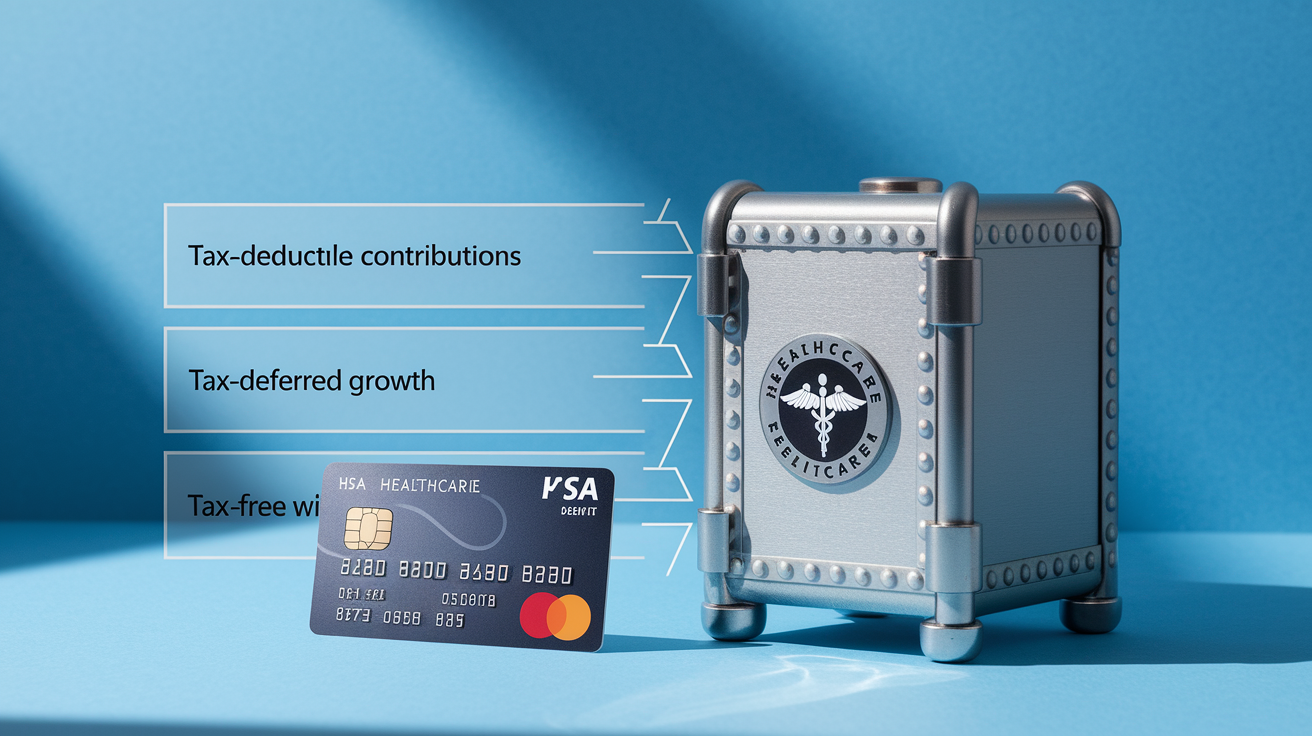
A Health Savings Account offers a triple tax advantage that no other account can match. Contributions are tax-deductible, the money grows tax-deferred, and withdrawals for qualified medical expenses are completely tax-free. For 2023, you can contribute up to $3,850 if you have self-only coverage or $7,750 for family coverage, with an extra $1,000 catch-up if you’re 55 or older. The catch is you must be enrolled in a qualified high-deductible health plan to contribute. If your employer offers a lower-deductible plan or you’re on a spouse’s plan that doesn’t qualify, you can’t use an HSA.
Most people place the HSA after the Roth IRA or alongside it. If you expect significant medical expenses in retirement, and most people do, the HSA acts like a specialized Roth account for health care. If you’re healthy now and can pay current medical bills out of pocket, let the HSA grow untouched. After age 65, you can withdraw HSA funds for non-medical expenses and pay only ordinary income tax, just like a traditional IRA. That flexibility makes the HSA a powerful retirement vehicle if you max it early.
Verify your health plan qualifies before contributing. The IRS sets minimum deductible thresholds and maximum out-of-pocket limits each year. If you switch jobs or your employer changes plans, recheck eligibility. Contributing to an HSA when you’re not eligible triggers taxes and penalties.
HSA advantages and rules:
- Tax-deductible contributions reduce taxable income for the year.
- Tax-deferred growth on investments inside the account.
- Tax-free withdrawals for qualified medical expenses at any age.
- After 65, non-medical withdrawals are taxed as income but no penalty applies.
Advancing to Max 401(k) Contributions in the Investing Sequence

Once you’ve captured the employer match, eliminated high-interest debt, filled your Roth IRA, and funded your HSA, the next step is increasing 401(k) contributions up to the annual limit. For 2023, that limit is $22,500 if you’re under 50 and $30,000 if you’re 50 or older. Unlike IRAs, 401(k) plans have no income caps on contributions, so high earners can defer a large chunk of salary and reduce taxable income immediately. Some plans also offer a Roth 401(k) option, which works like a Roth IRA but with much higher contribution limits.
Maxing the 401(k) makes sense at this stage because you’ve already secured liquidity, captured free money, removed expensive debt, and filled the most flexible tax-advantaged accounts. The 401(k) is less flexible than an IRA. Most plans charge fees, limit investment choices, and penalize early withdrawals. But the higher contribution ceiling and the tax deferral outweigh those downsides once the earlier steps are done. If your employer offers low-cost index funds in the 401(k), the difference between the 401(k) and an IRA shrinks.
Automate the increase gradually if jumping straight to the max feels too tight. Bump your contribution percentage by 1 or 2 percent every quarter or after every raise. Most people adjust to the smaller paycheck within a month and never notice the difference. The compounding benefit over decades is massive. An extra $5,000 a year starting at age 30, growing at 7 percent, adds more than $750,000 by age 65.
The Role of Taxable Brokerage Accounts in the Order of Investing

Taxable brokerage accounts have no contribution limits, no income caps, and no rules about when or how you take money out. That flexibility comes at a cost. You pay taxes on dividends and interest every year, and you owe capital gains tax when you sell investments at a profit. Long-term capital gains, on assets held more than a year, are taxed at lower rates than ordinary income, but you still lose a slice to the IRS annually. That makes taxable accounts the last priority for most people, used only after every tax-advantaged option is filled.
The timing matters. If you max your 401(k), IRA, and HSA, and you still have money to invest, the taxable account is the right next step. If you haven’t filled those accounts yet, putting money into a taxable brokerage is leaving tax savings on the table. The gap compounds over decades. A dollar in a Roth IRA grows tax-free. A dollar in a taxable account loses a bit to taxes every year.
When you do invest in a taxable account, use tax-efficient strategies to keep more of your return. Index funds and ETFs are better than actively managed mutual funds because they generate fewer taxable events. Holding investments for more than a year qualifies gains for the lower long-term rate. Municipal bonds pay interest that’s often exempt from federal tax. These choices add up.
Tax-efficient taxable account practices:
- Use index ETFs or total-market funds to minimize turnover and taxable distributions.
- Hold investments longer than one year to qualify for long-term capital gains rates.
- Consider municipal bonds if you’re in a high tax bracket and need income.
Including Low-Interest Debt and Mortgage in Your Investing Order

Low-interest debt sits near the bottom of the priority list because the opportunity cost of paying it off early is often higher than the guaranteed return. Debts below 5 percent, many student loans, car loans, and mortgages, cost less than the long-term expected return from a diversified stock portfolio. If your car loan charges 4 percent and the market averages 7 percent over the next decade, you’re better off investing the extra cash than paying off the car. That’s the math, anyway. The emotional side is different. Some people sleep better with zero debt, and that peace of mind is a real benefit even if it costs a point or two of return.
Mortgages are the biggest and most common low-interest debt. A mortgage locked in at 2 to 4 percent during the low-rate years of the 2010s and early 2020s is almost free money when you account for inflation. Paying off a 3 percent mortgage early gives you a guaranteed 3 percent return. Investing that money in the market gives you an expected 7 to 9 percent return with significant short-term volatility. If you have 15 or 20 years until retirement, the market bet usually wins. If you’re within five years of retirement or you can’t handle a 20 percent drawdown without panicking, paying off the mortgage makes sense.
Low-interest debt payoff is optional and personal. The recommended sequence puts it after taxable investing, but you can swap the order if eliminating debt fits your goals and risk tolerance better. The flexibility is the point. There’s no universal right answer once you’re past the high-interest debt and the tax-advantaged accounts.
| Debt Type | Typical Rate | Suggested Priority |
|---|---|---|
| Credit card | 16–20% | Pay off immediately, before most investing |
| Student loan (variable or high-rate) | 6–10% | Pay off after employer match, before Roth IRA |
| Car loan, student loan (low-rate), mortgage | 2–5% | Pay off after taxable investing, or keep and invest |
Keeping Your Investing Order on Track Over Time

Life changes faster than most financial plans. You switch jobs, get married, have kids, move states, change health plans, or see your income jump or drop. Each of those shifts can change the optimal investing order. A new employer might offer a better 401(k) match or no match at all. A raise might push you over the Roth IRA income limit. A new health plan might disqualify you from HSA contributions. A vesting schedule might mean waiting six more months before the employer match is truly yours. Checking your plan once or twice a year keeps you from missing opportunities or making contributions you’re not eligible for.
Annual contribution limits and income thresholds change almost every year. The IRS adjusts them for inflation, and the changes can be significant. What worked in 2023 might not work in 2024. Bookmark the IRS updates or set a calendar reminder every November to review the new numbers. If you’re close to an income phaseout, run the projection early in the year so you can adjust contributions before December.
Flexibility is built into the framework. If a step doesn’t apply to you, no employer match, no HSA eligibility, no mortgage, skip it and move to the next one. If your situation is unusual, large inheritance, stock options, rental property income, the standard order is a starting point, not a rulebook. The sequence works because it handles the most common scenarios for most people, but your life might demand a different order. The principles stay the same: safety first, capture free money, kill expensive debt, fill tax-advantaged space, then invest the rest.
Recurring investing order review checklist:
- Confirm employer match rules and vesting status if you changed jobs or your employer updated the plan.
- Check the current year’s contribution limits for 401(k), IRA, HSA, and 529 plans.
- Verify Roth IRA and HSA eligibility based on updated income and health plan status.
- Review debt interest rates and balances to see if any moved above or below the 5 percent threshold.
- Revisit your emergency fund target if your fixed expenses, dependents, or income stability changed.
- Adjust contribution percentages to reflect raises, bonuses, or changes in cash flow.
Final Words
Start with a 3–6 month cash cushion, grab your employer match, and pay high-interest debt. Then favor Roth IRA, HSA, boost 401(k), and only after that use taxable accounts or tackle low-interest loans.
That order moves from safety to tax savings to growth: cash avoids forced sales, matches are free money, and high-rate debt usually beats investing returns.
If you can spare only a bit each month, automate the match, build a small buffer, then send extras to the next step. Treat this order of investing as a checklist, review it yearly, and keep going—small steps add up.
FAQ
Q: What is the 7 5 3 1 rule?
A: The 7 5 3 1 rule is not a single standard finance rule; people use that pattern for different budgeting or priority guides, so share the context (budgeting, debt, or investing) for a clear explanation.
Q: What is the 70/20/10 rule money?
A: The 70/20/10 rule splits take-home pay: 70% for living costs, 20% to saving and investing, and 10% for debt repayment or giving, as a simple budgeting guideline.
Q: How many Americans have $1,000,000 in retirement savings?
A: Roughly one in ten Americans have $1,000,000 or more in retirement savings, though the exact share varies a lot by age group and which survey you use.
Q: How to turn $1000 into $5000 in a month?
A: Turning $1,000 into $5,000 in a month is possible but rare and risky; practical paths are selling stuff, freelancing, flipping items, or high-risk trading, and you should expect possible loss.