

Think it’s too late to catch up on retirement savings? Think again.
If you’re 50 or older, catch-up contributions let you add extra to your 401(k) and IRA, so you can boost savings fast and make up for years you couldn’t save.
This post explains who qualifies, the 2025–2026 limits, and the SECURE 2.0 changes that affect Roth catch-ups and higher limits for ages 60 to 63.
You’ll get simple steps to use catch-ups this year and the common pitfalls to avoid.
What Catch-Up Contributions Are and Who Qualifies

Catch-up contributions are extra amounts you can put into retirement accounts once you hit 50. The IRS built this rule to help people who started saving late or had years when they couldn’t save much. Think of it as a legal way to make up for lost time before retirement.
You qualify if you turn 50 by December 31 of the contribution year. That’s it. If your birthday lands in March, you can start catch-ups in January of the year you turn 50. Applies whether you’re working full time, part time, or switching jobs.
The catch-up amount sits on top of the standard limit. In 2024, the standard 401(k) limit is $23,000. If you’re 50 or older, you can add $7,500 more, totaling $30,500. That extra $7,500 is your catch-up space. For IRAs, the 2024 base is $7,000 and the catch-up is $1,000, so you can put in $8,000 total.
Catch-ups work in most employer plans: 401(k), 403(b), 457(b), and SIMPLE plans. They also work in Traditional and Roth IRAs. Each plan type has its own catch-up amount and rules about how you elect it.
You don’t need to prove you’re behind on savings or file special paperwork. Just need to be old enough and have the income to contribute. Your plan administrator handles the bookkeeping. Most payroll systems flag your age automatically once you hit 50 and let you increase deferrals.
One timing note: employer-plan contributions happen through payroll during the calendar year. IRA contributions for a tax year can be made up until tax filing deadline, usually April 15 of the following year. Gives you extra months to fund an IRA catch-up if you missed it during the calendar year.
If you have access to both an employer plan and an IRA, you can use catch-up space in both accounts in the same year. The limits are separate. A 52-year-old could defer $30,500 into a 401(k) and contribute $8,000 to an IRA, all in 2024, as long as income and plan rules allow.
SECURE 2.0 Act Changes to Catch-Up Rules

The SECURE 2.0 Act made two big changes to catch-ups. First is a new Roth requirement for high earners. Second is an optional higher catch-up amount for people aged 60 to 63. Both changes shift how late-stage savers plan their contributions.
The Roth catch-up rule was supposed to start in 2024 but got delayed. Starting January 1, 2026, any worker age 50 or older who earned more than $145,000 in FICA wages in the prior year must make catch-up contributions to employer plans on a Roth basis. That means no more pre-tax catch-ups if you’re over that income threshold.
The $145,000 limit is indexed to inflation and measured by your prior year’s FICA wages. FICA wages are the amount reported in Box 3 of your Form W-2. Usually close to your gross salary but can differ if you have pre-tax benefits like health insurance or 401(k) deferrals. Check Box 3 on last year’s W-2 to see if you cross the threshold.
If you earned $100,000 in 2025, you can still make pre-tax catch-ups in 2026. If you earned $160,000 in 2025, your 2026 catch-ups must go into a Roth account. Your payroll system should handle this automatically once the rule goes live, but confirm with HR that your employer’s plan has been updated.
The Roth requirement applies only to employer plans like 401(k)s and 403(b)s. It doesn’t apply to IRAs. You can still choose between Traditional and Roth IRAs for your IRA catch-ups, regardless of income (subject to normal Roth IRA income phaseout rules).
The second SECURE 2.0 change is the “super” catch-up for ages 60 to 63. This provision lets employers offer a larger catch-up limit during those four years. For 2025, that higher limit is expected to be around $11,250 instead of the standard $7,500, giving someone age 61 the ability to contribute up to $34,250 to a 401(k) if their employer adopts the rule.
The super catch-up is optional. Not all employers will offer it. If your plan hasn’t adopted it, you’re still limited to the standard $7,500 catch-up. Check your plan’s summary description or ask your benefits team whether the enhanced catch-up is available and when it goes into effect.
Both changes require plan amendments. Employers had until the end of 2025 to update their plans for the Roth requirement. Some may have delayed implementation or needed more time to adjust payroll systems. If you’re unsure how your plan handles these rules, reach out to your plan administrator before you hit the January 2026 deadline.
2025 and 2026 Contribution Limits by Plan Type
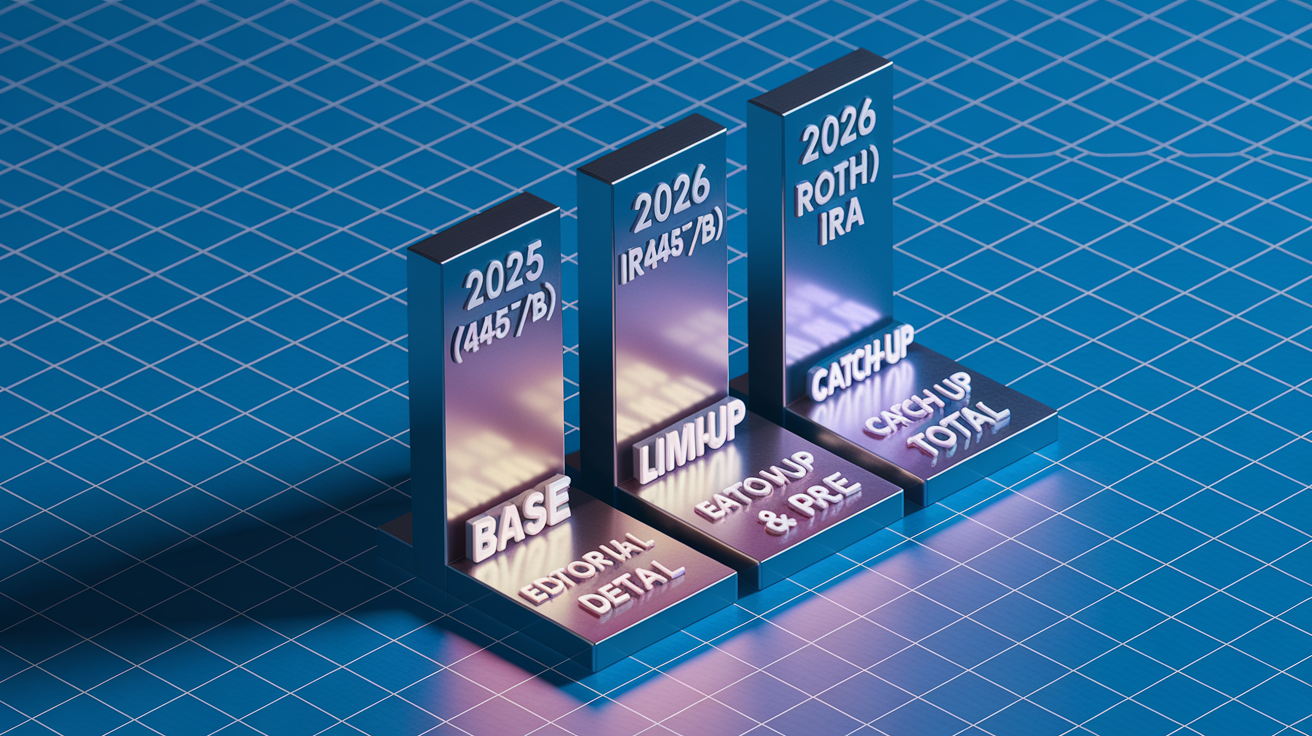
Contribution limits change every year based on inflation. Here are the numbers you need for 2025 and 2026 across major retirement plan types.
| Plan Type | 2025 Base Limit | 2025 Catch-Up (50+) | 2025 Total (50+) | 2026 Base Limit | 2026 Catch-Up (50+) | 2026 Total (50+) |
|---|---|---|---|---|---|---|
| 401(k), 403(b), 457(b) | $23,500 | $7,500 | $31,000 | $24,500 | $8,000 | $32,500 |
| SIMPLE IRA/401(k) | $16,500 | $3,500 | $20,000 | $17,000 | $3,500 | $20,500 |
| Traditional and Roth IRA | $7,000 | $1,000 | $8,000 | $7,500 | $1,100 | $8,600 |
For 401(k) plans, the 2026 elective deferral limit is $24,500. If you’re 50 or older, you can add $8,000 in catch-up for a combined $32,500. That’s $1,500 more than 2025. Applies to 403(b) and most 457(b) plans too.
SIMPLE plans are designed for smaller employers. In 2026, the base limit is $17,000 and the catch-up is $3,500, giving a 50-year-old a total of $20,500. SIMPLE catch-ups are smaller because the plans themselves have lower overall limits.
IRA limits grew modestly. In 2025, someone age 50 or older could contribute $8,000 total to an IRA. In 2026, that rises to $8,600, split between a $7,500 base and a $1,100 catch-up. The IRA catch-up is much smaller than the 401(k) catch-up, but IRAs remain useful for people without access to an employer plan or who want to save beyond their 401(k).
These limits apply per person, not per account. If you have two Traditional IRAs, your total contributions across both can’t exceed $8,600 in 2026. If you work two jobs and both offer 401(k)s, your combined elective deferrals across both plans can’t exceed $32,500 (including catch-ups). Employer contributions don’t count toward your elective deferral limit, but they do count toward the overall annual addition limit.
The annual addition limit for 2026 is expected to be around $70,000 for most plans (exact number to be announced by IRS). That cap includes your deferrals, catch-up contributions, employer matches, and profit-sharing contributions. Very few people hit this ceiling, but if you have a high match or profit-sharing plan, worth checking.
Roth IRA contributions are subject to income phaseout rules. In 2025, single filers start to phase out at modified adjusted gross income (MAGI) of $150,000 and are fully phased out at $165,000. Married filing jointly phases out between $236,000 and $246,000. For 2026, those thresholds will adjust slightly for inflation. If your income is too high to contribute directly to a Roth IRA, consider the backdoor Roth strategy.
SIMPLE plan limits apply if your employer offers a SIMPLE IRA or SIMPLE 401(k). Common at small businesses. The lower limits reflect simpler plan rules and lower administrative costs. If you’re age 50 or older and work for a small employer with a SIMPLE plan, your catch-up space is $3,500 in both 2025 and 2026.
The Super Catch-Up for Ages 60 to 63

SECURE 2.0 created a higher catch-up amount for people aged 60, 61, 62, and 63. Designed to give workers in their early 60s one last push before retirement. Sometimes called the “enhanced” or “super” catch-up.
For 2025, the enhanced catch-up is expected to be $11,250 (this is an estimate, exact numbers depend on IRS indexing). That’s $3,750 more than the standard $7,500 catch-up. In 2026, projected to rise to around $12,000. These amounts replace the regular catch-up during the four-year window. You don’t get both.
The super catch-up applies only to employer plans: 401(k), 403(b), and governmental 457(b) plans. Doesn’t apply to IRAs. If you’re 61 and eligible for the super catch-up in your 401(k), your IRA catch-up remains $1,100 (2026 number).
Not all employers will offer this. The super catch-up is optional. Employers must amend their plan documents to allow it. Some may adopt it quickly, others may wait, and some may never offer it. Ask your HR department or plan administrator whether your plan has adopted the ages-60-to-63 provision and when it takes effect.
If your plan does offer it, you become eligible on January 1 of the year you turn 60. You remain eligible through December 31 of the year you turn 63. On January 1 of the year you turn 64, you revert to the standard age-50-plus catch-up.
Example: Say you turn 61 in March 2026 and your employer adopted the super catch-up. You can contribute $24,500 (the base 2026 limit) plus $12,000 (the enhanced catch-up), for a total of $36,500 in 2026. Someone who is 55 in the same plan can contribute $24,500 + $8,000 = $32,500. The extra $4,000 is your super catch-up advantage.
The super catch-up amount is indexed to inflation and will rise over time. Calculated as the greater of $10,000 (in 2025 dollars, indexed) or 150 percent of the standard age-50 catch-up for that year. The IRS publishes the final number each fall for the following year.
When you turn 64, you lose access to the super catch-up and return to the standard catch-up. If the standard catch-up is $8,000 in 2026, that’s what you’ll use from age 64 onward (until limits change again). The four-year window is a one-time opportunity to speed up contributions before you retire or cut back hours.
If your employer doesn’t offer the super catch-up yet, consider asking benefits or HR to adopt it. Many employers are still reviewing SECURE 2.0 provisions and may add this feature in 2025 or 2026. Until they do, you’re limited to the standard catch-up.
How Catch-Up Contributions Are Taxed
Catch-up contributions can be either pre-tax (traditional) or after-tax (Roth), depending on your plan and the new SECURE 2.0 rules. Understanding the tax treatment matters because it changes how much hits your paycheck now and how much you keep in retirement.
Pre-tax catch-ups work like regular traditional 401(k) contributions. You defer income before tax is calculated, lowering your taxable income for the year. If you earn $80,000 and contribute $10,000 in catch-ups, your taxable income drops to $70,000. Saves you tax now. The money grows tax-deferred, and you pay ordinary income tax when you withdraw it in retirement.
Roth catch-ups are made with after-tax dollars. You pay income tax on the full amount before it goes into the account. If you contribute $10,000 Roth, your taxable income stays $80,000, and you take home less because tax is withheld. The upside is that the money grows tax-free, and qualified withdrawals (after age 59½ and a five-year holding period) are completely tax-free.
Starting in 2026, high earners must use Roth for catch-ups. If your prior-year FICA wages (Box 3 on your W-2) exceed $145,000, all catch-up contributions to employer plans must be Roth. You lose the option to make pre-tax catch-ups. This rule applies only to the catch-up portion. Your regular deferrals up to the base limit ($24,500 in 2026) can still be pre-tax or Roth, your choice.
Here’s what that looks like. You’re 52, you earned $160,000 in 2025, and you want to max out your 401(k) in 2026. You can contribute $24,500 as either pre-tax or Roth (your choice). But the $8,000 catch-up must be Roth. Your employer’s payroll system should route it correctly once the 2026 rule is live.
If you earned $130,000 in 2025, you’re under the $145,000 threshold. You can choose whether your 2026 catch-up is pre-tax or Roth. The forced-Roth rule doesn’t apply to you.
Roth catch-ups have different effects on your budget. Because tax is withheld up front, your paycheck shrinks more than it would with pre-tax contributions. If your marginal tax rate is 24 percent, an $8,000 Roth catch-up costs you about $1,920 more in current-year taxes than a pre-tax catch-up would. Plan your cash flow accordingly.
The long-term benefit of Roth is tax-free withdrawals and no required minimum distributions (RMDs) during your lifetime if the money is in a Roth 401(k) or Roth IRA. Pre-tax accounts require RMDs starting at age 73 (or 75, depending on your birth year), and those distributions are fully taxable. Roth accounts inside employer plans (Roth 401(k)) had RMDs before 2024. SECURE 2.0 eliminated RMDs for Roth 401(k)s starting in 2024. Roth IRAs never had RMDs.
If your employer plan doesn’t offer a Roth 401(k) option, you can’t make Roth catch-ups there. And if you’re subject to the 2026 Roth requirement, you have two choices: contribute catch-up amounts to a Roth IRA (if you’re within income limits), or use a backdoor Roth conversion. Talk to your plan administrator and a tax advisor if this applies to you.
Employer matching contributions are always pre-tax, even if your own contributions are Roth. If you contribute $8,000 Roth catch-up and your employer matches part of it, the match goes into a traditional (pre-tax) account. Most plans don’t match catch-up deferrals, but confirm your plan’s rules.
One tax quirk: if you make both pre-tax and Roth contributions in the same year, your plan tracks them in separate buckets. Withdrawals come from the pool you choose (or the plan’s default order). Pre-tax withdrawals are taxed. Roth withdrawals (if qualified) are not. Keep records of which contributions were Roth, especially if you change jobs or roll accounts over.
Step-by-Step: Enrolling in Catch-Up Contributions

Setting up catch-up contributions takes a few simple steps. Most of the work happens through your employer’s benefits portal or HR department.
Step 1: Confirm your eligibility. You must be age 50 or older by December 31 of the contribution year. Check your birthdate and the current year. If you turn 50 in November 2026, you’re eligible for the full year 2026. Younger? You have to wait.
Step 2: Check your prior-year FICA wages if you’re nearing the $145,000 threshold. Pull your 2025 Form W-2 and look at Box 3. Over $145,000? Your 2026 catch-ups must be Roth. Under? You can choose pre-tax or Roth (assuming your plan offers both).
Step 3: Verify your plan offers catch-up contributions. Most 401(k), 403(b), and 457 plans allow them, but a few don’t. Log into your plan’s website or call the plan administrator. Ask: “Does this plan allow age-50-plus catch-up contributions, and are they available as Roth, pre-tax, or both?” If your plan doesn’t offer Roth and the 2026 rule requires it, ask what your options are.
Step 4: Decide how much to contribute. Figure out how much extra you can afford each paycheck. Paid twice a month (24 paychecks a year) and you want to contribute the full $8,000 catch-up in 2026? That’s about $333 per paycheck. Want the full $32,500 (base + catch-up)? About $1,354 per paycheck. Run the numbers against your take-home pay and budget.
Step 5: Update your payroll deferral election. Most employers have an online benefits portal. Log in, find your retirement plan section, and increase your deferral percentage or dollar amount. Many systems have a separate field for “catch-up contributions” once you’re age 50. Don’t see it? Contact HR. Tell them you want to start or increase catch-up deferrals and specify the amount or percentage. Ask them to confirm whether the catch-up will be pre-tax or Roth (or let you choose).
Step 6: Specify pre-tax or Roth (if you have a choice). If your plan offers both and you’re not subject to the forced-Roth rule, pick one. Pre-tax lowers your taxable income now. Roth gives you tax-free withdrawals later. Required to use Roth? Make sure the system routes your catch-up correctly. Double-check the confirmation screen or email.
Step 7: Confirm the change in your next paycheck. Once the election is processed, your next pay stub should show the increased deferral. Look for a line item labeled “401k catch-up” or “Roth 401k” and verify the amount. Wrong? Call payroll immediately. Mistakes are easier to fix early in the year.
Step 8: Monitor your account balance and contribution totals. Log into your retirement account every few months and check your year-to-date contributions. Make sure they don’t exceed the legal limits ($32,500 for someone 50+ in a 401(k) in 2026, for example). Change jobs mid-year or have two employers? You’re responsible for tracking combined contributions across plans.
Step 9: Contribute to an IRA if you want to save more. You can make IRA contributions in addition to your employer plan. For 2026, that’s up to $8,600 if you’re 50 or older. You have until the tax-filing deadline (usually April 15, 2027) to fund your 2026 IRA. Open an IRA at a brokerage or bank, transfer the money, and designate it for the 2026 tax year.
Step 10: File Form 8606 if you make nondeductible IRA contributions or do a backdoor Roth conversion. If your income is too high to deduct a Traditional IRA contribution or you’re using the backdoor Roth strategy, you must file Form 8606 with your tax return. This form tracks the after-tax basis in your IRA so you don’t get taxed twice. Keep a copy for your records.
Common enrollment mistakes to avoid:
Assuming catch-ups happen automatically. They don’t. You have to elect them.
Forgetting to specify Roth vs pre-tax, then being surprised by your paycheck.
Contributing too much across multiple accounts and facing an excess-contribution penalty.
Missing the fact that your plan doesn’t offer Roth, then finding out in January you can’t comply with the 2026 rule.
Not checking whether your employer adopted the super catch-up for ages 60 to 63.
If you’re self-employed or own a small business, you can set up a Solo 401(k) or SEP IRA and make catch-up contributions there. The rules are similar, but you handle both the employee and employer sides. Talk to a tax advisor or use a plan provider that specializes in self-employed retirement accounts.
Roth Conversions, Backdoor Roth, and the Pro-Rata Rule
If you’re a high earner blocked from contributing directly to a Roth IRA, or if you want to move money from pre-tax accounts into Roth accounts, you need to understand Roth conversions and the backdoor Roth strategy. These tactics let you build Roth savings even when income limits would otherwise shut you out.
A Roth conversion is when you move money from a Traditional IRA (or pre-tax employer plan) into a Roth IRA. You pay income tax on the converted amount in the year you convert. Once it’s in the Roth, it grows tax-free, and qualified withdrawals are tax-free. Conversions are useful when you expect higher tax rates in retirement or want to leave tax-free money to heirs.
Anyone can convert, regardless of income. No income limits on Roth conversions, only on direct Roth IRA contributions. If your modified adjusted gross income is too high to contribute to a Roth IRA directly (over $165,000 single or $246,000 married filing jointly in 2025, with 2026 thresholds slightly higher), you can still convert pre-tax IRA dollars to Roth.
The backdoor Roth is a two-step workaround for high earners. Step one: contribute to a Traditional IRA without taking a tax deduction (a “nondeductible” contribution). Step two: immediately convert that Traditional IRA balance to a Roth IRA. Because you already paid tax on the contribution (it was nondeductible), the conversion itself is mostly tax-free. This lets you funnel $8,600 (2026 limit for age 50+) into a Roth IRA even though you earn too much to contribute directly.
Here’s the process. Say you’re 52, your income is $200,000, and you’re blocked from Roth IRA contributions. You open a Traditional IRA and contribute $8,600 (the full 2026 limit with catch-up). You don’t claim a deduction on your tax return. A few days later, you convert the entire $8,600 to a Roth IRA. You file Form 8606 with your taxes to report the nondeductible contribution and the conversion. Done. You now have $8,600 in a Roth IRA.
The catch is the pro-rata rule. If you have any other pre-tax IRA balances (old Traditional IRAs, SEP IRAs, rollover IRAs from 401(k)s), the IRS treats all your IRAs as one pot when calculating the taxable portion of a conversion. You can’t cherry-pick which dollars to convert. The pro-rata rule forces you to convert a proportional mix of pre-tax and after-tax dollars.
Example of how the pro-rata rule works: You have $94,000 in a pre-tax Traditional IRA and you contribute $6,000 nondeductible (after-tax) to a new Traditional IRA. Your total IRA balance is $100,000. You want to convert just the $6,000 nondeductible piece to Roth. The IRS says no. When you convert $6,000, only 6 percent of it ($360) is tax-free because only 6 percent of your total IRA balance is after-tax. The other $5,640 is taxable. You owe income tax on $5,640 even though you “only converted the nondeductible money.” The IRS aggregates all your Traditional, SEP, and SIMPLE IRAs for this calculation.
The pro-rata rule kills the backdoor Roth strategy if you have big pre-tax IRA balances. To avoid it, some people roll their pre-tax IRA money into an employer 401(k) before doing the backdoor Roth. If your 401(k) plan accepts incoming rollovers, you can move your Traditional IRA into the 401(k), leaving your IRA account empty (or with only after-tax money). Then you do the nondeductible contribution and conversion without triggering pro-rata tax. Not all plans allow incoming rollovers, so check first.
Each Roth conversion has its own five-year clock. To withdraw converted dollars tax-free and penalty-free before age 59½, you must wait five years from January 1 of the conversion year. Convert in March 2026? The five-year clock starts January 1, 2026, and ends January 1, 2031. After that, you can withdraw the converted principal without tax or penalty (but earnings still require age 59½). Already over 59½? You can withdraw converted principal anytime after the five-year period.
Conversions also trigger a tax bill in the year you convert. Convert $50,000 and you’re in the 24 percent bracket? Expect to owe about $12,000 in federal tax (plus state tax in most states). Pay the tax from cash outside the IRA if possible. Use IRA money to pay the tax? That portion is treated as a distribution, subject to income tax and a 10 percent penalty if you’re under 59½.
Timing matters. Many people convert in years when their income is lower (early retirement, job loss, business down year) to keep the conversion in a lower tax bracket. You can also convert small amounts over several years instead of one big conversion, spreading the tax hit.
Conversions are reported on Form 8606 (if converting from a nondeductible Traditional IRA) and on your 1040. Your IRA custodian will send you a 1099-R showing the conversion. You must report it even if no tax is owed (for example, if the entire conversion was nondeductible basis).
The backdoor Roth is a legal workaround blessed by the IRS in Notice 2014-54. Been used for over a decade and is considered safe. Just follow the steps, file the forms, and keep good records. Unsure about the pro-rata rule or your specific situation? Talk to a CPA or tax advisor before converting.
Real-World Catch-Up Contribution Examples

Numbers make more sense with examples. Here are three scenarios showing how catch-up contributions work.
Example 1: Age 50, $100,000 income, 401(k) only, 2026
Maria turns 50 in March 2026. Works for a mid-size company with a 401(k) that offers both traditional and Roth contributions. Her salary is $100,000, and her 2025 FICA wages (Box 3 on her W-2) were $98,000, well under the $145,000 threshold. She can choose pre-tax or Roth for her catch-up.
Maria decides to max out her 401(k). The 2026 base limit is $24,500. The catch-up for age 50+ is $8,000. She can contribute $24,500 + $8,000 = $32,500 total. She chooses to make the base $24,500 as pre-tax (to lower her taxable income) and the $8,000 catch-up as Roth (to build tax-free savings). Her employer matches 50 percent of the first 6 percent of salary, so she gets a $3,000 match (50 percent of $6,000). Her total 401(k) contributions for 2026: $32,500 from her, $3,000 from her employer, $35,500 total going into the account.
Her taxable income for 2026 is $100,000 minus $24,500 (pre-tax deferrals) = $75,500. The $8,000 Roth catch-up doesn’t reduce taxable income, so her federal income tax is calculated on $75,500. She’ll pay income tax on the Roth piece now but never again on withdrawals.
Example 2: Age 62, $160,000 income, super catch-up, 2026
James is 62 in 2026. Works for a company that adopted the SECURE 2.0 super catch-up for ages 60 to 63. His salary is $160,000, and his 2025 FICA wages were $158,000 (over the $145,000 threshold). That means his catch-up contributions in 2026 must be Roth.
His plan allows the enhanced catch-up of $12,000 (projected 2026 amount for ages 60 to 63). He can contribute $24,500 base + $12,000 super catch-up = $36,500 total in 2026. The entire $12,000 catch-up must be Roth. He can choose pre-tax or Roth for the $24,500 base. Decides to keep the base as pre-tax to reduce current taxes.
His employer doesn’t match catch-up contributions, only regular deferrals. He gets a 4 percent match on his $24,500 base deferrals, which equals $6,400 (4 percent of $160,000). His total account contributions for 2026: $36,500 from James, $6,400 from employer, $42,900 total.
His taxable income is $160,000 minus $24,500 (pre-tax base) = $135,500. The $12,000 Roth catch-up doesn’t reduce taxable income. He’ll owe income tax on $135,500 plus the $12,000 Roth contribution (since Roth is after-tax). If he’s in the 24 percent federal bracket, the Roth catch-up costs him about $2,880 in extra federal tax.
Example 3: Age 51, $90,000 income, 401(k) + IRA, 2026
Tina is 51, earns $90,000, and her employer offers a basic 401(k) with no match. She wants to save as much as possible. Her 2025 FICA wages were $88,000 (under the threshold), so she can choose pre-tax or Roth for her catch-up.
She decides to contribute $20,000 to her 401(k) in 2026 ($15,000 pre-tax, $5,000 Roth). That’s below the $32,500 max, but it’s what she can afford. She has room and wants to save more, so she also opens a Roth IRA and contributes the full $8,600 (2026 limit with catch-up). Her modified adjusted gross income is low enough to contribute directly to a Roth IRA without phaseout.
Her total retirement contributions for 2026: $20,000 to 401(k), $8,600 to Roth IRA, $28,600 total. Her taxable income is $90,000 minus $15,000 (the pre-tax 401(k) piece) = $75,000. The $5,000 Roth 401(k) and $8,600 Roth IRA don’t reduce taxable income. She pays tax now on those amounts but builds $13,600 in tax-free Roth savings.
She makes her IRA contribution in March 2027 (before the April 15, 2027 filing deadline) and designates it for tax year 2026. Her 401(k) contributions happen through payroll during calendar year 2026.
Example 4: Age 55, self-employed, Solo 401(k), 2026
David is a self-employed consultant with no employees. Set up a Solo 401(k). His net self-employment income after expenses is $120,000. As both employee and employer, he can make both types of contributions.
As an employee, he can defer up to $24,500 plus an $8,000 catch-up = $32,500. As the employer, he can contribute up to 20 percent of his net self-employment income (after deducting half of self-employment tax). That’s roughly $20,000. His total Solo 401(k) contribution for 2026 could be around $52,500.
He chooses to make the employee deferrals ($32,500) as Roth to build tax-free income in retirement. The employer contribution ($20,000) must be pre-tax. His taxable income is $120,000 minus the employer contribution ($20,000) minus half of self-employment tax
Final Words
in the action: you saw why catch-up contributions matter, who qualifies, simple math for limits, and a step-by-step way to set them up with your paycheck or plan provider. We covered pros and cons and a short checklist to avoid mistakes.
Next, pick an extra amount you can afford, set an automatic transfer or ask HR to increase contributions, and check plan rules at year start.
If you use a retirement catch up plan, you’ll likely boost your savings faster with steady, manageable steps. Nice and doable.
FAQ
Q: How does retirement catch up work?
A: Retirement catch-up allows savers age 50 and older to add extra contributions above standard limits to accounts like 401(k)s and IRAs; you tell your plan or IRA custodian to increase pre-tax or Roth contributions.
Q: What is the retirement catch up limit for 2026?
A: The retirement catch-up limit for 2026 isn’t confirmed yet. The IRS usually updates limits each year for inflation, so check the IRS website or your plan for the official 2026 numbers.
Q: How many Americans have $1,000,000 in their 401k?
A: The number of Americans with $1,000,000 in their 401(k) is small; estimates vary, but roughly a low single-digit percent have that balance. It’s more common among older savers and higher earners.
Q: Is 401k catch up a good idea?
A: 401(k) catch-up contributions are often a good idea if you’re 50+ and behind on retirement savings; they increase tax-advantaged savings and speed progress, though they lower take-home pay and carry market risk.