

What if your IRA could buy a rental house, fund a friend’s startup, or hold Bitcoin, without a broker calling the shots?
Self directed retirement plans put you in charge of what your retirement money buys, not a fund manager.
They follow the same tax rules as Traditional and Roth accounts, but let you pick real estate, private company shares, precious metals, crypto, and private loans.
This post explains how these plans work, the main account types, allowed assets, and the key risks and rules so you can decide if this choice fits your goals.
Core Overview of Self‑Directed Retirement Plans and How They Work

A retirement plan becomes “self‑directed” when you pick the investments, not some broker or fund manager. The tax structure doesn’t change: a Traditional IRA still defers taxes until withdrawal, and a Roth IRA still grows tax‑free if you play by the rules. What shifts is the menu. Instead of being stuck with mutual funds, stocks, and bonds from a brokerage platform, you can buy real estate, private company shares, cryptocurrency, or precious metals. A custodian or trust company still holds your account and handles compliance paperwork, but you call every shot on what gets bought and sold. The custodian processes transactions and files forms with the IRS. They don’t pick investments or give advice. Think of them as the paperwork partner, not the investment advisor.
The wider investment universe is why people bother with this setup. You can put retirement dollars into rental properties, tax liens, private loans, venture capital deals, or digital assets. Some investors back a friend’s startup or buy farmland. Others go for commodities like gold bars in an approved vault. If the IRS doesn’t explicitly ban the asset and you follow ownership and use rules, you’re clear. The point is control and diversification. You’re not relying on a packaged fund’s manager to make calls for you.
The tradeoff? Responsibility lands on you. You do all the due diligence, research the property, vet the private company’s financials, and make sure your purchase doesn’t trip over IRS prohibited‑transaction rules. Accidentally use a retirement‑owned property for personal benefit or deal with a disqualified person, and the IRS can treat your entire account as distributed. Immediate taxes and penalties follow. Custodians give you compliance support and annual reporting, but they won’t stop you from making a mistake. The freedom to invest in almost anything comes with the obligation to know the rules and follow them every time.
Common types of self‑directed retirement plans:
- Self‑Directed Traditional IRA – tax‑deductible contributions, tax‑deferred growth, and required minimum distributions starting at age 73.
- Self‑Directed Roth IRA – after‑tax contributions, tax‑free growth on qualified withdrawals, no required minimum distributions during your lifetime.
- Solo 401(k) – for self‑employed individuals or business owners with no full‑time employees; higher contribution limits and borrowing allowed.
- SEP IRA – designed for small business owners and the self‑employed; higher contribution ceilings than traditional IRAs, catch‑up contributions allowed after age 50.
- SIMPLE IRA – smaller employer plan with modest contribution limits, straightforward setup.
- Self‑Directed Health Savings Account (HSA) – primarily for medical expenses but can double as a retirement vehicle when invested in alternative assets.
Types of Self‑Directed Retirement Plans and Their Key Differences
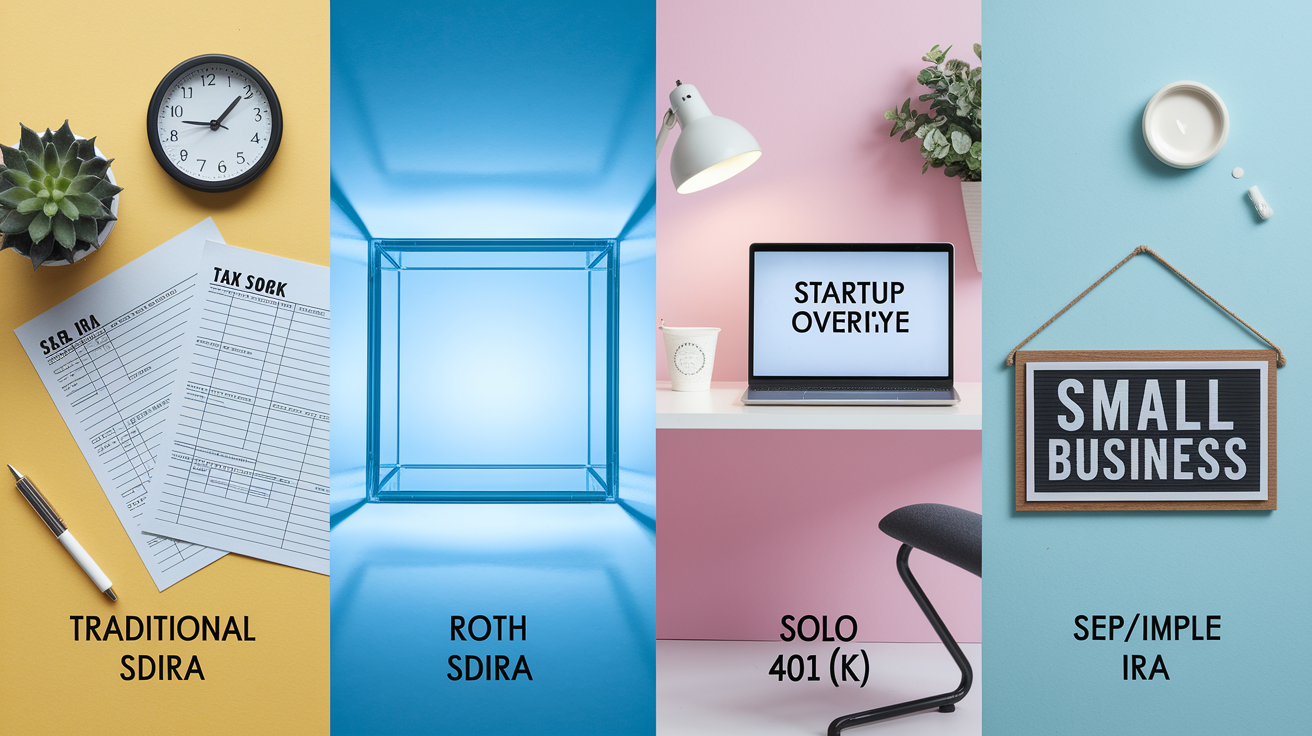
Picking the right self‑directed account depends on your employment status, income level, and how much you want to contribute each year. Each plan type has different contribution caps, tax treatment, and eligibility rules. Understanding these differences helps you match the account to your situation and avoid leaving money on the table or running into compliance headaches later.
Traditional & Roth SDIRAs
A Traditional SDIRA lets you deduct contributions from your taxable income in the year you make them. Investments grow tax‑deferred until you withdraw the money in retirement. Withdrawals get taxed as ordinary income. A Roth SDIRA works backwards: you contribute after‑tax dollars, but qualified withdrawals come out tax‑free, both contributions and earnings. Roth accounts don’t force required minimum distributions during your lifetime, which gives you more flexibility if you don’t need the cash right away. Both versions allow the same alternative assets: rental properties, private equity stakes, cryptocurrency, precious metals, tax liens, and more. Choosing between Traditional and Roth comes down to whether you expect your tax rate to be higher now or in retirement. If you think taxes are going up or you’re in a low bracket today, Roth usually wins.
Solo 401(k)s
A Solo 401(k) works only for business owners or self‑employed individuals with no full‑time employees (you can have a spouse on payroll). The big advantage is contribution headroom. You can put in money as both the employee and the employer, which often results in much higher annual limits than a standard IRA. For 2025, total contributions can reach $69,000 if you’re under 50, or $76,500 if you’re 50 or older. Solo 401(k)s also let you borrow from your account balance for short‑term liquidity needs, something IRAs don’t allow. You can hold alternative investments just like an SDIRA, and you can choose a Traditional (pre‑tax) or Roth (after‑tax) structure, or split contributions between both. The tradeoff is complexity. You’ll need to file Form 5500 once your account balance exceeds $250,000, and loan rules require careful tracking to avoid penalties.
SEP & SIMPLE IRAs
A SEP IRA (Simplified Employee Pension) is aimed at small business owners and the self‑employed who want to contribute more than a Traditional IRA allows but don’t want the administrative load of a 401(k). Contribution limits are higher, up to 25 percent of net self‑employment income or $69,000 for 2025, whichever is lower. Contributions are tax‑deductible. SEP IRAs also permit catch‑up contributions once you turn 50. The downside? If you have employees, you must contribute the same percentage of salary for each eligible worker, which can get expensive. A SIMPLE IRA is similar but designed for very small businesses with 100 or fewer employees. Contribution limits are lower than a SEP or Solo 401(k), but setup and compliance are straightforward. Both can be structured as self‑directed accounts if your custodian supports alternative assets.
HSAs & Coverdell ESAs
A Health Savings Account wasn’t originally designed as a retirement plan. It’s meant to cover medical expenses tax‑free. But it can function like one if you invest the balance instead of spending it on healthcare. Contributions are tax‑deductible, growth is tax‑free, and withdrawals for qualified medical expenses are also tax‑free at any age. After age 65, you can withdraw for any reason and only pay ordinary income tax (no penalty), making it work like a Traditional IRA. Self‑directed HSAs let you hold real estate, precious metals, or private placements, though few custodians offer this feature. A Coverdell Education Savings Account follows a similar pattern. It’s designed for education costs, but some custodians allow alternative investments within the account, giving you self‑directed control over how those education dollars grow.
| Account Type | Key Benefit |
|---|---|
| Traditional SDIRA | Tax‑deductible contributions and tax‑deferred growth on any allowed asset |
| Roth SDIRA | Tax‑free withdrawals in retirement with no required distributions during your lifetime |
| Solo 401(k) | Higher contribution limits and the ability to borrow from your balance |
| SEP IRA | Simple setup and large contribution capacity for self‑employed individuals |
| Self‑Directed HSA | Triple tax advantage (deductible contributions, tax‑free growth, tax‑free medical withdrawals) with retirement flexibility after 65 |
Allowed Alternative Assets in Self‑Directed Retirement Plans

The IRS defines allowable retirement investments by what you can’t hold, not by what you can. If an asset isn’t on the prohibited list and you avoid disqualified‑person transactions, it’s generally permitted. That opens the door to a wide range of investments that most brokerages don’t offer and many traditional retirement savers never consider.
Alternative assets often behave differently from stocks and bonds, which is exactly why investors use them. Real estate can hedge against inflation because rents and property values tend to rise when prices go up. Private credit generates steady income through loan interest, often at rates higher than public bonds. Venture capital offers exposure to high‑growth startups before they go public, though the risk of total loss is real. Cryptocurrency and blockchain assets show low correlation to traditional markets, meaning they can zig when stocks zag. Precious metals like gold and silver serve as a store of value during monetary uncertainty. Each asset class plays a different role. Holding several types in your self‑directed plan can smooth out overall volatility. Diversification isn’t just owning ten stocks. It’s spreading retirement dollars across industries, structures, and risk profiles that don’t all move together.
Investment types allowed in self‑directed retirement plans:
- Real estate – single‑family rentals, multifamily properties, commercial buildings, raw land, and real estate investment trusts (REITs) not traded on public exchanges.
- Private equity – ownership stakes in privately held companies, often structured as limited partnership interests or membership units in an LLC.
- Venture capital – early‑stage investments in startups and growth companies, typically illiquid until an exit event like acquisition or IPO.
- Private lending and promissory notes – loans to individuals or businesses where your IRA acts as the lender and earns interest; includes hard‑money loans and peer‑to‑peer notes.
- Cryptocurrency and digital assets – Bitcoin, Ethereum, and other blockchain‑based tokens held in custodial or self‑custody wallets (depending on your custodian’s structure).
- Precious metals – IRS‑approved gold, silver, platinum, and palladium bullion stored in a qualified depository; collectible coins are prohibited.
- Tax liens and tax deeds – certificates purchased at government auctions that give your IRA a claim on delinquent property taxes and potential ownership if the lien isn’t redeemed.
- Hedge funds and private investment funds – pooled vehicles that invest in non‑public strategies; often require accredited investor status and high minimums.
- Syndications and joint ventures – fractional ownership in larger projects like apartment complexes or energy developments, typically structured as limited partnerships.
- Small business investments – direct equity or debt positions in operating companies, including franchise opportunities and local businesses (as long as you don’t provide services or own a controlling interest in a disqualified way).
Prohibited Transactions and Disqualified Persons for Self‑Directed Plans

The IRS draws bright lines around what you cannot do with retirement money. Crossing those lines can cost you the entire account. A prohibited transaction happens when your IRA engages in certain deals with disqualified persons or when you personally benefit from an IRA‑owned asset before retirement age. Disqualified persons include you, your spouse, your lineal descendants (children and grandchildren), your lineal ascendants (parents and grandparents), and any entity you control or in which these family members have significant ownership. Fiduciaries to the plan, such as your IRA custodian, are also disqualified. The rule is simple in concept: retirement money must benefit the retirement account, not you or your family, until you take a qualified distribution.
Prohibited assets are short and specific. You cannot hold life insurance contracts, S‑corporation stock (because S‑corps can only have eligible shareholders and IRAs don’t qualify), or collectibles. Collectibles include art, antiques, gems, stamps, alcoholic beverages, and most coins (except for certain government‑minted bullion). If you buy a prohibited asset or engage in a prohibited transaction, the IRS treats your entire IRA as distributed on January 1 of the year the violation occurred. That means you owe income tax on the full balance, plus a 10 percent early‑withdrawal penalty if you’re under 59½. The account loses its tax‑advantaged status permanently. Custodians will block obvious prohibited assets during account setup, but they rely on you to disclose relationships and avoid self‑dealing. They process transactions based on your instructions. They don’t investigate whether your real‑estate purchase involves a disqualified person or whether you’re renting an IRA‑owned condo to your daughter.
Common prohibited‑transaction examples:
- Using an IRA‑owned property for personal benefit – staying in a vacation rental your IRA owns, even for one night, or allowing a family member to live there rent‑free.
- Selling property you own to your IRA – transferring your personally held rental into your self‑directed account is a prohibited sale between you and your IRA.
- Paying yourself for work on an IRA asset – if your IRA owns a fixer‑upper, you can’t charge the IRA for your own labor or materials you purchased personally.
- Borrowing from your IRA or lending to it from personal funds – taking a short‑term loan from your IRA balance (outside of a Solo 401(k) loan provision) or personally guaranteeing a mortgage on IRA‑owned real estate.
- Buying an asset from or selling to a disqualified person – purchasing a rental property from your parents, or selling IRA‑held private company shares to your adult child or a business you control.
Tax Rules, UBIT/UBTI, UDFI, and Required Minimum Distributions
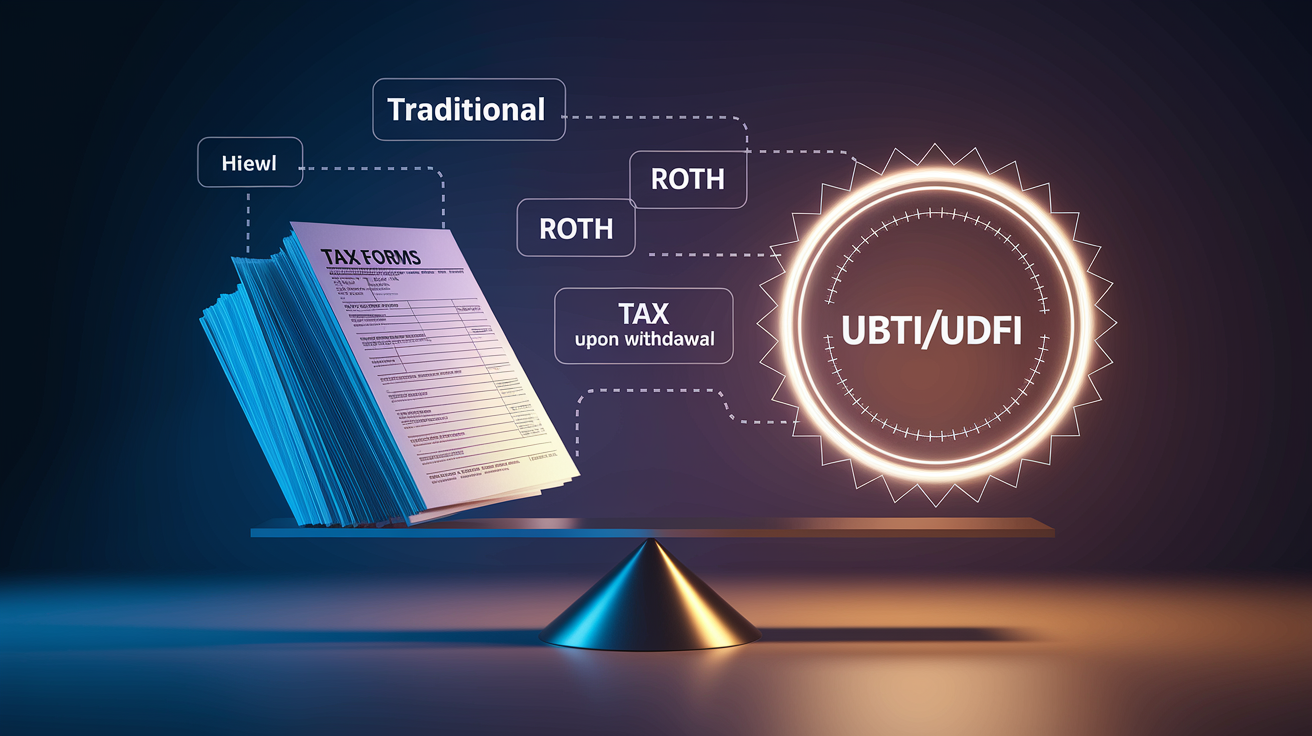
Self‑directed retirement accounts follow the same core tax treatment as their standard counterparts. A Traditional SDIRA or Solo 401(k) shelters investment income and gains from current taxation, but you’ll pay ordinary income tax on every dollar you withdraw. A Roth SDIRA or Roth Solo 401(k) grows tax‑free, and qualified distributions (taken after age 59½ and after the account has been open at least five years) come out with no tax at all. The difference with self‑directed plans is the type of income flowing into the account. Rental income, private‑loan interest, cryptocurrency gains, and proceeds from a business sale all receive the same tax deferral or exclusion as stock dividends and bond interest would in a conventional IRA.
Two tax complications can arise when your IRA earns income from active business operations or uses borrowed money. Unrelated Business Taxable Income (UBTI) applies when your IRA owns an interest in a partnership or LLC that conducts an active trade or business, as opposed to passive investing. If that business generates more than $1,000 of gross income in a year, your IRA must file Form 990‑T and pay tax on the income at trust tax rates before it hits your account balance. Unrelated Debt‑Financed Income (UDFI) is a subset of UBTI triggered when your IRA buys an asset with borrowed money (a nonrecourse mortgage on rental property, for example). The portion of income and gain attributable to the debt is subject to UDFI tax. If your IRA takes out a 50 percent loan on a rental property, roughly half the net rental income and half the gain on sale will be taxable inside the IRA. The tax is paid by the IRA itself, reducing the amount that compounds tax‑deferred. UDFI doesn’t apply to Roth IRAs’ qualified distributions, but the tax is still owed during the accumulation phase.
Required minimum distributions add another layer. If you hold a Traditional SDIRA, SEP IRA, or Solo 401(k), you must begin taking RMDs in the year you turn 73 (under current law). The RMD is calculated as a percentage of your account balance, and that percentage increases with age. The challenge with self‑directed accounts is that many alternative assets are illiquid. You can’t sell 4 percent of a rental property or cash out a fraction of a private equity stake on demand. If your entire SDIRA is tied up in real estate or a startup, you may need to sell an asset prematurely or hold enough liquid reserves to cover the distribution. Missing an RMD triggers a steep penalty (25 percent of the amount you should have taken), so planning liquidity years in advance is critical. Roth IRAs don’t require distributions during your lifetime, but your beneficiaries will face RMDs after you pass, and they’ll need to navigate the same liquidity issues if the account holds hard‑to‑sell assets.
Setting Up and Funding a Self‑Directed Retirement Plan

Opening a self‑directed retirement account is more involved than signing up for a brokerage IRA, but the process follows a predictable sequence. Your first task is to choose a custodian or trust company that supports the alternative assets you want to hold. Not every firm offers self‑directed services. Among those that do, some only handle real estate while others support the full range of private placements, crypto, and precious metals. Confirm the custodian’s asset coverage, fee schedule, and compliance‑support services before you commit.
Once you’ve selected a custodian, you’ll complete an application and provide identification, similar to opening any financial account. The custodian will establish your SDIRA, Solo 401(k), or other plan type and assign it a unique account number. Next, you fund the account. You can make a direct contribution (subject to annual IRA limits), transfer money from an existing IRA at another institution, or roll over a balance from a former employer’s 401(k). Transfers between IRAs are typically processed custodian‑to‑custodian and don’t count as a distribution. Rollovers from a 401(k) give you 60 days to deposit the funds into your new SDIRA if you take possession of the check. Miss the deadline and the IRS treats it as a taxable distribution. Many investors choose a direct rollover (trustee‑to‑trustee) to avoid the 60‑day risk and any mandatory withholding. The cleanest funding path is a direct transfer. No checks in your hand, no withholding, no countdown clock.
After the account is funded, you identify the investment you want to make and perform your due diligence. Review financials, inspect property, or vet the management team of a private company. When you’re ready to proceed, you submit a purchase request (often called a “buy direction” or “investment authorization”) to your custodian, along with any required documents like a purchase agreement or subscription paperwork. The custodian reviews the request for prohibited transactions and compliance red flags, then processes the transaction using IRA funds. Title or ownership documents must name the IRA as the owner (for example, “ABC Trust Company FBO Jane Doe IRA”), not you personally. The custodian will also handle any ongoing reporting, such as issuing Form 5498 to report contributions and account value, and Form 1099‑R if you take a distribution.
Step‑by‑step setup process:
- Research and select a qualified custodian – confirm they support your target asset classes and offer compliance guidance and annual reporting.
- Complete the account application – provide personal details, beneficiary designations, and any entity documentation if setting up a checkbook IRA structure.
- Fund the account – contribute new money, transfer from another IRA, or roll over a 401(k) balance using direct trustee‑to‑trustee movement when possible.
- Identify and research your investment – conduct full due diligence on the property, private company, or alternative asset you plan to buy.
- Submit a purchase direction to the custodian – include all transaction details, purchase price, and copies of contracts or subscription agreements.
- Custodian performs compliance review – they check for prohibited‑person involvement and confirm the asset is IRS‑permissible.
- Custodian completes the purchase and updates title – funds are wired or checks are issued from the IRA; ownership documents are recorded in the IRA’s name.
- Maintain records and file annual reports – keep all transaction paperwork, valuations, and correspondence; custodian files IRS forms on your behalf.
Timing a rollover or transfer requires attention to tax deadlines and employer‑plan rules. If you leave a job mid‑year, you can typically roll your 401(k) into a self‑directed IRA immediately, but some plans require you to wait until termination paperwork is complete. Contributions to an IRA for a given tax year can be made up until the tax‑filing deadline (usually April 15 of the following year), giving you extra months to fund the account if you’re close to year‑end. Roth conversions (moving money from a Traditional IRA to a Roth IRA) trigger taxable income in the year of the conversion, so many investors time those moves for low‑income years or spread the conversion across multiple years to manage the tax hit.
Custodians, Administrators, Fees, and Compliance Responsibilities

A custodian’s job is to hold your retirement assets, process transactions according to your instructions, and file required tax forms. They are not investment advisors. They don’t vet your deals for financial soundness. Their role is administrative and regulatory: making sure paperwork is correct, ownership is titled properly, and the IRS receives the annual reports it expects. Some custodians offer additional services (annual tax consulting, prohibited‑transaction reviews, or referrals to attorneys and CPAs) while others provide only basic custody and expect you to handle compliance questions on your own.
Fee structures vary widely and can materially affect your net returns over time. Many self‑directed custodians charge an annual account fee (often between 100 and 500 dollars), plus per‑transaction fees for each purchase or sale you make. Some custodians bill asset‑based fees, charging a percentage of your IRA’s total value, which can become expensive as your balance grows. Others use a hybrid model with a flat base fee and usage charges. Transaction fees can range from 50 dollars for a simple stock trade to several hundred dollars for processing a real‑estate closing or private‑placement subscription. If you hold multiple properties or make frequent investments, those per‑asset and per‑transaction costs add up quickly. A custodian charging 300 dollars per property per year might look cheap at first, but if you own five rentals, that’s 1,500 dollars annually before any transaction fees. Request a full fee schedule in writing, including charges for distributions, required minimum distribution calculations, and annual IRS reporting, so you can model the total cost before you commit.
Questions to ask when evaluating a custodian:
- What asset classes do you support, and are there any restricted or excluded investments within those classes?
- What is your total annual fee, including account maintenance, asset‑holding fees, and transaction charges?
- Do you provide compliance consulting or prohibited‑transaction guidance, or do I need to hire that separately?
- How do you handle IRS reporting (Form 5498, Form 1099‑R, and Form 990‑T for UBTI), and are those filings included in your base fee?
- What is your process and timeline for executing buy and sell directions, and how do you communicate status updates?
- Do you require third‑party appraisals for illiquid assets, and if so, how often and at what cost?
Risks, Liquidity Constraints, and Due‑Diligence Requirements

Alternative investments often carry higher risk than publicly traded stocks and bonds. That risk shows up in several forms. Many private assets are illiquid, meaning you can’t sell them quickly or at a predictable price. A rental property might take months to market and close. A private equity stake may be locked up for five to ten years with no secondary market. Cryptocurrency can be sold fast, but prices swing wildly, and you might be forced to exit at a loss if you need cash for a required distribution. Volatility and concentration risk go hand in hand. If your entire SDIRA is invested in one startup or one piece of land, a single bad outcome can wipe out your retirement savings. Diversification is just as important inside a self‑directed account as it is in a traditional portfolio. Spreading retirement money across real estate, private credit, and some liquid stocks reduces the chance that one failure costs you everything.
Due diligence is your responsibility, and it’s more demanding than reviewing a mutual fund prospectus. When you invest in a private company, you need to evaluate the management team’s track record, review financial statements and projections, understand the business model and competitive landscape, and assess the terms of the deal (valuation, liquidation preferences, voting rights). For real estate, that means inspecting the property, reviewing rent rolls and expense history, confirming clear title, and stress‑testing your cash‑flow assumptions against vacancy and repair costs. For private loans, you’ll analyze the borrower’s creditworthiness, the collateral securing the note, and your legal remedies if the loan defaults. Custodians do not perform any of this analysis. They process the transaction you direct and assume you’ve done the homework. If you lack the time or expertise to vet a deal properly, the prudent move is to pass or hire a professional (attorney, CPA, or investment advisor) to help. Skipping due diligence is how investors end up in fraudulent schemes or deals that looked good on paper but had fatal flaws buried in the fine print.
Valuation of illiquid assets creates another layer of risk and complexity. The IRS requires you to report the fair market value of your IRA every year, but determining that value for a private company, a parcel of raw land, or a tax lien is often subjective. Custodians may require a third‑party appraisal, especially for real estate, and those appraisals cost money and take time. Overvaluing an asset can trigger tax issues or incorrect required minimum distribution calculations. Undervaluing it may raise IRS questions during an audit. When you contribute property to an IRA (in‑kind contributions are allowed in some cases), the valuation you assign becomes your cost basis, and disagreements with the IRS can result in penalties. If the numbers aren’t clear and defensible, you’re adding audit risk on top of investment risk.
Due‑diligence steps for alternative assets:
- Verify the background and reputation of all parties involved (management teams, deal sponsors, property sellers, and intermediaries).
- Review all legal and financial documents including operating agreements, subscription docs, title reports, and audited financials when available.
- Stress‑test projected returns by modeling pessimistic scenarios (lower rents, higher vacancy, delayed exits, or borrower default).
- Confirm the asset and transaction structure comply with IRS rules and will not trigger a prohibited transaction or disqualified‑person issue.
Using Self‑Directed Plans to Invest in Real Estate

Real estate is the most popular alternative asset in self‑directed IRAs because the mechanics are well understood and the tax advantages are significant. When your IRA owns rental property, all income (rent checks, lease option fees, and eventual sale proceeds) flows back into the IRA without triggering current income tax. In a Traditional SDIRA, that income compounds tax‑deferred until you take a distribution. In a Roth SDIRA, it grows completely tax‑free if you follow the qualified‑withdrawal rules. Compare that to owning the same property personally. You’d pay tax on rental income every year, and you’d owe capital gains tax when you sell. The tax shelter alone can add thousands of dollars to your net return over a decade.
The process starts with identifying a property and negotiating a purchase price. Your IRA cannot buy property from you, your spouse, or any lineal family member, and you cannot use the property personally at any point. Once you have a signed purchase agreement, you direct your custodian to wire funds from your IRA to the closing agent (title company or attorney). The title and deed must name the IRA as the owner, typically phrased as “[Custodian Name] FBO [Your Name] IRA.” You cannot personally guarantee a mortgage on IRA‑owned real estate. If you need financing, you must use a nonrecourse loan, where the lender’s only claim in case of default is the property itself. Nonrecourse loans typically carry higher interest rates and require larger down payments (often 30 to 40 percent), but they keep the transaction compliant. All operating expenses (property taxes, insurance, repairs, property management fees) must be paid from IRA funds, and all income must be deposited back into the IRA. You cannot pay for a new roof with your personal checking account, and you cannot pocket rent checks to cover your own bills.
Rental income inside a self‑directed IRA is generally tax‑deferred or tax‑free, but if you finance the purchase with a nonrecourse loan, the income and gains attributable to the debt are subject to Unrelated Debt‑Financed Income (UDFI) tax. For example, if your IRA puts 40 percent down and borrows 60 percent, roughly 60 percent of the net rental income and 60 percent of the gain on sale will be taxable to the IRA at trust tax rates. The IRA files Form 990‑T and pays the tax from the account balance. As you pay down the loan, the taxable percentage decreases. Many investors accept the UDFI cost because borrowed money amplifies returns. Borrowing lets you control a larger asset and capture more appreciation than you could with cash alone. Others prefer to buy properties outright with IRA funds to avoid the tax and the complexity of annual 990‑T filings.
Managing IRA‑owned real estate requires careful recordkeeping. You’ll track every expense, every rent payment, and every repair. Your custodian will need copies of leases, invoices, and settlement statements for their files and for annual IRS reporting. Some investors hire a property manager to handle tenant communication, maintenance, and rent collection, with the management company paid directly from the IRA. Others self‑manage but must ensure they never provide sweat equity or services that benefit the IRA without charging the account (and even then, paying yourself from your IRA can be a prohibited transaction if you’re considered a disqualified person providing services). The safest approach is to hire third parties for all work and pay them from IRA funds. When you eventually sell the property, the proceeds return to the IRA, and you can reinvest in another property, park the cash, or take a distribution and pay the applicable taxes.
| Step | Requirement |
|---|---|
| Property identification and purchase agreement | Must not involve disqualified persons; all contracts signed by custodian on behalf of IRA |
| Financing (if needed) | Nonrecourse loan only; no personal guarantees or co‑mingling of personal and IRA funds |
| Title and closing | Property titled in IRA’s name; all purchase funds and closing costs paid from IRA |
| Ongoing operations | All expenses paid from IRA; all income deposited to IRA; no personal use or benefit |
Diversification Strategies and Portfolio Integration for Self‑Directed Plans

A self‑directed retirement account gives you access to private markets and hard assets, but it doesn’t eliminate the need for diversification. It increases it. Putting all your retirement money into one rental property or one private company is a concentrated bet. If that single investment fails, your future income takes the hit. The goal is to spread capital across asset classes that respond to different economic conditions and don’t all decline at the same time. In 2025, some institutional advisors advocated for a 50/30/20 allocation: 50 percent in equities (public stocks or private equity), 30 percent in fixed income (bonds, private credit, or real estate debt), and 20 percent in alternative assets (real estate, commodities, crypto, or venture capital). That framework is more aggressive on alternatives than the traditional 60/40 stock/bond split, but it reflects the diversification and return potential that private markets can offer. The right mix depends on your age, risk tolerance, and how much liquidity you need in the next five years.
Rebalancing becomes trickier with illiquid holdings. In a standard brokerage account, you can sell a portion of your stock index fund and buy bonds to restore your target allocation. In a self‑directed IRA holding real estate and private placements, selling 10 percent of a rental property isn’t an option. Instead, you rebalance with new contributions or by directing income (rent, loan interest, dividends from a private company) into underweighted asset classes. If your private equity stake has grown to 40 percent of your IRA and your target is 20 percent, you’d steer future contributions and any liquid distributions into stocks or bonds until the percentages realign. Some investors hold a small allocation to publicly traded index funds or money market accounts inside the same SDIRA, giving them a liquid buffer they can shift around as needed.
Liquidity planning is essential when you have required minimum distributions on the horizon. If you’re 72 and your entire Traditional SDIRA is tied up in a private real estate fund with a seven‑year lockup, you won’t have cash to meet your RMD without selling another asset or taking an in‑kind distribution (which is allowed but complex). Start building a liquidity cushion at least five years before RMDs begin, either by holding some cash or short‑term bonds, or by planning property sales or private‑equity exits that will free up capital in time. Roth IRA owners don’t face lifetime RMDs, but beneficiaries will, so the same liquidity logic applies if you plan to pass the account to heirs.
Performance measurement and benchmarking are harder with alternative assets because private investments don’t publish daily prices. You might own a rental property for ten years before you sell and realize the total return. Private equity funds report net asset value quarterly or annually, and those valuations are often based on models rather than market transactions. That makes it difficult to know whether your self‑directed IRA is outperforming or underperforming a public‑market benchmark in real time. A practical approach is to set return expectations at the start (what yield or appreciation you need to justify the illiquidity and complexity) and review actual performance against those goals at regular intervals (annually or when you receive updated valuations). If a private investment consistently underperforms or the thesis has changed, consider exiting when you can, even if it means realizing a loss. Private markets offer potential for higher returns, but only if you’re willing to cut losing positions and let winners run.
Diversification principles for self‑directed retirement accounts:
- Hold at least three to five distinct asset classes or investment types to reduce single‑point‑of‑failure risk.
- Balance illiquid positions (real estate, private equity) with liquid reserves (cash, publicly traded funds) to meet RMDs and emergency needs.
- Avoid overconcentration in any one property,
Final Words
Pick the account that matches your situation — Traditional or Roth SDIRA, Solo 401(k), SEP/SIMPLE, HSA, or Coverdell. We covered what each allows, how custodians work, and which alternative assets you can hold.
Remember the hard parts: prohibited transactions, tax traps like UBIT, required minimum distributions, fees, and liquidity limits. Follow the setup steps, do due diligence, and get titles and paperwork right.
With care and a simple plan, self directed retirement plans can broaden your options and help you stay on track.
FAQ
Q: What is the loophole for self-directed IRAs?
A: The so-called loophole for self-directed IRAs is using them to hold alternative assets like real estate or private deals; it’s not a loophole and carries strict prohibited-transaction and compliance risks.
Q: What is the $1000 a month rule for retirement?
A: The $1,000 a month rule for retirement is a simple savings target: saving $1,000 each month can build a meaningful nest egg over decades, but your needs, timeline, and investment returns will change the outcome.
Q: Where can I put $10,000 to make the most money?
A: To make the most money with $10,000, consider low-cost stock index funds for long-term growth, while higher-return options like individual stocks, private deals, or crypto are riskier—match the choice to your timeline and risk tolerance.
Q: Do IRA withdrawals affect SSDI?
A: IRA withdrawals affect SSDI by generally not reducing SSDI benefits, because SSDI is not means-tested, but withdrawals can affect SSI eligibility and may influence Medicare-related premiums or other need-based aid.