

Thinking of taking money out of retirement early?
It can cost you more than you expect: the IRS often adds a 10% early withdrawal penalty on top of income tax, and missing required minimum distributions later can trigger steep excise taxes.
This post lays out the rules by account type and age (55, 59½, 73), the common exceptions, and smart, practical moves, when to wait, when the Rule of 55 helps, and how a Roth can lower your tax bill.
You’ll get clear tradeoffs and simple steps you can use this week.
How Retirement Withdrawals Work: Rules, Taxes, and Penalties

The basic deal is simple. You can pull money from your retirement account without a penalty once you’re 59½. Before that, the IRS tacks on a 10% early withdrawal penalty on top of whatever income tax you owe. Exceptions exist, but they’re narrow. If you’re thinking about grabbing cash before 59½, plan on paying extra unless you’ve got proof you qualify for an exception. Then at 73, the rules reverse. You’re forced to start taking minimum distributions whether you want the money or not.
Traditional retirement account withdrawals (401(k)s and traditional IRAs) get taxed as ordinary income. The amount you take out gets added to your income for the year, and you pay tax at your regular rate. Pull $30,000 and you’re in the 22% federal bracket? You’ll owe around $6,600 in federal tax on that distribution, plus whatever your state charges. Roth accounts work differently. Meet the age and holding requirements, and qualified Roth withdrawals come out clean.
Here’s how the most common situations break down:
- Before 59½, no exception: 10% penalty plus ordinary income tax on everything (unless it’s a qualified Roth distribution).
- After 59½: No penalty. Ordinary income tax still applies to traditional account withdrawals.
- Roth contributions: Withdraw anytime without tax or penalty.
- Roth earnings: Tax and penalty free only after 59½ and five years of account ownership.
- After 73: Required minimum distributions kick in for traditional accounts. Skip one and you face a 25% excise tax (10% if you fix it fast).
- Employment separation at 55 or older: Penalty-free withdrawals from that employer’s 401(k) only (Rule of 55).
These rules matter. Miss an RMD and you can lose a quarter of what you should’ve withdrawn. Take money early without an exception and you’re handing the IRS an extra 10% on top of the income tax. Know your account type, understand which age thresholds apply, and plan accordingly.
Withdrawal Rules by Account Type
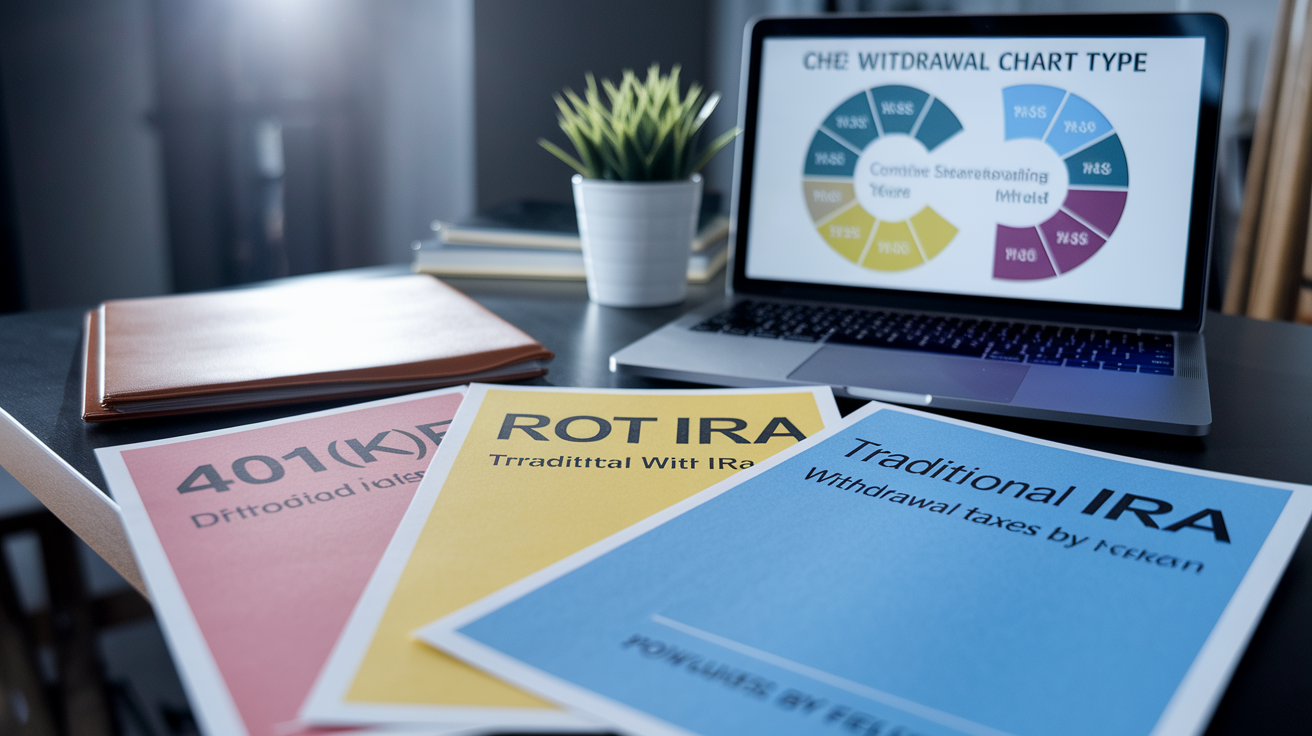
Different retirement accounts follow different rules depending on who sponsors them and how contributions were taxed. A 401(k) comes with employer restrictions that can be tighter than IRS minimums. An IRA gives you more control but sticks closely to federal tax rules. Roth accounts flip the usual pattern by allowing tax-free withdrawals under the right conditions. Pensions lock your money down until you hit a plan-defined retirement age or leave the job.
401(k) Withdrawals
Most 401(k) plans won’t let you touch the money while you’re still working unless you qualify for a hardship withdrawal or you’ve reached 59½. Leave the job and you can start taking distributions, but if you’re under 59½, expect the 10% early withdrawal penalty unless an exception applies. The Rule of 55 is a key exception. Leave your job in or after the calendar year you turn 55, and you can take penalty-free withdrawals from that specific employer’s 401(k). This doesn’t work if you roll the money into an IRA. Many plans offer loans (up to $50,000 or 50% of your vested balance), but leave your job with an outstanding loan balance and the unpaid amount gets treated as a taxable distribution with the penalty attached.
Traditional IRA Withdrawals
Traditional IRAs let you take money out anytime, but distributions before 59½ usually trigger the 10% penalty plus income tax. Every dollar counts as ordinary income. If you made nondeductible (after-tax) contributions, those come out tax-free, but you’ll owe tax on the earnings. The IRS provides a list of penalty exceptions (disability, certain medical expenses, first-time home purchase up to $10,000, qualified education costs), but you need strict documentation. After 59½, the penalty disappears. The income tax stays. At 73, RMDs begin, and you’re required to withdraw a minimum amount each year based on IRS life expectancy tables.
Roth IRA Withdrawals
Roth IRAs let you pull your contributions anytime without taxes or penalties because you already paid tax on that money. Earnings are different. To take earnings out tax-free and penalty-free, you need to be at least 59½ and the account needs to have been open for at least five years. Pull earnings before meeting both conditions, and you’ll owe income tax and the 10% penalty (unless an exception applies). Roth IRAs don’t have RMDs during your lifetime, so you can leave the money alone as long as you want. This makes them powerful for managing taxable income in retirement and leaving tax-free assets to heirs.
Pension Withdrawals
Traditional pensions (defined benefit plans) typically pay a monthly benefit starting at your plan’s normal retirement age, often 65, sometimes earlier if you meet years-of-service criteria. Early retirement options may be available, but the monthly benefit usually gets reduced permanently. You generally can’t take a lump sum or partial withdrawal before the plan allows it. Once payments start, they continue for life (or for a period certain, depending on the payout option you choose). Leave the employer before vesting fully and you may forfeit some or all of the pension benefit.
Your account type shapes every decision about when and how much to withdraw. A 401(k) withdrawal might make sense at 56 under the Rule of 55, but roll that money to an IRA first and you kill the exception. A Roth conversion in a low-income year can save thousands down the road. Match your strategy to the rules of the account you’re tapping.
Age-Based Withdrawal Rules and Milestones

Three ages control most of your withdrawal flexibility: 55, 59½, and 73. Each one opens or closes a door.
Age 55 matters only if you leave your job in or after the calendar year you turn 55. The Rule of 55 lets you take penalty-free withdrawals from that employer’s 401(k) or 403(b), but not from an IRA and not from a different employer’s plan. Public safety workers (police, firefighters, EMTs) get the same break starting at 50. Leave at 53 and you’re too early. Wait until the year you turn 55. Once eligible, you can keep taking distributions from that old plan even if you get a new job, as long as you don’t roll the money into an IRA.
Age 59½ is the universal threshold. Hit it and the 10% early withdrawal penalty goes away for all retirement accounts (401(k), 403(b), traditional IRA, Roth IRA). You’ll still owe income tax on distributions from pre-tax accounts, but the extra 10% penalty is gone. This is when the IRS considers you old enough for “normal” retirement access. Planning to retire before 59½ and need to live on your retirement savings? The Rule of 55 or one of the specific penalty exceptions becomes critical.
Age 73 is when required minimum distributions begin. You must start withdrawing a minimum amount from traditional 401(k)s, traditional IRAs, and other pre-tax accounts each year, calculated using IRS life expectancy tables. Miss an RMD and the penalty is steep: 25% of the amount you should have withdrawn (10% if you correct it quickly). Roth IRAs don’t have RMDs during your lifetime, and recent law changes have eliminated RMDs from Roth 401(k) accounts too. Under current law, the RMD age is scheduled to increase to 75 starting in 2033.
What each milestone unlocks:
- Age 55 (Rule of 55): Penalty-free access to your employer’s 401(k) if you left the job that year or later.
- Age 59½: Penalty-free access to all retirement accounts. Income tax still applies to pre-tax withdrawals.
- Age 73: RMDs begin. You must take annual distributions from traditional accounts or face a 25% excise tax.
Exceptions to Early Withdrawal Penalties

The 10% early withdrawal penalty isn’t absolute. The IRS allows penalty-free withdrawals in specific situations, even before 59½. You’ll still owe income tax on pre-tax money, but you avoid the extra 10%. These exceptions require documentation, so keep records and be ready to prove eligibility if the IRS asks.
Disability is one of the broadest exceptions. Become totally and permanently disabled (unable to do any substantial work because of a physical or mental condition expected to last indefinitely or result in death) and you can withdraw penalty-free. Proof can include Social Security disability payments, disability insurance benefits, or medical certification. Unreimbursed medical expenses above 7.5% of your adjusted gross income also qualify. If your AGI is $80,000 and you have $12,000 in deductible medical bills, the first $6,000 (7.5% of AGI) doesn’t count, but you can withdraw the remaining $6,000 penalty-free. The withdrawal and the expense must happen in the same tax year.
First-time homebuyers can take up to $10,000 from an IRA penalty-free (the IRS defines “first-time” as not owning a home in the prior two years). The money can go toward a down payment, closing costs, or building a home for yourself, your spouse, your children, or your grandchildren. In a 22% tax bracket, that $10,000 withdrawal would still cost around $2,200 in income tax. Penalty-free doesn’t mean tax-free. Qualified higher education expenses (tuition, fees, books, supplies, room and board for at least half-time students at accredited institutions) are penalty-free for IRA withdrawals covering you, your spouse, children, or grandchildren. This exception doesn’t typically apply to 401(k) hardship withdrawals, which may still incur the penalty unless another exception applies.
Substantially equal periodic payments (SEPP), also called 72(t) distributions, let you set up a series of annual withdrawals calculated using one of three IRS-approved methods. Once you start, you must continue taking the same amount every year for at least five years or until you reach 59½, whichever is longer. Start at 52 and you’re locked in until 59½ (seven years). Start at 57 and you’re locked in for five years until 62. Change the amount or skip a payment and the IRS will retroactively apply the 10% penalty to every distribution you took, plus interest. Use a 72(t) calculator to model payment amounts before you commit.
Most common penalty exceptions:
- Total and permanent disability: Documented inability to work.
- Unreimbursed medical expenses: Amounts above 7.5% of AGI in the same tax year.
- First-time homebuyer: Up to $10,000 from an IRA.
- Qualified higher education expenses: Tuition, fees, books, and room/board at accredited schools (IRA only for penalty exception).
- SEPP / 72(t) payments: Substantially equal periodic payments for at least five years or until 59½.
Taxes on Retirement Withdrawals

Every dollar you take out of a traditional 401(k) or traditional IRA is taxed as ordinary income in the year you withdraw it. Pull out $50,000 and you’re in the 24% federal tax bracket? Expect to owe around $12,000 in federal tax, plus state income tax if your state taxes retirement income. Withdrawals don’t get special capital gains treatment. They’re taxed at your marginal rate, same as your paycheck.
Roth accounts flip the script. Contributions to a Roth IRA or Roth 401(k) were made with after-tax dollars, so you can withdraw those contributions anytime without owing tax or penalty. Earnings are tax-free only if you’re at least 59½ and the account has been open for at least five years (the “qualified distribution” rules). Take earnings out before meeting both conditions and you’ll owe income tax and the 10% penalty unless you qualify for an exception. Nondeductible traditional IRA contributions (after-tax money you contributed but didn’t deduct) come out tax-free, but the earnings on those contributions are taxable.
State taxes vary widely. Some states don’t tax retirement income at all. Others tax it fully. A few exempt Social Security but tax IRA and 401(k) withdrawals. Check your state’s rules before you move or start taking distributions. Relocating to a no-income-tax state in retirement can save thousands every year.
| Account Type | How Withdrawals Are Taxed |
|---|---|
| Traditional IRA / 401(k) | Ordinary income tax on the full amount; no penalty after 59½ |
| Roth IRA / Roth 401(k) | Contributions tax-free anytime; earnings tax-free if 59½+ and 5-year rule met |
| Nondeductible IRA contributions | Contributions tax-free; earnings taxed as ordinary income |
Strategies for Minimizing Taxes and Penalties

Smart withdrawal planning can save you thousands in taxes and help your money last longer. The goal? Control your taxable income, stay in lower brackets, and avoid penalties whenever possible.
One of the most powerful moves is Roth conversions during low-income years. Retire at 62 but delay Social Security until 70? Your income between 62 and 70 might be unusually low. Convert chunks of your traditional IRA to a Roth IRA during those years, paying tax at a lower rate now to avoid higher RMDs and taxes later. Once money is in a Roth, it grows tax-free and you can withdraw it tax-free after 59½. Roth IRAs also have no RMDs, so you’re not forced to take taxable distributions in your 80s when you might not need the cash.
Timing withdrawals to manage your tax bracket is another key tactic. Instead of taking a $100,000 lump sum that shoves you into the 24% or 32% bracket, spread the withdrawals over two or three years to stay in the 22% bracket. This matters especially if a big withdrawal would trigger higher Medicare premiums (IRMAA surcharges) or make more of your Social Security taxable. Coordinate your retirement account withdrawals with Social Security claiming decisions. Delaying Social Security while living on IRA withdrawals can reduce lifetime taxes if you’re in a lower bracket before benefits start.
Use the Rule of 55 if you leave your job at 55 or later and need penalty-free access to your 401(k) before 59½. Keep the money in the employer plan instead of rolling it to an IRA. Need systematic income? Set up annual or quarterly distributions from the old 401(k). Once you hit 59½, you can roll the rest to an IRA without losing access. For those retiring earlier, consider a 72(t) SEPP plan, but only if you can commit to the payment schedule for the required period. Breaking a SEPP early triggers retroactive penalties and interest.
Four practical strategies to reduce your tax bill:
- Roth conversions in low-income years: Convert traditional IRA balances to Roth when your income is temporarily low (early retirement, job gap, business loss).
- Bracket management: Spread large withdrawals across multiple years to stay in lower marginal tax brackets and avoid IRMAA.
- Coordinate Social Security timing: Delay Social Security while taking IRA withdrawals in your early 60s, then reduce IRA distributions when Social Security starts.
- Leverage the Rule of 55: Leave your 401(k) with your employer if you separate at 55 or later and need penalty-free access before 59½.
Retirement Withdrawal Calculators and Planning Tools

Calculators take the guesswork out of complex withdrawal decisions. They help you model different scenarios, estimate tax impact, and avoid costly mistakes like missing an RMD or triggering an unexpected penalty.
An RMD calculator is essential once you approach 73. Plug in your account balance and birth date, and it’ll estimate your required minimum distribution using the IRS Uniform Lifetime Table. This helps you plan cash flow and avoid the 25% excise tax for missing a distribution. Some calculators let you compare multiple accounts and see your total RMD across all traditional IRAs and 401(k)s. A tax impact calculator shows how a withdrawal will affect your taxable income and marginal rate. Enter your current income, filing status, and the withdrawal amount, and it’ll estimate your federal and state tax bill. This is especially useful when deciding whether to take a lump sum or spread it over two years.
A SEPP (72(t)) calculator helps you design a substantially equal periodic payment plan. Input your account balance, age, and beneficiary age (if applicable), and it’ll show the annual payment under each of the three IRS-approved methods. You can compare fixed amortization, minimum distribution, and annuitization approaches and choose the one that balances income needs with long-term account preservation. Use these tools before you commit. Changing a SEPP plan after you start triggers retroactive penalties.
Key tools to use:
- RMD calculator: Estimate required distributions starting at 73 to avoid the 25% penalty.
- Tax impact estimator: Model federal and state tax on withdrawals to optimize timing and bracket management.
- 72(t) SEPP calculator: Calculate allowable payment amounts under IRS-approved methods if you need penalty-free income before 59½.
Alternatives to Early Withdrawals

Tapping your retirement account before 59½ should be a last resort. Every dollar you take out is a dollar that stops compounding. On top of that, you’ll likely owe the 10% penalty plus income tax. Before you withdraw, consider other ways to cover the expense.
An emergency fund is the first line of defense. If you don’t have three to six months of expenses saved in cash, build that before anything else. Once it’s in place, you can handle car repairs, medical bills, or a short job gap without touching retirement money. Facing a larger expense (home repairs, medical procedure, helping a family member)? Look at a personal loan or a home equity line of credit. Interest rates on personal loans have come down, and a HELOC lets you borrow against your home equity at a lower rate than most credit cards. Yes, you’ll pay interest, but that’s often cheaper than the combined hit of a 10% penalty plus income tax on a retirement withdrawal.
Some employers offer employee assistance programs or short-term hardship loans. Check with HR before you assume a 401(k) withdrawal is your only option. If you have a 401(k) loan feature, that can be a middle ground. You borrow from yourself, pay yourself interest, and avoid taxes as long as you repay on schedule. Just know that if you leave your job with an outstanding loan, the unpaid balance becomes a taxable distribution subject to the penalty. Credit cards with promotional 0% APR offers can cover short-term cash needs if you’re confident you can pay off the balance before the rate jumps. This works for planned expenses with a clear repayment timeline. Don’t use it for ongoing budget shortfalls.
Four practical alternatives to consider before pulling money out of retirement:
- Build or tap an emergency fund: Cash savings give you a penalty-free, tax-free source for unexpected expenses.
- Personal loan or HELOC: Borrow at a fixed rate or against home equity. Interest costs are often lower than the tax and penalty hit on an early withdrawal.
- 401(k) loan (if available): Borrow from your account and repay yourself with interest. Avoid taxes and penalties as long as you meet repayment terms.
- 0% APR promotional credit: Use introductory credit offers for short-term needs you can pay off quickly, avoiding long-term interest charges.
Final Words
Start by checking the age, account rules, taxes, and penalties before you withdraw. That’s the action that matters.
This post walked through who can take money when, how traditional and Roth accounts are taxed, common penalty exceptions, and key ages like 55, 59½, and RMDs at 73. It also covered simple tactics—Roth conversions, timing withdrawals, calculators—and practical alternatives to avoid early taps.
When you’re taking money out of retirement, use a checklist, run the numbers, and pick the least costly path. You’ll keep more of your savings and feel steadier about the plan.
FAQ
Q: How much tax will I pay if I cash out my retirement?
A: The tax you’ll pay if you cash out your retirement depends on account type, age, and state. Traditional account withdrawals are taxed as ordinary income, may incur a 10% early withdrawal penalty if under 59½, plus state tax.
Q: Do 401k withdrawals affect SSDI?
A: 401(k) withdrawals generally do not affect SSDI benefits because SSDI is based on work credits, not current income; they can affect need-based programs like SSI or Medicaid.
Q: Can I use a 401k to pay medical bills?
A: You can use a 401(k) to pay medical bills with a plan loan or hardship withdrawal if allowed; loans avoid immediate taxes but must be repaid, while hardship distributions may be taxable and penalized under 59½.
Q: What is the $1000 a month rule for retirement?
A: The $1,000-a-month rule for retirement usually means needing $1,000 extra monthly income, or $12,000 a year, which would require roughly $300,000 saved using a 4% withdrawal rule.