
What if where you hold an investment matters as much as what you buy?
Most people pick a mix of stocks and bonds, then ignore asset location (which account holds each investment), and that oversight can quietly shave years off your after-tax return.
This post lays out clear, practical, tax-efficient placement rules, showing where to put bonds, REITs, growth stocks, and municipal bonds across taxable, tax-deferred, and Roth accounts, so you keep more of what you earn and let compounding work its magic.
Immediate Asset Location Guidelines for Tax Efficiency
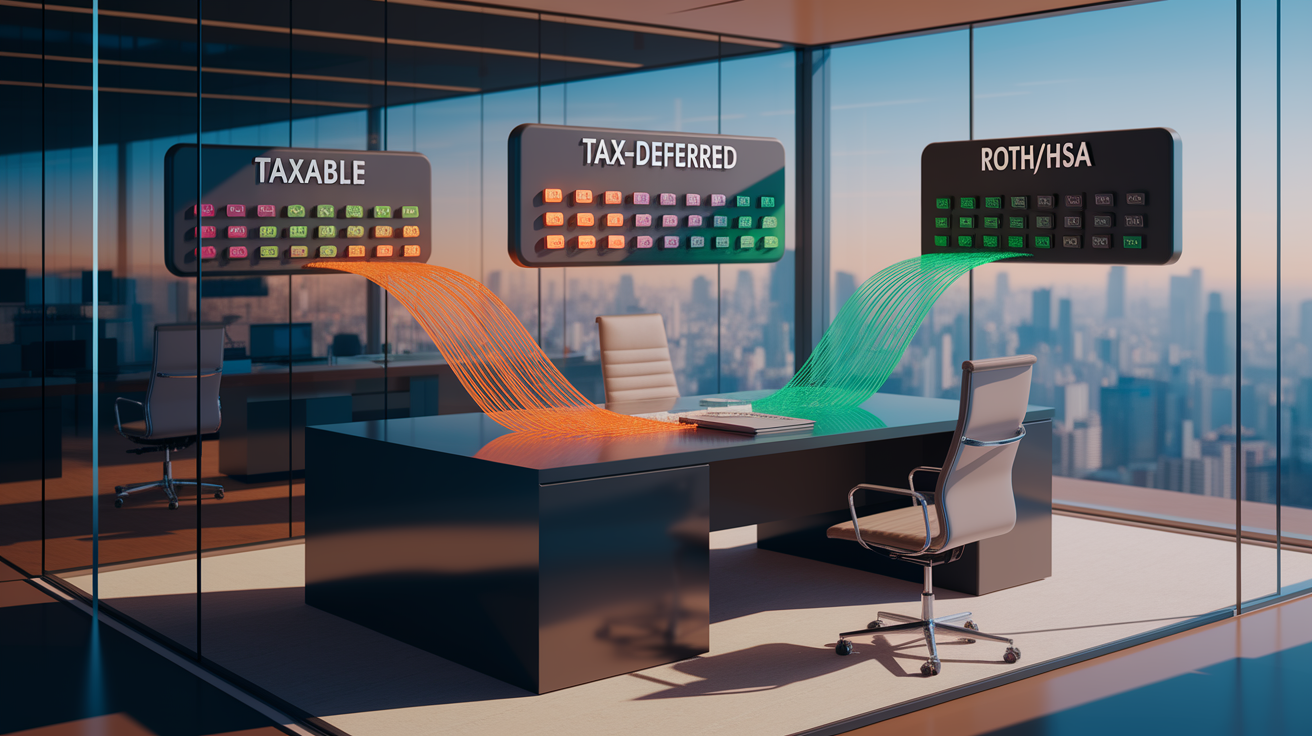
Your overall asset allocation determines most of your long-term return. How you split between stocks and bonds is the big decision. Asset location comes second: which specific accounts hold which specific assets. Get both right and you keep more of what you earn.
The basic idea is simple. Some investments generate taxable income every year. Corporate bonds throw off ordinary interest, REITs distribute rental income, actively managed funds churn through trades and spit out capital gains. Other investments are quiet. Index funds distribute very little, municipal bonds pay tax-exempt interest, and growth stocks can sit for years without triggering a tax bill. The tax code punishes the noisy assets and rewards the quiet ones. You want to shelter the noisy ones inside tax-protected accounts where the IRS can’t touch the gains each year. Hold the quiet ones in taxable accounts where the favorable treatment actually helps you.
Tax-free accounts like Roth IRAs and Health Savings Accounts offer the best deal: contributions go in after-tax, growth is untaxed, and qualified withdrawals come out tax-free. Tax-deferred accounts like traditional 401(k)s and IRAs let you skip tax today but convert every dollar into ordinary income when you withdraw. Contributions and gains, all of it. Taxable brokerage accounts tax you as you go: dividends, interest, and realized capital gains all create annual tax bills, but long-term capital gains and qualified dividends get lower rates than ordinary income. And you control the timing of sales.
Here are six core asset location rules to get started:
-
Corporate bonds, high-yield bonds, and bond funds generating ordinary interest go into tax-deferred accounts (traditional 401(k) or IRA). Interest is taxed at ordinary rates, often 22 percent to 37 percent federally, so shielding it saves the most tax.
-
REITs and real estate funds belong in tax-deferred accounts. Most REIT distributions are taxed as ordinary income, making them expensive to hold in taxable accounts.
-
High-growth stocks and small-cap equity fit best in a Roth IRA or Roth 401(k). The highest expected returns compound fastest when they grow completely tax-free.
-
U.S. total market stock index funds and tax-managed ETFs stay in taxable accounts. Low turnover, qualified dividends, and long-term capital gains treatment make these naturally tax efficient. You can donate appreciated shares to charity or harvest losses to manage taxes further.
-
Municipal bonds live in taxable accounts. Interest is usually exempt from federal tax (and state tax if you buy in-state bonds), so there’s no tax burden to shelter.
-
International stock index funds are flexible. Lean toward taxable if you want to claim the foreign tax credit on dividends. Lean toward tax-advantaged if the fund’s dividend yield is high and treated as ordinary income.
Core Principles Behind Tax-Efficient Asset Allocation
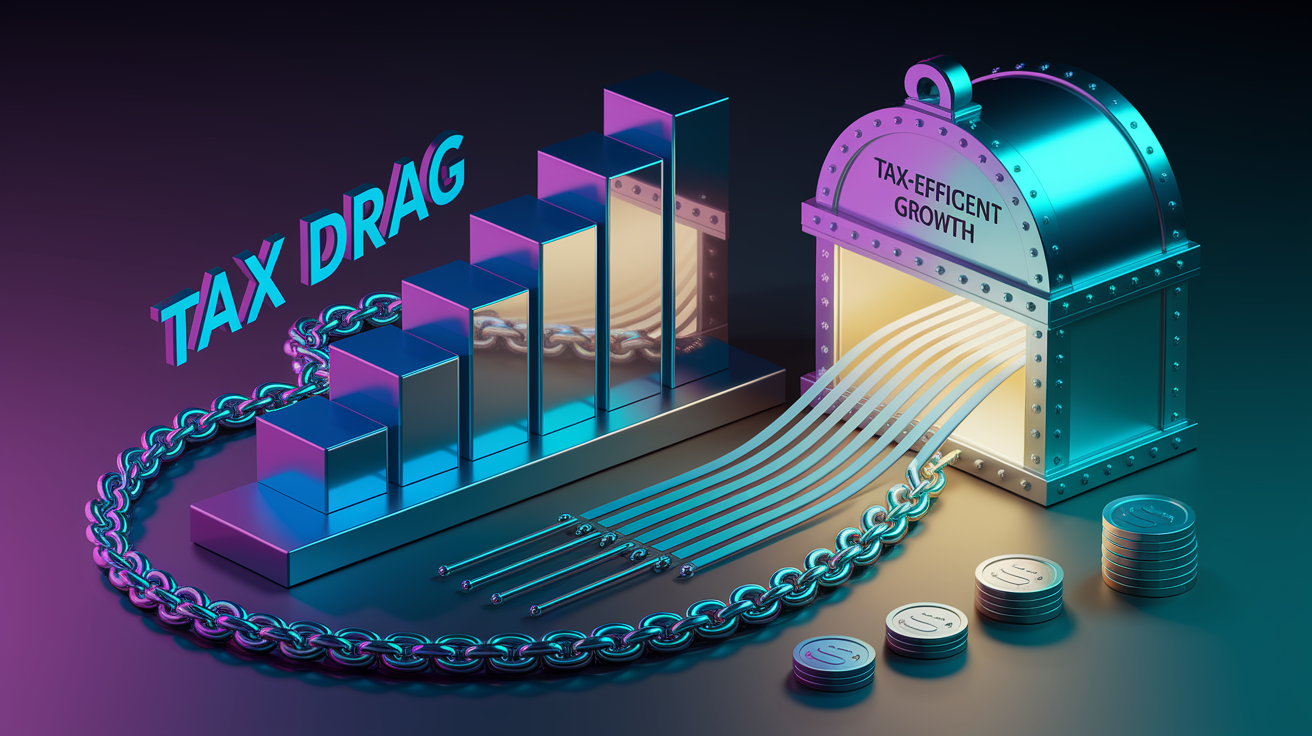
Tax drag is the silent partner in every taxable account. Each year, dividends arrive, interest accrues, and fund managers sell holdings. All of which can trigger tax bills. A corporate bond yielding 3 percent in a taxable account might net you only 2.28 percent after a 24 percent federal tax bite. Over thirty years, the difference between a 3 percent gross return and a 2.28 percent after-tax return is huge. Compounding magnifies every tenth of a percent. Proper asset location can recover much of that drag by moving the tax-inefficient assets into accounts where annual taxes don’t apply.
The payoff isn’t tiny. Research suggests that thoughtful asset location can add as much as 0.75 percentage points per year to your portfolio’s after-tax return. That might not sound dramatic. But on a million-dollar portfolio it’s an extra $7,500 annually, money you keep instead of sending to the tax collector. The benefit comes from letting high-return, tax-inefficient assets compound without interruption inside Roth or tax-deferred wrappers, and from harvesting losses and managing gains in taxable accounts where you have more control.
Asset location does not replace asset allocation. If your risk tolerance and timeline call for 60 percent stocks and 40 percent bonds, you still want that overall mix. Location simply asks, “Which account should hold the stock portion, and which should hold the bonds?” When your balances are small or heavily concentrated in one account type, location choices are limited. When you have meaningful balances across taxable, tax-deferred, and Roth accounts, location becomes a tool you can use to cut your lifetime tax bill and grow wealth faster.
Account Type Characteristics and Tax Implications
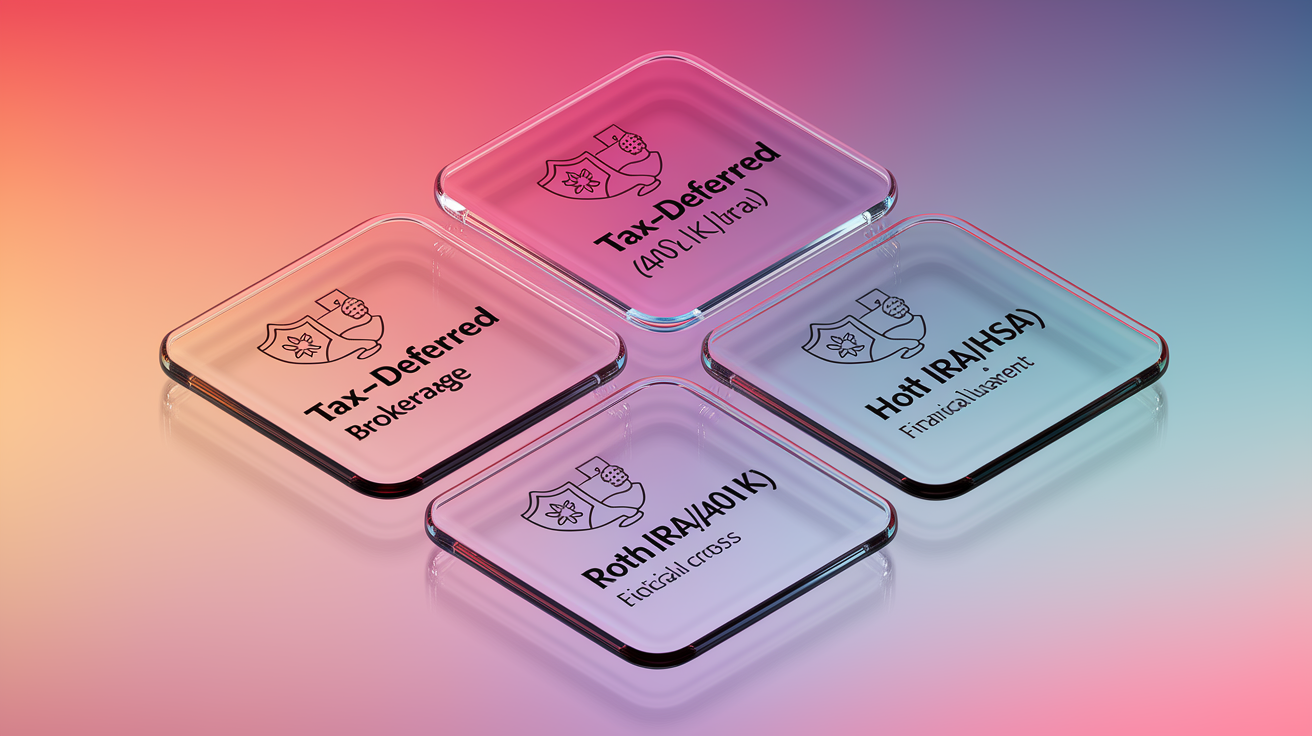
Taxable brokerage accounts offer total flexibility. Deposit and withdraw anytime, no age limits, no required distributions. The price for that freedom is ongoing taxation. Interest and nonqualified dividends are taxed at ordinary income rates every year. Qualified dividends from U.S. corporations and long-term capital gains (on assets held more than one year) receive preferential rates, commonly 0 percent, 15 percent, or 20 percent federally depending on your taxable income. Short-term gains and actively managed fund distributions are taxed at ordinary rates, which can reach 37 percent at the federal level. You also control timing: you can harvest losses to offset gains and carry forward unused losses indefinitely. You can donate appreciated shares to charity to avoid capital gains entirely while claiming a deduction.
Tax-deferred accounts (traditional 401(k)s, traditional IRAs, and similar plans) let you contribute pre-tax dollars, lowering your taxable income today, and defer all taxes until you withdraw the money. Inside the account, interest, dividends, and capital gains grow without any annual tax. When you take money out, every dollar is taxed as ordinary income at your marginal rate. There are no special rates for capital gains or dividends once the money leaves a tax-deferred account. It all becomes ordinary income. You must begin required minimum distributions at age 73 (for those reaching that age between 2023 and 2032) or age 75 (starting in 2033). The IRS penalizes early withdrawals before age 59½ with a 10 percent penalty on top of ordinary income tax unless an exception applies.
Roth accounts (Roth IRAs and Roth 401(k)s) flip the tax timing. Contributions go in after-tax, no deduction today, but qualified withdrawals of contributions and earnings are completely tax-free. Growth inside a Roth is untaxed, and there are no required minimum distributions during your lifetime for Roth IRAs. Roth 401(k)s do have RMDs unless you roll the balance into a Roth IRA. To take tax-free earnings, the account must be at least five years old and you must be 59½ or meet another qualifying event. Roth conversions (moving money from a traditional IRA into a Roth) trigger ordinary income tax on the converted amount in the year of conversion, but then that balance grows tax-free forever.
Health Savings Accounts sit at the top of the tax-privilege ladder: contributions are pre-tax (or tax-deductible), growth is tax-free, and withdrawals for qualified medical expenses are tax-free. Triple tax advantage. If you use HSA money for nonqualified expenses before age 65, you pay ordinary income tax plus a 20 percent penalty. After 65, nonqualified withdrawals are taxed as ordinary income (no penalty), similar to a traditional IRA.
| Account Type | Tax Treatment | Ideal Asset Types |
|---|---|---|
| Taxable brokerage | Annual tax on interest, dividends, realized gains; preferential long-term cap-gains rates | Tax-efficient equity index funds, municipal bonds, assets you plan to donate or hold forever |
| Tax-deferred (Traditional 401(k)/IRA) | Pre-tax contributions; all withdrawals taxed as ordinary income; RMDs required | Corporate bonds, REITs, high-yield bonds, actively managed funds |
| Roth IRA/401(k) | After-tax contributions; tax-free qualified withdrawals; no RMDs (Roth IRA) | High-growth stocks, small-cap equity, any asset with highest expected return |
| HSA | Pre-tax contributions; tax-free growth; tax-free withdrawals for medical expenses | High-growth stocks or any asset expected to compound for decades |
Asset-Class Placement Recommendations
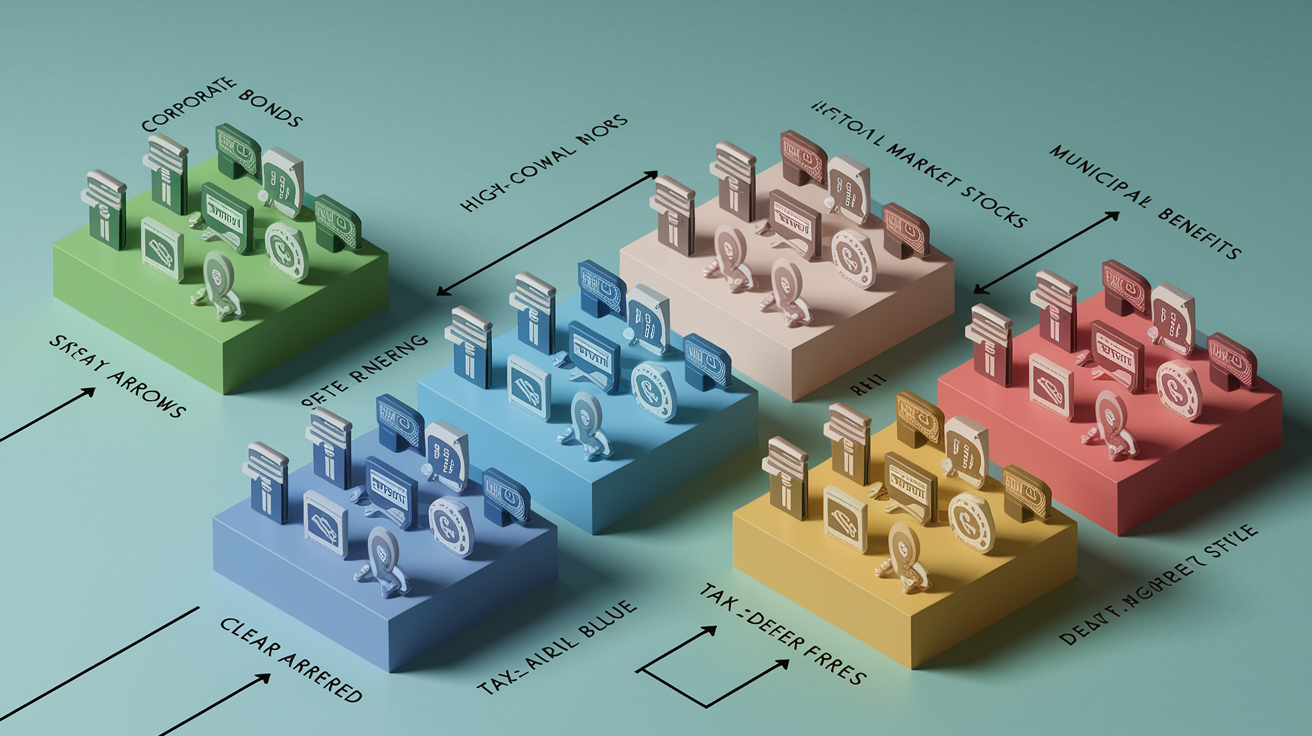
Bonds and bond funds that pay taxable interest belong in tax-deferred accounts whenever possible. A corporate bond yielding 3 percent will hand you $3,000 a year on a $100,000 position. At a 24 percent federal marginal rate, you lose $720 to tax annually. Your real yield drops to 2.28 percent. Park the same bond inside a traditional IRA and the full 3 percent compounds tax-deferred. You pay ordinary income tax only when you withdraw, and in the meantime your money grows faster. High-yield bonds, Treasury bonds, and most bond mutual funds or ETFs all fit this pattern.
REITs and real estate investment trusts distribute most of their income as dividends, but those dividends are usually taxed at ordinary rates rather than the favorable qualified-dividend rates that apply to most stock dividends. A REIT paying a 4 percent distribution can cost you 1 percent or more annually in taxes if held in a taxable account. Move it into a tax-deferred IRA and you shelter that income until withdrawal. Direct real estate holdings (rental property or real estate partnerships) often generate depreciation deductions that can shelter some income, so the tax picture is more nuanced. But publicly traded REITs are straightforward tax-inefficient and should live in retirement accounts when you have the space.
High-growth equities (think small-cap stocks, concentrated growth positions, or sector funds with high expected returns) are best in Roth accounts. The logic is simple: Roth money grows tax-free forever, so you want the highest-return assets compounding inside that wrapper. If you expect an asset to return 10 percent annually over decades, every dollar of that gain is yours to keep in a Roth. In a taxable account, you would eventually owe capital gains tax. In a traditional IRA, the entire withdrawal (including all gains) would be taxed as ordinary income. Roth wins when the returns are large and the holding period is long.
U.S. broad market stock index funds and tax-managed equity ETFs are natural fits for taxable accounts. They generate qualified dividends (taxed at preferential rates) and produce very few capital gains distributions because index funds rarely sell holdings. You control when you sell, so you can hold for years and defer gains, harvest losses when the market dips, or donate appreciated shares to charity and avoid the tax entirely. These assets are tax efficient enough that the taxable-account disadvantage is small. Placing them there frees up space in your retirement accounts for the truly tax-inefficient stuff like bonds and REITs.
International equity funds can go either way. Holding them in a taxable account lets you claim the foreign tax credit for taxes the fund paid to foreign governments on dividends. This can recover some of the tax bite. Holding them in a Roth means you lose that credit but gain tax-free compounding. For most people with moderate international allocations and relatively low foreign dividend yields, the difference is small. If foreign withholding is high or the fund’s yield is large, lean toward tax-deferred or taxable. If you expect strong long-term returns and the fund is tax efficient, Roth is fine.
Here are five common asset classes and their ideal homes:
Corporate bonds, bond funds, CDs go into tax-deferred (traditional IRA/401(k)). Ordinary interest is expensive in taxable accounts.
REITs and REIT funds belong in tax-deferred. Distributions are mostly ordinary income.
High-growth stocks, small-cap funds fit in Roth IRA or HSA. Maximize tax-free compounding on the highest expected returns.
U.S. total market or S&P 500 index funds/ETFs stay in taxable accounts. Naturally tax efficient, qualified dividends and deferred gains.
Municipal bonds live in taxable accounts. Interest is already tax-exempt, so no need to shelter it.
Practical Steps for Implementing Asset Location

Start by listing every account you own and its current balance. Taxable brokerage, traditional IRA, Roth IRA, 401(k), HSA. Write down the asset allocation you want overall (for example, 70 percent stocks, 30 percent bonds). Your goal is to hold that mix across all accounts combined, but place each piece in the account that treats it best from a tax perspective.
Next, tag each asset class by how tax efficient it is. Bonds, REITs, and actively managed funds are tax-inefficient. Broad market stock index funds and municipal bonds are tax efficient. Growth stocks have high expected returns, making them ideal for Roth. Make a simple chart: tax-inefficient assets go into tax-deferred accounts, tax efficient assets stay in taxable, highest-growth assets move to Roth or HSA.
Now map your actual holdings to that ideal. If you have $200,000 in bonds and $300,000 in tax-deferred space, put all the bonds there. If your target is 30 percent bonds on a $500,000 total portfolio, you need $150,000 in bonds. Easy fit. If you have only $50,000 in tax-deferred space but want $150,000 in bonds, you will have to hold some bonds in taxable or Roth. In that case, consider municipal bonds for the taxable portion or accept that some corporate bonds will sit in Roth (not ideal, but not a disaster).
Here are six steps to execute the plan:
Calculate your overall target allocation (percent stocks, percent bonds, percent other) based on your risk tolerance and timeline.
Inventory all accounts with current balances and tax treatment (taxable, tax-deferred, Roth, HSA).
Rank your assets by tax efficiency: bonds and REITs at the bottom (least efficient), index equity funds in the middle, municipal bonds and growth stocks context-dependent.
Fill tax-deferred accounts first with the least tax efficient assets up to the balance limit. Place highest-growth or highest-expected-return assets in Roth. Use taxable accounts for tax-efficient equities and munis.
Adjust future contributions to move toward the target over time. Direct new 401(k) dollars into bond funds if bonds belong there, and direct Roth contributions into small-cap or growth funds if that’s the plan.
Rebalance inside tax-advantaged accounts whenever possible to avoid triggering capital gains. Use new cash (contributions or required distributions) to rebalance taxable holdings without selling.
If your accounts are badly misaligned (say all your bonds sit in taxable and all your stocks in traditional IRAs), don’t sell everything at once and trigger a huge tax bill. Shift gradually by directing all new contributions to the right assets in the right accounts. Rebalance inside retirement accounts where trades are tax-free. Over a year or two, the mix will move closer to the ideal without unnecessary tax costs.
Small imbalances are fine. If 90 percent of your money is in one account type, optimizing the remaining 10 percent has limited impact. Focus on the big stuff: max out retirement contributions, put bonds and REITs in tax-deferred space, keep index funds in taxable, and make sure your Roth holds your best long-term growth bets.
Example Portfolios and Real-World Scenarios
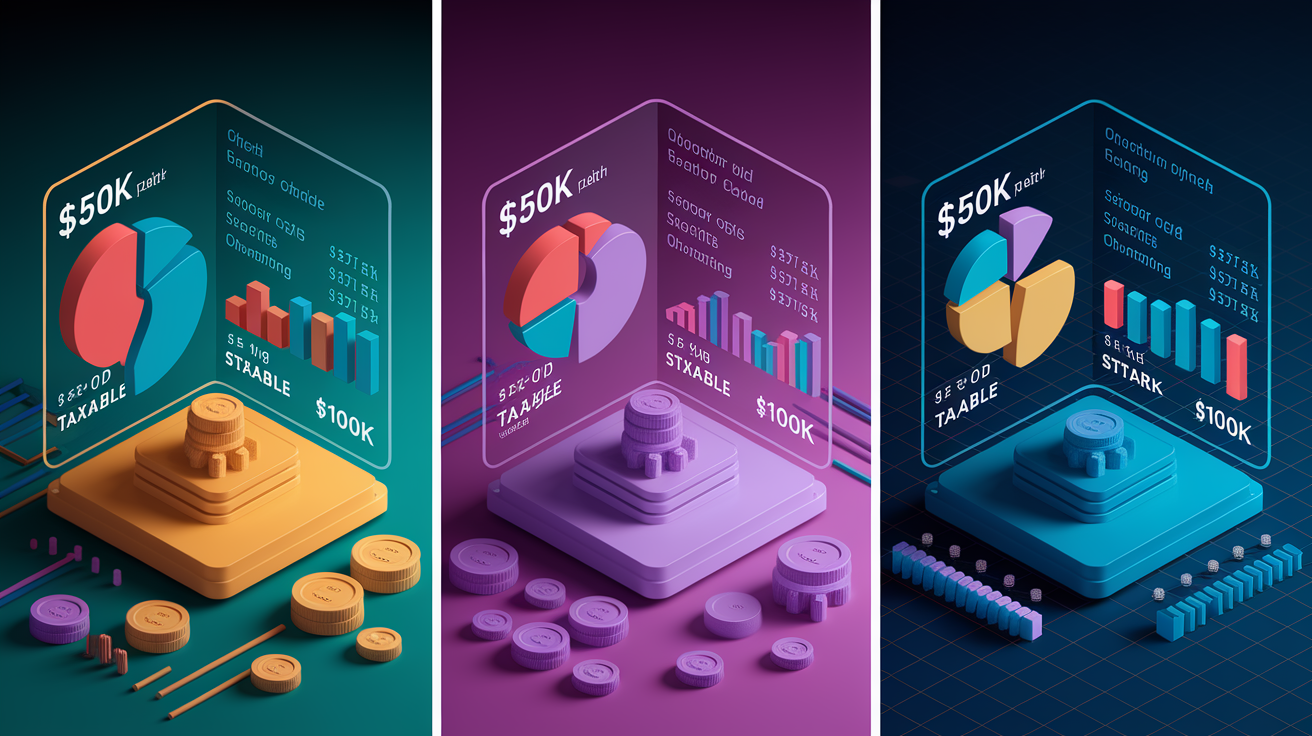
A 35-year-old with $50,000 in a taxable account, $150,000 in a traditional 401(k), and $25,000 in a Roth IRA wants an 80 percent stock, 20 percent bond allocation. Total portfolio is $225,000, so the target is $180,000 stocks and $45,000 bonds. Place all $45,000 of bonds in the 401(k) (tax-deferred), put $105,000 of U.S. total market stock index funds in the remaining 401(k) space, direct the $25,000 Roth entirely into a small-cap or international growth fund (highest expected return), and hold $50,000 of U.S. total market index ETF in the taxable account. Result: bonds sheltered, high-growth assets in Roth, tax efficient equities in taxable.
A 55-year-old couple has $750,000 in taxable accounts, $750,000 in traditional IRAs, and $100,000 in Roth IRAs. They want 60 percent stocks ($960,000) and 40 percent bonds ($640,000). Put the entire $640,000 bond allocation into the traditional IRAs (sheltering all the interest). Place $110,000 of high-growth or small-cap equity in the remaining IRA space plus the $100,000 Roth. That leaves $750,000 of stocks for the taxable accounts. Hold U.S. and international index funds there, harvesting losses when possible and planning to donate shares to charity in retirement. This setup shields every dollar of bond interest, maximizes Roth growth potential, and keeps the taxable account full of assets that benefit from preferential long-term capital gains treatment.
A 28-year-old just starting out has $10,000 in a Roth IRA and $5,000 in a taxable account, targeting 90 percent stocks and 10 percent bonds. With only $15,000 total, asset location is simple: put $1,500 (10 percent) in a bond fund and $13,500 in stock funds. The entire bond position fits in the Roth, leaving $8,500 of stocks also in the Roth and $5,000 in taxable. Not ideal. You’d prefer bonds in tax-deferred and growth in Roth. But when balances are small, simplicity and consistency matter more than perfect location. As the accounts grow and a 401(k) is added, shift the bonds there and move growth stocks into the Roth.
| Scenario | Asset Mix | Account Placement Strategy |
|---|---|---|
| Young saver: $50k taxable, $150k 401(k), $25k Roth | 80% stocks, 20% bonds | All bonds in 401(k); high-growth stocks in Roth; U.S. index funds in taxable |
| Pre-retiree couple: $750k taxable, $750k IRA, $100k Roth | 60% stocks, 40% bonds | All bonds in IRA; small-cap/growth in Roth; index equity in taxable for tax-loss harvesting and donations |
| Early career: $10k Roth, $5k taxable | 90% stocks, 10% bonds | Keep it simple: small bond position can sit in Roth temporarily until 401(k) balance grows |
Rebalancing Strategies Across Multiple Account Types
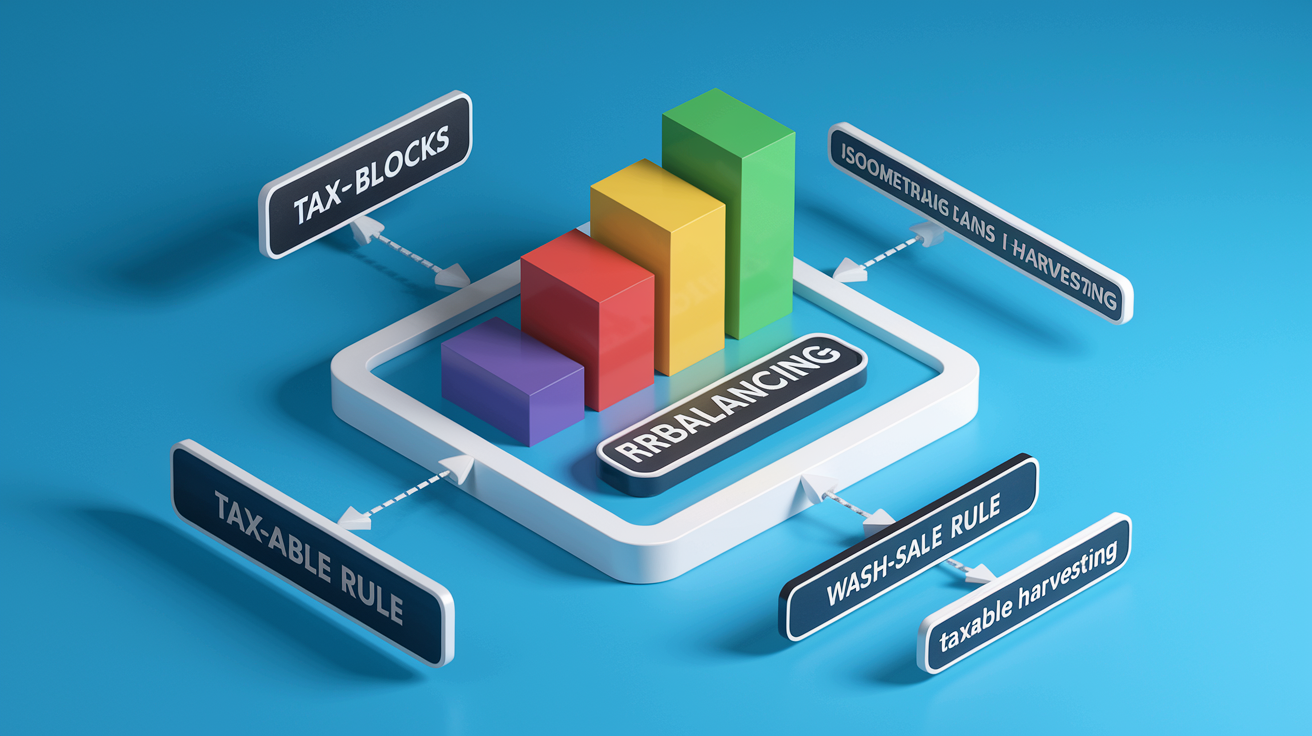
Rebalancing keeps your asset allocation on target as markets move. Selling what has grown and buying what has lagged. In taxable accounts, every sale of an appreciated asset triggers a capital gains tax. Frequent trading can rack up a large tax bill over time. In tax-deferred and Roth accounts, you can trade freely without any immediate tax consequence. So the first rule of tax-efficient rebalancing is to do as much of the buying and selling as possible inside your retirement accounts.
When your stock allocation drifts from 70 percent to 75 percent, sell stocks and buy bonds to rebalance. If you can make that trade inside your traditional IRA or 401(k), you pay no tax today. The transaction is invisible to the IRS until you eventually withdraw the money. If you have to sell in your taxable account, you’ll owe capital gains tax on any profit from the shares you sell. Over decades, trading exclusively inside retirement accounts can save thousands of dollars in unnecessary taxes and keep more money compounding.
Use new contributions and required withdrawals to rebalance your taxable account without selling. If stocks have run up and you need to trim them, direct your next paycheck or IRA contribution into bonds instead of selling stock. If you’re taking a required minimum distribution or spending from your portfolio, withdraw from the asset class that has grown too large. Effectively rebalancing by selective selling. In taxable accounts, you can also harvest tax losses when an asset has declined: sell it at a loss (creating a tax deduction), immediately buy a similar (but not identical) fund to maintain your allocation, and use the harvested loss to offset gains elsewhere or up to $3,000 of ordinary income per year. Just watch the wash-sale rule. If you buy a substantially identical security within 30 days before or after the sale, the IRS disallows the loss.
Roth Conversions and Their Impact on Asset Location
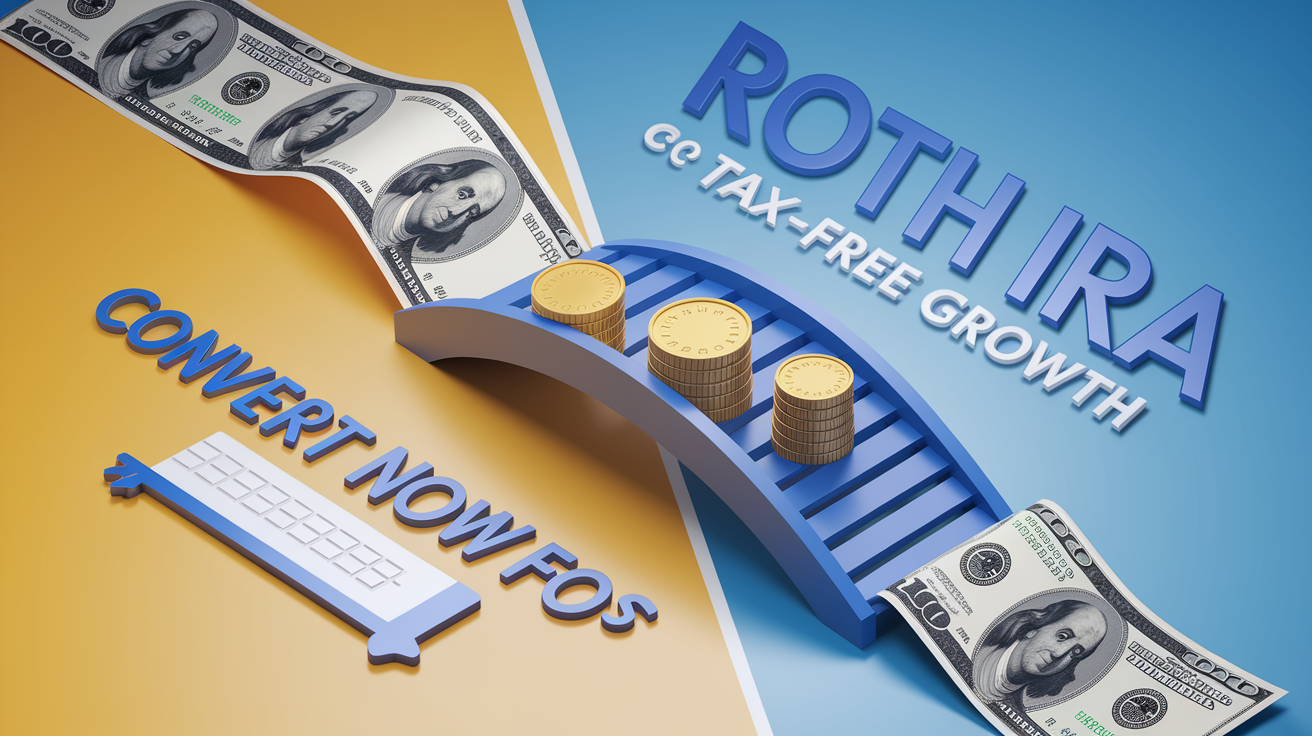
A Roth conversion moves money from a traditional IRA into a Roth IRA, triggering ordinary income tax on the converted amount in the year you convert. The payoff is future tax-free growth and withdrawals. Conversions are especially powerful when done in low-income years. Maybe you retired early and are living off taxable savings, or you had a temporary income drop. Converting just enough to fill up the 12 percent or 22 percent federal tax bracket lets you prepay tax at a low rate and lock in decades of tax-free compounding in the Roth.
Conversions also change your asset location strategy. Once you move money into a Roth, you want to invest it in the highest expected return assets you own. Small-cap stocks, emerging markets, concentrated growth positions. Every dollar of gain in a Roth is yours forever. If you convert during a market downturn, you pay tax on a smaller balance, then capture the full recovery tax-free. For example, convert $50,000 of traditional IRA money when the market is down 20 percent, and the same investments might be worth $62,500 when they recover. An extra $12,500 of tax-free gain you wouldn’t have captured if you’d waited to convert at higher valuations.
Converting reduces your future required minimum distributions because Roth IRAs have no RMDs during your lifetime. Large RMDs can push you into higher tax brackets in your 70s and 80s, increase Medicare premiums, and force you to withdraw more than you need. Systematic partial conversions in your 60s (especially before you claim Social Security and trigger RMDs) can whittle down your traditional IRA balance, lower future RMD amounts, and keep your marginal tax rate from spiking later.
Four strategic reasons to convert:
Fill low tax brackets in early retirement before Social Security and RMDs raise your taxable income. Convert enough each year to stay within the 12 percent or 22 percent bracket.
Convert during market downturns to pay tax on depressed values and capture the recovery tax-free in the Roth.
Reduce future RMDs and avoid being forced into higher brackets or higher Medicare IRMAA surcharges when you turn 73 or 75.
Optimize for heirs if you expect beneficiaries to be in higher tax brackets than you. Convert now at your lower rate so they inherit tax-free Roth dollars instead of taxable IRA balances.
Integrating RMD Planning Into Asset Location
Required minimum distributions force you to withdraw a percentage of your traditional IRA and 401(k) balances every year starting at age 73 (or 75 if you reach that age in 2033 or later). The IRS calculates the RMD by dividing your year-end account balance by a life expectancy factor. The result is a minimum dollar amount you must withdraw and pay ordinary income tax on. Miss an RMD and the penalty is steep: 25 percent of the amount you should have taken (reduced to 10 percent if corrected quickly).
RMDs create two problems for asset location. First, they force taxable income whether you need the cash or not, potentially pushing you into a higher marginal bracket and making other income (Social Security, investment gains, even Roth conversions) more expensive from a tax perspective. Second, large RMDs can require you to sell assets inside your IRA at inopportune times. Maybe bonds when rates have risen and values have fallen, or stocks during a bear market. If your IRA is heavily weighted toward volatile, high-return assets, RMDs amplify the risk that you’ll be forced to liquidate at a bad moment.
That’s why many retirees keep lower-volatility, lower-return assets like bonds in their traditional IRAs as they age. Bonds generate the ordinary income anyway, so there’s no additional tax penalty from holding them in a tax-deferred account. Having stable-value assets makes it easier to meet RMDs without selling stocks at a loss. Meanwhile, you can hold equities in taxable accounts (where you control the timing of sales and can harvest losses) or in Roth accounts (where there are no RMDs and you never have to sell). This approach smooths the tax and market timing risks that come with mandatory distributions.
Partial Roth conversions in your 60s and early 70s (before RMDs begin) let you shrink your traditional IRA balance on your own schedule, paying tax at rates you choose rather than rates the RMD forces on you. For example, a couple with $1 million in traditional IRAs at age 72 might face RMDs starting around $37,000 in the first year, growing each year as the divisor shrinks. If they convert $100,000 to Roth in each of five years before RMDs start, they pay tax at their current bracket (say, 22 percent), reduce the IRA to $500,000, and cut future RMDs nearly in half. The trade-off is paying $22,000 in federal tax each conversion year, but the long-run savings from lower RMDs and lower future tax rates can be much larger.
Final Words
Put tax-inefficient assets like bonds and REITs in tax-deferred accounts, hold high-growth stocks in Roths, and keep tax-efficient index funds in taxable accounts.
We explained the why—tax drag, compounding, and how each account type treats gains—and walked through steps, example portfolios, rebalancing tips, Roth conversion ideas, and RMD planning.
Use these rules as a starting framework for tax-efficient asset allocation for retirement accounts. Adjust for your goals and timeline, and you can make steady progress with a small, repeatable plan.
FAQ
Q: What are the immediate asset-location rules for taxable, tax-deferred, and tax-free accounts?
A: The immediate asset-location rules place tax-inefficient assets (bonds, REITs, high-turnover funds) in tax-deferred accounts, high-growth stocks in tax-free Roths, and tax-efficient index funds/ETFs in taxable accounts.
Q: Why do tax rules affect which assets belong in which account?
A: Tax rules affect placement because taxes reduce long-term growth (tax drag); putting assets where taxes bite less preserves compounding and supports your overall risk and account mix.
Q: How do taxable accounts, traditional IRAs, and Roth IRAs differ tax-wise?
A: Taxable accounts face yearly taxes on dividends and gains; traditional IRAs delay taxes until withdrawal; Roth IRAs grow and withdraw tax-free if rules are met, changing where assets should sit.
Q: Which assets should I put in Roth IRAs, traditional IRAs, and taxable accounts?
A: High-growth stocks typically belong in Roths for tax-free growth; bonds and REITs fit well in traditional tax-deferred accounts; tax-efficient index funds and ETFs suit taxable accounts.
Q: How do I implement asset location across my existing accounts?
A: To implement asset location, list holdings by account, move tax-inefficient items into tax-deferred accounts when sensible, direct future contributions by account type, and plan tax-aware rebalancing.
Q: How should I rebalance across multiple account types to minimize taxes?
A: Rebalance inside tax-advantaged accounts first to avoid taxable events; in taxable accounts use new contributions, harvest losses, or selectively sell tax-efficient holdings to limit taxes.
Q: When should I consider Roth conversions and how do they affect asset placement?
A: Consider Roth conversions to shift growth into tax-free space, especially during low-income years or market downturns, but weigh conversion taxes against long-term tax-free growth benefits.
Q: How do required minimum distributions (RMDs) influence asset location over time?
A: RMDs increase taxable income, so plan account composition by moving growth to Roths where possible and leaving lower-growth or tax-efficient assets in accounts subject to RMDs.
Q: What simple rules of thumb help decide where to put an asset?
A: Simple rules of thumb: put bonds and REITs in tax-deferred accounts; keep high-growth stocks in Roths; hold tax-efficient index funds in taxable accounts; put high-turnover funds in tax-deferred; use taxable loss harvesting.
Q: How should my account balances and income level change my asset-location choices?
A: Account balances and income matter: small balances or high current income may favor tax-deferred accounts for immediate tax savings, while low income or large Roth space favors conversions and moving growth into Roths.