

Think you saved enough for retirement?
You might still be handing a big chunk of your income to the IRS.
Small timing and account choices can add up to thousands in taxes over 20 or 30 years.
This post lays out simple, practical moves, like Roth conversions, smart withdrawal order, Social Security timing, QCDs (direct IRA gifts to charity), asset location, and tax-aware selling, to spread taxable income and boost after-tax cash.
Read on to learn which moves fit your timing and how to act before the tax bills arrive.
How to Reduce Taxes in Retirement: The Core Strategies

Planning how you withdraw money in retirement matters just as much as how much you save. A simple shift in the order you tap accounts, or the timing of a single conversion decision, can save thousands of dollars in taxes over 20 or 30 years.
Taxes hit retirement income from multiple angles at once. Required distributions from tax-deferred accounts, Social Security benefits, capital gains from selling investments, and even Medicare premiums can all pile up in the same tax year if you’re not careful. The goal is to spread taxable income across years so you stay in lower brackets and avoid unexpected jumps in what you owe.
The tools for doing this are straightforward and most of them cost nothing to implement. The hard part is coordinating them before you need the money, not after the bills arrive.
Here are six core strategies that form the foundation of tax-efficient retirement planning:
Roth conversions in lower-income years. Move pre-tax money into Roth accounts when your tax rate is low, locking in tax-free withdrawals later.
Strategic withdrawal sequencing. Draw from the right accounts at the right time to manage taxable income year by year.
Social Security timing. Delay benefits when it makes sense to reduce taxes on those payments and preserve other assets.
Qualified Charitable Distributions (QCDs). Send IRA money directly to charity after age 70½ to satisfy RMDs without adding to taxable income.
Asset location. Keep tax-inefficient investments inside tax-advantaged accounts and tax-friendly ones in taxable accounts.
Capital gains and tax-loss harvesting. Manage when you sell investments to stay in lower capital gains brackets and offset gains with losses.
Roth vs. Traditional Accounts: Choosing the Right Mix

Traditional accounts give you a tax break now. Roth accounts give you tax-free money later. The trick is figuring out which version saves you more over your lifetime, and the answer depends on whether your tax rate today is higher or lower than it’ll be when you retire.
If you expect to be in a lower tax bracket in retirement, lean toward traditional contributions. If you think your tax rate will stay the same or go up, Roth contributions and conversions start to make more sense. Most people end up using both types and adjusting the mix over time as income and tax law change.
When deciding how much to hold in each type of account, consider these five factors:
Current marginal tax rate. If you’re in the 12 percent bracket now, a Roth contribution or conversion only costs you 12 cents per dollar.
Expected tax rate in retirement. Will pensions, Social Security, and RMDs push you into a higher bracket later?
Time until retirement. The longer money grows tax-free in a Roth, the bigger the benefit.
State tax rules. Some states tax traditional withdrawals but not Roth. Others have no income tax at all.
Legacy goals. Roth IRAs pass to heirs tax-free and have no RMDs, making them powerful for wealth transfer.
Roth conversions are most useful when your income drops temporarily. For example, if you retire at 62 but don’t start Social Security until 67, those five years may offer a narrow window to convert traditional IRA money at a 12 percent or 22 percent rate instead of the 24 percent or higher rate you’ll face once RMDs and Social Security kick in. Converting just enough each year to stay below the next bracket can flatten your future tax bill without causing a painful spike today.
Withdrawal Sequencing for Lower Lifetime Taxes
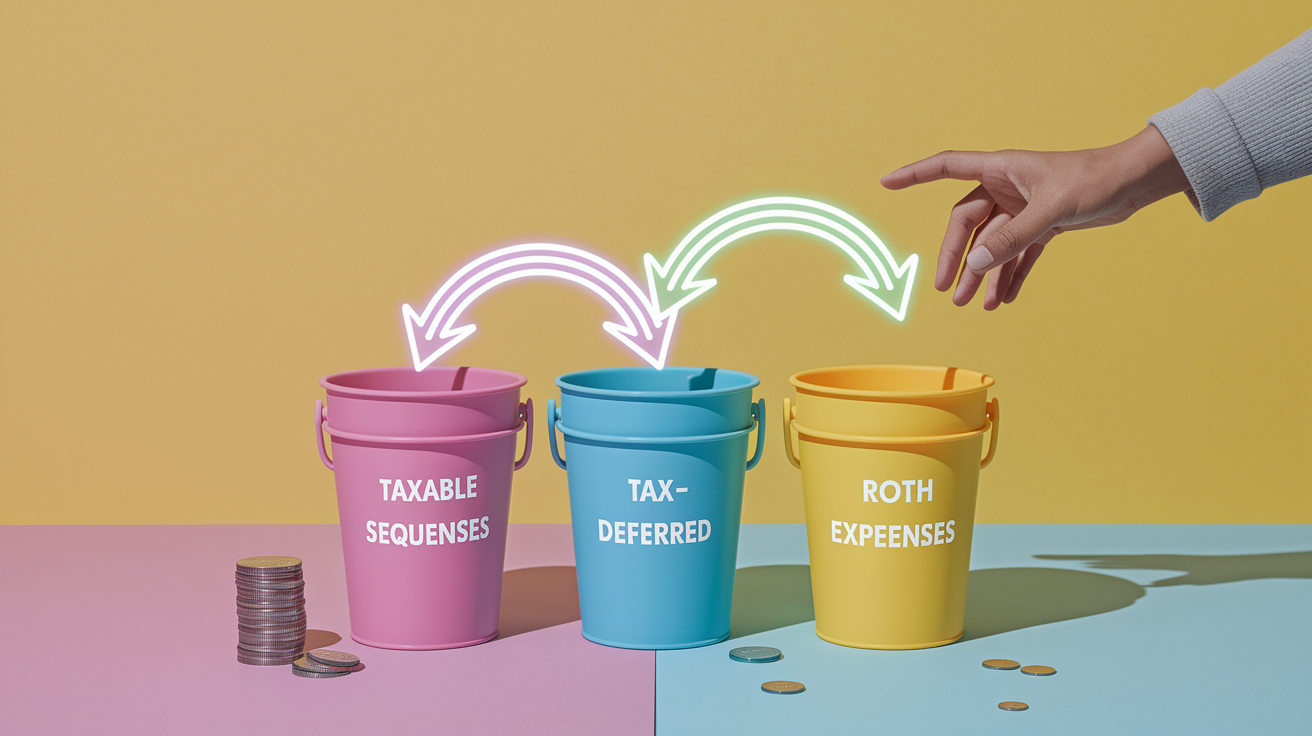
The order you pull money from accounts shapes your tax bill for decades. Withdraw from the wrong account first and you might push yourself into a higher bracket, trigger taxes on Social Security, or face bigger Medicare premiums.
The most common rule of thumb is to spend taxable accounts first, tax-deferred accounts second, and Roth accounts last. This approach lets tax-advantaged money keep growing while you draw down assets that would generate taxable gains, dividends, or interest anyway. It also preserves Roth balances for as long as possible, giving those tax-free dollars more time to compound.
In practice, you may need to adjust this order depending on your tax bracket and income sources in any given year. For example, if you have a low-income year before Social Security starts, it might make sense to convert some traditional IRA money to Roth instead of spending from taxable accounts. If you’re close to a bracket cutoff, pulling a bit more from taxable accounts and less from tax-deferred can keep you under the line.
Here’s a basic four-step withdrawal sequence that works for many retirees:
-
Take required minimum distributions first. These are mandatory once you hit age 73 (or 75 depending on your birth year), and skipping them means a steep penalty.
-
Draw from taxable brokerage accounts next. Use dividends, interest, and capital gains to cover living expenses while letting tax-advantaged accounts grow.
-
Tap tax-deferred accounts after taxable money runs low. Pull from traditional IRAs and 401(k)s to fill spending gaps and manage bracket exposure.
-
Leave Roth accounts for last. Let these grow tax-free as long as possible, and use them for large one-time expenses or to pass wealth to heirs.
This sequence isn’t rigid. Some years you’ll mix withdrawals from two or three buckets at once. The key is to review your projected taxable income each year and adjust which account you tap to stay in the bracket you want.
Required Minimum Distribution (RMD) Planning

RMDs force you to pull money from traditional IRAs and 401(k)s once you reach a certain age, currently 73 for most people. These withdrawals count as ordinary income, and if you don’t take them the IRS can hit you with a penalty of up to 25 percent of the amount you should have withdrawn.
The size of your RMD grows each year because the IRS divides your prior December 31 account balance by a distribution period that shrinks as you age. That means the older you get and the larger your balance, the bigger the taxable withdrawal you must take, whether you need the cash or not.
Roth IRAs aren’t subject to RMDs during your lifetime, which is one reason Roth conversions before you reach RMD age can reduce future tax pressure. If you convert a chunk of your traditional IRA to Roth at age 65, that money’s no longer sitting in an account that will force larger taxable distributions at 75 or 80.
Here are three ways to manage RMD tax exposure:
Convert to Roth in low-income years. Move money out of traditional accounts before RMDs start, paying tax at today’s lower rate instead of tomorrow’s higher one.
Use Qualified Charitable Distributions (QCDs). After age 70½, you can send up to $100,000 per year directly from your IRA to charity. This counts toward your RMD but isn’t included in taxable income.
Coordinate with other income sources. If possible, delay Social Security or manage pension timing to reduce the total taxable income in years when RMDs are largest.
Social Security Taxation and Timing

Roughly 40 percent of people who collect Social Security end up paying federal income tax on part of their benefits. How much gets taxed depends on your “combined income,” which the IRS calculates as half of your Social Security benefits plus all other taxable income plus tax-exempt interest.
For single filers, combined income between $25,000 and $34,000 makes up to 50 percent of benefits taxable. Above $34,000, up to 85 percent is taxable. For married couples filing jointly, the thresholds are $32,000 to $44,000 for the 50 percent level and above $44,000 for the 85 percent level.
Delaying Social Security can lower lifetime taxes in two ways. First, the longer you wait to claim (up to age 70), the higher your monthly benefit. Second, if you use other savings to cover expenses before you start Social Security, you may be able to draw from Roth accounts or spend taxable accounts at a time when your overall income is lower, keeping more of your benefit out of the taxable range once payments begin.
You can also elect to have federal taxes withheld from Social Security payments if you expect to owe tax on them. This spreads the tax bill across the year instead of leaving you with a lump sum due at filing time. Most states don’t tax Social Security, but a handful do, so check your state’s rules before finalizing your claiming approach.
Tax-Efficient Investment Strategies in Retirement

Where you hold an investment matters as much as what you hold. Placing the right assets in the right accounts can cut your tax bill without changing your portfolio’s risk or return.
Tax-inefficient investments, things like taxable bonds, REITs, and actively managed funds that spin off lots of short-term gains, belong inside IRAs or 401(k)s where the tax on interest and dividends is deferred. Tax-efficient investments, like index funds, ETFs, and stocks you plan to hold long-term, work well in taxable accounts because they generate fewer taxable events and benefit from lower long-term capital gains rates.
Here are five investment tactics that help reduce taxes in retirement:
Hold bonds and REITs in tax-deferred accounts. Interest and REIT dividends are taxed as ordinary income, so shelter them where possible.
Keep stock index funds in taxable accounts. Long-term capital gains are taxed at lower rates, and you control when you sell.
Harvest tax losses each year. Sell investments that are down to offset realized gains. You can use up to $3,000 of excess losses against ordinary income and carry the rest forward.
Manage capital gains timing. If you’re in the 12 percent tax bracket or lower, long-term capital gains may be taxed at 0 percent, making it a good year to sell appreciated assets.
Turn off automatic dividend reinvestment in taxable accounts. Send dividends to cash so you’re not forced to sell shares (and realize gains) just to cover spending.
Charitable Giving as a Tax Strategy

If you plan to donate to charity in retirement, doing it the right way can save you taxes while supporting causes you care about. The most powerful tool for this is the Qualified Charitable Distribution (QCD), which lets you send money directly from your IRA to a qualified charity once you turn 70½.
QCDs count toward your RMD but are excluded from your taxable income, meaning the donation satisfies the withdrawal requirement without increasing your adjusted gross income. You can donate up to $100,000 per year this way, and it works even if you take the standard deduction and don’t itemize.
For those who do itemize, donating appreciated securities instead of cash can deliver a double benefit. You avoid paying capital gains tax on the appreciation, and you get a deduction for the full fair market value of the asset. Bunching multiple years of donations into one year through a donor-advised fund can also push you over the standard deduction threshold in high-giving years while letting you take the standard deduction in others.
Here are three charitable strategies that reduce retirement taxes:
QCDs to satisfy RMDs. Send IRA money straight to charity after age 70½ to keep it out of taxable income.
Donate appreciated stock. Avoid capital gains tax and claim a fair-market-value deduction if you itemize.
Use a donor-advised fund to bunch gifts. Contribute several years’ worth of donations in one year to maximize itemized deductions, then distribute to charities over time.
State Tax Considerations in Retirement
Federal tax planning matters, but state taxes can change the math in a big way. Some states tax Social Security benefits, some tax pension income, and others have no income tax at all. Where you live in retirement can save or cost you thousands of dollars a year.
States with no income tax, like Florida, Texas, and Washington, let you keep more of your retirement withdrawals, though they may have higher property or sales taxes to make up for it. Other states, like Pennsylvania, exempt retirement income from state tax but still tax wages and investment income. A few states tax everything.
| State Tax Factor | Why It Matters |
|---|---|
| No state income tax | All retirement withdrawals and Social Security stay untaxed at the state level. |
| Social Security exemption | Many states exclude Social Security from taxable income even if they tax other retirement income. |
| Pension and IRA taxation | Some states tax traditional IRA withdrawals and pensions. Others offer partial or full exemptions. |
| Roth conversion treatment | A few states tax Roth conversions differently than the federal government, so check before converting large amounts. |
If you’re considering a move, model your expected retirement income under both your current state’s rules and the rules in the state you’re thinking about. The difference can be significant enough to influence where you choose to spend your retirement.
Final Words
Cut taxes over your retirement by using Roth conversions, smart withdrawal sequencing, RMD tactics, Social Security timing, tax-aware investing, and charitable moves.
We showed how accounts, benefits, and state rules interact and gave practical steps: compare scenarios, set a modest conversion plan, use QCDs when they fit, and place tax-inefficient assets where they belong. It depends on your timeline and tax brackets.
Start with a simple tax efficient retirement planning checklist, act conservatively, and you may keep more of what you earned.
FAQ
Q: What is the best way to avoid taxes in retirement?
A: The best way to avoid taxes in retirement is to plan tax moves early: mix Roth accounts, time withdrawals, use Roth conversions, and manage Social Security and RMDs to lower lifetime taxable income.
Q: What does Dave Ramsey say about lirp?
A: Dave Ramsey says about LIRPs that he generally advises against using life insurance as a primary retirement plan, preferring term insurance plus investing in retirement accounts instead.
Q: How many Americans have $1,000,000 in retirement savings?
A: Only a small share of Americans have $1,000,000 in retirement savings; estimates vary by source, generally ranging from low single-digit to low-teens percent, concentrated among older and higher-income households.
Q: How much do I need to retire on $80,000 a year at 60?
A: To retire on $80,000 a year at 60, you’ll generally need about $2.0M using a 4% withdrawal rule; about $2.3M using a 3.5% rule, less if you expect Social Security or pensions.